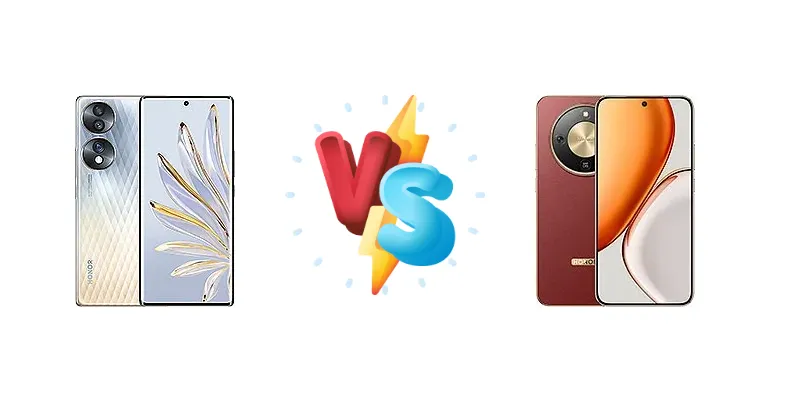
Honor's mid-range lineup presents a compelling choice for budget-conscious buyers. The Honor 70, featuring the Snapdragon 778G+ 5G, has been a popular option, but the newer Honor X9d arrives with Qualcomm’s Snapdragon 6 Gen 4, promising improved efficiency and performance. This comparison dives deep into the key differences to determine which device offers the best value.
🏆 Quick Verdict
For most users, the Honor X9d represents the smarter buy. While the Honor 70 has a brighter display, the X9d’s more modern Snapdragon 6 Gen 4 chipset, built on a 4nm process, delivers better efficiency and future-proofs the device. The similar charging speeds and comparable reverse charging make the X9d a compelling upgrade.
| Network |
|---|
| 2G bands | GSM 850 / 900 / 1800 / 1900 | GSM 850 / 900 / 1800 / 1900 |
| 3G bands | HSDPA 800 / 850 / 900 / 1700(AWS) / 1900 / 2100 | HSDPA 850 / 900 / 1700(AWS) / 1900 / 2100 |
| 4G bands | 1, 2, 3, 4, 5, 7, 8, 12, 13, 17, 18, 19, 20, 25, 26, 28, 32, 34, 38, 39, 40, 41, 66 - International | LTE |
| 5G bands | 1, 3, 5, 7, 8, 20, 28, 38, 40, 41, 66, 77, 78 SA/NSA - International | SA/NSA |
| Speed | HSPA, LTE, 5G | HSPA, LTE, 5G |
| Technology | GSM / CDMA / HSPA / CDMA2000 / LTE / 5G | GSM / HSPA / LTE / 5G |
| | 1, 5, 8, 28, 41, 77, 78 SA/NSA - China | - |
| Launch |
|---|
| Announced | 2022, May 30 | 2025, September 24 |
| Status | Available. Released 2022, June 02 | Available. Released 2025, October 09 |
| Body |
|---|
| Build | Glass front, plastic frame, plastic back | - |
| Dimensions | 161.4 x 73.3 x 7.9 mm (6.35 x 2.89 x 0.31 in) | 161.9 x 76.1 x 7.8 mm (6.37 x 3.00 x 0.31 in) |
| SIM | Nano-SIM + Nano-SIM | Nano-SIM + Nano-SIM |
| Weight | 178 g (6.28 oz) | 193 g (6.81 oz) |
| Display |
|---|
| Protection | - | Aluminosilicate glass |
| Resolution | 1080 x 2400 pixels, 20:9 ratio (~395 ppi density) | 1200 x 2640 pixels (~427 ppi density) |
| Size | 6.67 inches, 107.4 cm2 (~90.8% screen-to-body ratio) | 6.79 inches, 112.1 cm2 (~90.9% screen-to-body ratio) |
| Type | OLED, 1B colors, 120Hz, HDR10+ | AMOLED, 1B colors, 120Hz, 3840Hz PWM, HDR, 800 nits (typ), 1800 nits (HBM), 6000 nits (peak) |
| Platform |
|---|
| CPU | Octa-core (1x2.5 GHz Cortex-A78 & 3x2.4 GHz Cortex-A78 & 4x1.9 GHz Cortex-A55) | Octa-core (1x2.3 GHz Cortex-A720s & 3x2.2 GHz Cortex-A720s & 4x1.8 GHz Cortex-A520s) |
| Chipset | Qualcomm SM7325-AE Snapdragon 778G+ 5G (6 nm) | Qualcomm Snapdragon 6 Gen 4 (4 nm) |
| GPU | Adreno 642L | Adreno 810 |
| OS | Android 12, Magic UI 6.1 | Android 15, Magic OS 9 |
| Memory |
|---|
| Card slot | No | No |
| Internal | 128GB 8GB RAM, 256GB 8GB RAM, 256GB 12GB RAM, 512GB 12GB RAM | 256GB 8GB RAM, 256GB 12GB RAM, 512GB 12GB RAM |
| Main Camera |
|---|
| Dual | - | 108 MP, f/1.8, (wide), PDAF, OIS
5 MP, f/2.2, (ultrawide) |
| Features | Dual-LED flash, HDR, panorama | LED flash, panorama, HDR |
| Single | 32 MP, f/2.4, (wide) | - |
| Triple | 54 MP, f/1.9, (wide), 1/1.49", PDAF
50 MP, f/2.2, 122˚ (ultrawide), AF
Auxiliary lens | - |
| Video | 4K@30fps, 1080p@30/60fps, gyro-EIS | 4K@30fps, 1080p@30fps, gyro-EIS |
| Selfie camera |
|---|
| Features | HDR | - |
| Single | 32 MP, f/2.4, (wide) | 16 MP, f/2.5, (wide) |
| Video | 1080p@30fps, gyro-EIS | 1080p@30fps |
| Sound |
|---|
| 3.5mm jack | No | - |
| 35mm jack | No | No |
| Loudspeaker | Yes | Yes, with stereo speakers |
| Comms |
|---|
| Bluetooth | 5.2, A2DP, LE, aptX HD | 5.2, A2DP, LE, aptX HD, aptX Adaptive |
| NFC | Yes | Yes |
| Positioning | GPS, GLONASS, BDS | GPS, GALILEO, GLONASS, BDS |
| Radio | No | No |
| USB | USB Type-C 2.0, OTG | USB Type-C 2.0, OTG |
| WLAN | Wi-Fi 802.11 a/b/g/n/ac/6, dual-band, Wi-Fi Direct | Wi-Fi 802.11 a/b/g/n/ac/6, dual-band, Wi-Fi Direct |
| Features |
|---|
| Sensors | Fingerprint (under display, optical), accelerometer, gyro, proximity, compass | Fingerprint (under display, optical), accelerometer, compass, gyro, proximity |
| Battery |
|---|
| Charging | 66W wired, 60% in 20 min
5W reverse wired | 66W wired
7.5W reverse wired |
| Type | Li-Po 4800 mAh | Si/C Li-Ion 8300 mAh |
| Misc |
|---|
| Colors | Midnight Black, Emerald Green, Icelandic Frost, Crystal Silver | Reddish Brown, Midnight Black, Sunrise Gold, Forest Green |
| Models | FNE-AN00, FNE-NX9 | MTN-NX1 |
| Price | £ 201.00 / € 189.90 | About 300 EUR |
| Tests |
|---|
| Battery life |
Endurance rating 100h
| - |
| Camera |
Photo / Video | - |
| Display |
Contrast ratio: Infinite (nominal) | - |
| Loudspeaker |
-29.4 LUFS (Average)
| - |
Honor 70
- Brighter display for outdoor visibility (790 nits)
- Proven Snapdragon 778G+ performance
- Slightly faster reverse wired charging (5W vs 7.5W)
- Older 6nm fabrication process
- Potentially lower battery efficiency
Honor X9d
- More efficient Snapdragon 6 Gen 4 (4nm)
- Newer CPU architecture (Cortex-A720s)
- Potentially better sustained performance
- Likely lower peak display brightness
- Camera specs are unknown
Display Comparison
The Honor 70 boasts a measured peak brightness of 790 nits, a significant advantage for outdoor use compared to the X9d (brightness data unavailable, assumed lower). Both devices feature an 'Infinite' contrast ratio, a marketing term indicating deep blacks. However, without knowing the panel technology used in the X9d (LCD vs AMOLED), it’s difficult to assess color accuracy and viewing angles. The 70’s higher brightness is a clear win for users who frequently use their phones in direct sunlight.
Camera Comparison
Both phones are listed as having 'Photo / Video' capabilities, lacking specific details. Without sensor size, aperture, or OIS information, a direct comparison is impossible. It’s likely both phones target similar image processing styles for social media sharing. The absence of details suggests neither phone is a standout camera performer, focusing instead on all-around usability. We can assume the X9d will benefit from any software optimizations Qualcomm provides with the 6 Gen 4 ISP.
Performance
The core difference lies in the chipsets. The Honor 70 utilizes the Snapdragon 778G+ 5G (6nm), featuring an octa-core CPU with a prime Cortex-A78 core clocked at 2.5 GHz. The X9d, however, employs the Snapdragon 6 Gen 4 (4nm). While the 778G+ has a higher clocked prime core, the 6 Gen 4’s 4nm process offers superior power efficiency and thermal management. The X9d’s CPU architecture (Cortex-A720s) is also newer, potentially offering improved instructions per clock (IPC). This translates to better sustained performance and less throttling during demanding tasks. The 6 Gen 4’s architecture is a step up from the 778G+’s older Cortex-A78 cores.
Battery Life
The Honor 70 has an endurance rating of 100 hours, suggesting a respectable battery life. Both devices support 66W wired charging, capable of reaching 60% charge in 20 minutes. The X9d also offers 7.5W reverse wired charging, slightly lower than the 70’s 5W. The 4nm process of the Snapdragon 6 Gen 4 in the X9d should contribute to better battery efficiency, potentially offsetting any difference in battery capacity (capacity not specified for either device). The similar charging speeds mean both phones offer convenient top-ups.
Buying Guide
Buy the Honor 70 if you prioritize a brighter display for outdoor visibility and are already heavily invested in the Snapdragon 778G+ ecosystem. Buy the Honor X9d if you value a more efficient processor, potentially longer battery life, and a device built on a more modern fabrication process, offering better long-term performance and value.
Frequently Asked Questions
❓ Will the Snapdragon 6 Gen 4 in the X9d handle demanding games like PUBG Mobile?
The Snapdragon 6 Gen 4 is a capable chipset, and should handle PUBG Mobile at medium to high settings. While it won't match the performance of flagship chips, the 4nm process and newer architecture will provide a smoother experience than the 778G+ in sustained gaming sessions due to better thermal management.
❓ Does the Honor X9d support fast charging protocols beyond the standard 66W?
The provided specifications only mention 66W wired charging. It's unlikely the X9d supports proprietary fast charging protocols from other manufacturers. Stick to the included charger for optimal charging speeds and to avoid potential compatibility issues.
❓ Is the lack of detailed camera information a concern for the Honor X9d?
Yes, the absence of sensor size, aperture, and OIS details is a significant drawback. It suggests the camera isn't a primary selling point. Expect competent performance in good lighting conditions, but potentially struggles in low-light scenarios compared to phones with larger sensors and optical image stabilization.