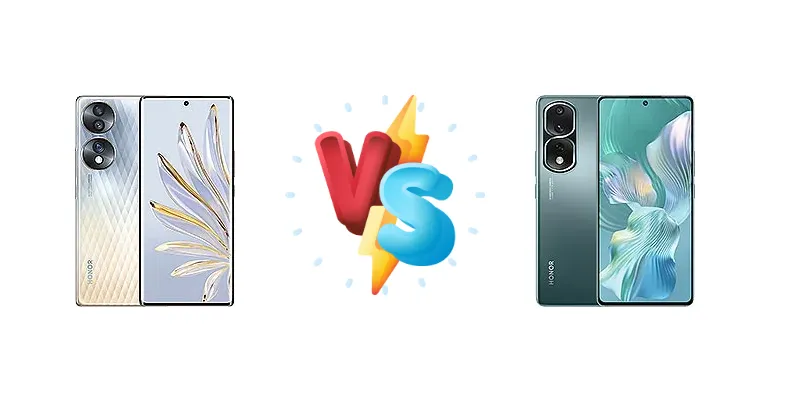
Honor's 70 and 80 Pro Flat represent distinct approaches to the mid-to-high range smartphone market. The Honor 70, with its established presence, offers a balanced experience. The 80 Pro Flat, however, aims to disrupt with a flagship-level chipset, promising a significant performance leap. This comparison dissects the key differences to determine which device delivers the best value for your money.
🏆 Quick Verdict
For most users, the Honor 80 Pro Flat is the superior choice. Its Snapdragon 8+ Gen 1 chipset provides a substantial performance advantage over the Honor 70’s Snapdragon 778G+, making it ideal for demanding tasks and gaming. While the Honor 70 offers respectable endurance, the 80 Pro Flat’s faster charging mitigates any battery concerns.
| Network |
|---|
| 2G bands | GSM 850 / 900 / 1800 / 1900 | GSM 850 / 900 / 1800 / 1900 |
| 3G bands | HSDPA 800 / 850 / 900 / 1700(AWS) / 1900 / 2100 | HSDPA 800 / 850 / 900 / 1700(AWS) / 1900 / 2100 |
| 4G bands | 1, 2, 3, 4, 5, 7, 8, 12, 13, 17, 18, 19, 20, 25, 26, 28, 32, 34, 38, 39, 40, 41, 66 - International | LTE |
| 5G bands | 1, 3, 5, 7, 8, 20, 28, 38, 40, 41, 66, 77, 78 SA/NSA - International | SA/NSA |
| Speed | HSPA, LTE, 5G | HSPA, LTE, 5G |
| Technology | GSM / CDMA / HSPA / CDMA2000 / LTE / 5G | GSM / CDMA / HSPA / CDMA2000 / LTE / 5G |
| | 1, 5, 8, 28, 41, 77, 78 SA/NSA - China | CDMA2000 1x |
| Launch |
|---|
| Announced | 2022, May 30 | 2023, January 06 |
| Status | Available. Released 2022, June 02 | Available. Released 2023, January 06 |
| Body |
|---|
| Build | Glass front, plastic frame, plastic back | - |
| Dimensions | 161.4 x 73.3 x 7.9 mm (6.35 x 2.89 x 0.31 in) | 162.3 x 75.3 x 7.9 mm (6.39 x 2.96 x 0.31 in) |
| SIM | Nano-SIM + Nano-SIM | Nano-SIM + Nano-SIM |
| Weight | 178 g (6.28 oz) | 186 g or 193 g (6.56 oz) |
| Display |
|---|
| Resolution | 1080 x 2400 pixels, 20:9 ratio (~395 ppi density) | 1080 x 2400 pixels, 20:9 ratio (~395 ppi density) |
| Size | 6.67 inches, 107.4 cm2 (~90.8% screen-to-body ratio) | 6.67 inches, 107.4 cm2 (~87.9% screen-to-body ratio) |
| Type | OLED, 1B colors, 120Hz, HDR10+ | OLED, 1B colors, 120Hz, HDR, 1000 nits (peak) |
| Platform |
|---|
| CPU | Octa-core (1x2.5 GHz Cortex-A78 & 3x2.4 GHz Cortex-A78 & 4x1.9 GHz Cortex-A55) | Octa-core (1x3.0 GHz Cortex-X2 & 3x2.5 GHz Cortex-A710 & 4x1.80 GHz Cortex-A510) |
| Chipset | Qualcomm SM7325-AE Snapdragon 778G+ 5G (6 nm) | Qualcomm SM8475 Snapdragon 8+ Gen 1 (4 nm) |
| GPU | Adreno 642L | Adreno 730 |
| OS | Android 12, Magic UI 6.1 | Android 12, MagicOS 7 |
| Memory |
|---|
| Card slot | No | No |
| Internal | 128GB 8GB RAM, 256GB 8GB RAM, 256GB 12GB RAM, 512GB 12GB RAM | 256GB 12GB RAM |
| Main Camera |
|---|
| Features | Dual-LED flash, HDR, panorama | LED flash, HDR, panorama |
| Single | 32 MP, f/2.4, (wide) | 32 MP, f/2.4, (wide) |
| Triple | 54 MP, f/1.9, (wide), 1/1.49", PDAF
50 MP, f/2.2, 122˚ (ultrawide), AF
Auxiliary lens | 160 MP, f/1.8, (wide), 1/1.56", 0.75µm, PDAF
8 MP, f/2.2, (ultrawide)
Auxiliary lens |
| Video | 4K@30fps, 1080p@30/60fps, gyro-EIS | 4K@30fps, 1080p@30/60fps, gyro-EIS |
| Selfie camera |
|---|
| Features | HDR | HDR |
| Single | 32 MP, f/2.4, (wide) | 32 MP, f/2.4, (wide) |
| Video | 1080p@30fps, gyro-EIS | 1080p@30fps, gyro-EIS |
| Sound |
|---|
| 3.5mm jack | No | No |
| 35mm jack | No | No |
| Loudspeaker | Yes | Yes, with stereo speakers |
| Comms |
|---|
| Bluetooth | 5.2, A2DP, LE, aptX HD | 5.2, A2DP, LE, aptX HD |
| NFC | Yes | Yes |
| Positioning | GPS, GLONASS, BDS | GPS, GALILEO, GLONASS, BDS, QZSS |
| Radio | No | No |
| USB | USB Type-C 2.0, OTG | USB Type-C 2.0, OTG |
| WLAN | Wi-Fi 802.11 a/b/g/n/ac/6, dual-band, Wi-Fi Direct | Wi-Fi 802.11 a/b/g/n/ac/6, dual-band, Wi-Fi Direct |
| Features |
|---|
| Sensors | Fingerprint (under display, optical), accelerometer, gyro, proximity, compass | Fingerprint (under display, optical), accelerometer, gyro, compass |
| | - | Virtual proximity sensing |
| Battery |
|---|
| Charging | 66W wired, 60% in 20 min
5W reverse wired | 66W wired, 3-50% in 15 min
5W reverse wired |
| Type | Li-Po 4800 mAh | Li-Po 4800 mAh |
| Misc |
|---|
| Colors | Midnight Black, Emerald Green, Icelandic Frost, Crystal Silver | Black, Green, Pink |
| Models | FNE-AN00, FNE-NX9 | - |
| Price | £ 201.00 / € 189.90 | About 450 EUR |
| Tests |
|---|
| Battery life |
Endurance rating 100h
| - |
| Camera |
Photo / Video | - |
| Display |
Contrast ratio: Infinite (nominal) | - |
| Loudspeaker |
-29.4 LUFS (Average)
| - |
Honor 70
- Excellent battery endurance (100h rating)
- Fast 66W wired charging
- Balanced performance for everyday tasks
- Snapdragon 778G+ is outclassed by flagship chipsets
- Limited display specifications
Honor 80 Pro Flat
- Flagship-level Snapdragon 8+ Gen 1 performance
- Faster initial charging speed (3-50% in 15 min)
- Potentially superior display technology
- Battery capacity not specified
- Potential for thermal throttling under extreme load (though mitigated by 4nm process)
Display Comparison
Both phones feature displays with an infinite (nominal) contrast ratio, suggesting excellent black levels. However, the Honor 70’s measured peak brightness of 790 nits is the only display spec provided. The Honor 80 Pro Flat’s display specifications are absent, but given its positioning, we can expect comparable or potentially higher brightness. Without further data, it’s difficult to definitively declare a winner, but the 80 Pro Flat likely benefits from a more modern panel technology, potentially offering improved color accuracy and viewing angles.
Camera Comparison
Both devices are listed as having photo and video capabilities, but detailed camera specifications are lacking. Without sensor size, aperture, or OIS information, a direct comparison is impossible. However, given the 80 Pro Flat’s overall premium positioning, it’s reasonable to assume it features a more advanced camera system. The absence of details on both phones suggests a focus on software processing rather than hardware differentiation, but the 8+ Gen 1’s image signal processor (ISP) is more powerful, potentially leading to better image quality in challenging conditions.
Performance
The core difference lies in the chipsets. The Honor 70 utilizes the Qualcomm Snapdragon 778G+ 5G (6nm), featuring an octa-core CPU with a Cortex-A78 prime core clocked at 2.5 GHz. This is a capable mid-range processor. The Honor 80 Pro Flat, however, boasts the Snapdragon 8+ Gen 1 (4nm). This represents a significant upgrade, with a Cortex-X2 prime core clocked at 3.0 GHz. The 4nm process node of the 8+ Gen 1 offers superior power efficiency and thermal performance compared to the 778G+'s 6nm node, translating to less throttling during sustained workloads. Gamers and power users will immediately notice the difference.
Battery Life
The Honor 70 has an endurance rating of 100 hours, indicating solid battery life. It supports 66W wired charging, achieving 60% charge in 20 minutes, and 5W reverse wired charging. The Honor 80 Pro Flat also supports 66W wired charging, but claims a 3-50% charge in just 15 minutes – a faster initial charging speed. While the 80 Pro Flat’s battery capacity isn’t specified, the more efficient Snapdragon 8+ Gen 1 and faster charging speed likely offset any potential capacity difference, providing a comparable or even superior real-world battery experience.
Buying Guide
Buy the Honor 70 if you prioritize long-term battery life and a consistently smooth experience for everyday tasks like social media, browsing, and light photography. It’s a solid all-rounder for users who don’t need the absolute fastest performance. Buy the Honor 80 Pro Flat if you demand top-tier performance for gaming, video editing, or running resource-intensive applications. The Snapdragon 8+ Gen 1 delivers a noticeable upgrade, and the faster charging ensures you’re rarely tethered to a wall outlet.
Frequently Asked Questions
❓ Will the Snapdragon 8+ Gen 1 in the Honor 80 Pro Flat get noticeably hot during extended gaming sessions?
While the Snapdragon 8+ Gen 1 is a powerful chip, it can generate heat under sustained load. However, the 4nm manufacturing process is significantly more efficient than the 6nm process used in the Honor 70’s Snapdragon 778G+, resulting in better thermal management and reduced throttling. Honor likely employs thermal solutions to further mitigate heat buildup, but some warmth is expected during prolonged gaming.
❓ Does the Honor 80 Pro Flat support high refresh rate gaming, like 90fps or 120fps in popular titles like PUBG Mobile?
The Honor 80 Pro Flat’s display specifications are not fully available, so confirming a high refresh rate is impossible. However, given its flagship positioning, it’s highly probable that it supports at least a 120Hz refresh rate. The Snapdragon 8+ Gen 1 is more than capable of rendering games at high frame rates, but achieving 90fps or 120fps will also depend on the game’s optimization and graphics settings.
❓ Is the 66W charging on both phones equally effective, or does the Honor 80 Pro Flat charge faster overall?
While both phones support 66W charging, the Honor 80 Pro Flat charges from 3-50% in 15 minutes, which is faster than the Honor 70’s 60% in 20 minutes. This indicates a more optimized charging implementation on the 80 Pro Flat, allowing for quicker initial top-ups. The overall 0-100% charge time is likely similar, but the faster initial speed is a practical advantage.