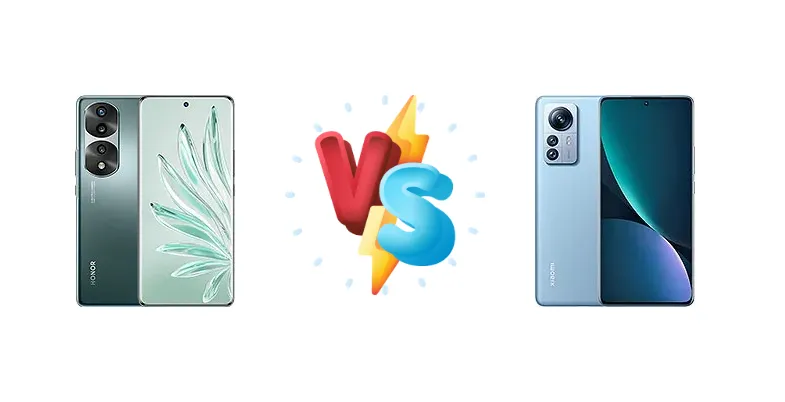
Both the Honor 70 Pro+ and the Xiaomi 12 Pro (Dimensity variant) represent compelling flagship options, particularly as pricing adjusts post-launch. This comparison focuses on the core differences stemming from their closely related, yet distinct, Mediatek Dimensity 9000 series chipsets and charging implementations, helping you determine which device best suits your needs.
🏆 Quick Verdict
For most users, the Xiaomi 12 Pro (Dimensity) offers a slightly more refined experience thanks to the Dimensity 9000+’s incremental performance gains and established software ecosystem. However, the Honor 70 Pro+’s significantly faster 100W charging is a major draw for those prioritizing convenience.
| Network |
|---|
| 2G bands | GSM 850 / 900 / 1800 / 1900 | GSM 850 / 900 / 1800 / 1900 |
| 3G bands | HSDPA 800 / 850 / 900 / 1700(AWS) / 1900 / 2100 | HSDPA 800 / 850 / 900 / 1700(AWS) / 1900 / 2100 |
| 4G bands | 1, 2, 3, 4, 5, 8, 19, 28, 34, 38, 39, 40, 41 | 1, 2, 3, 4, 5, 7, 8, 18, 19, 26, 34, 38, 39, 40, 41, 42 |
| 5G bands | 1, 5, 8, 28, 41, 77, 78 SA/NSA | 1, 3, 5, 8, 28, 38, 40, 41, 77, 78 SA/NSA |
| Speed | HSPA, LTE, 5G | HSPA, LTE, 5G |
| Technology | GSM / CDMA / HSPA / CDMA2000 / LTE / 5G | GSM / CDMA / HSPA / EVDO / LTE / 5G |
| | - | CDMA2000 1xEV-DO |
| Launch |
|---|
| Announced | 2022, May 30 | 2022, July 04 |
| Status | Available. Released 2022, June 17 | Available. Released 2022, July 13 |
| Body |
|---|
| Dimensions | 163.9 x 74.6 x 8.2 mm (6.45 x 2.94 x 0.32 in) | 163.6 x 74.6 x 8.2 mm (6.44 x 2.94 x 0.32 in) |
| SIM | Nano-SIM + Nano-SIM | Nano-SIM + Nano-SIM |
| Weight | 192 g (6.77 oz) | 201 g (7.09 oz) |
| Display |
|---|
| Protection | - | Corning Gorilla Glass Victus |
| Resolution | 1200 x 2652 pixels (~429 ppi density) | 1440 x 3200 pixels, 20:9 ratio (~521 ppi density) |
| Size | 6.78 inches, 111.4 cm2 (~91.1% screen-to-body ratio) | 6.73 inches, 109.4 cm2 (~89.6% screen-to-body ratio) |
| Type | OLED, 1B colors, 120Hz | LTPO2 AMOLED, 1B colors, 120Hz, Dolby Vision, HDR10+, 1000 nits (HBM), 1500 nits (peak) |
| Platform |
|---|
| CPU | Octa-core (1x3.05 GHz Cortex-X2 & 3x2.85 GHz Cortex-A710 & 4x1.80 GHz Cortex-A510) | Octa-core (1x3.20 GHz Cortex-X2 & 3x2.85 GHz Cortex-A710 & 4x1.80 GHz Cortex-A510) |
| Chipset | Mediatek Dimensity 9000 (4 nm) | Mediatek Dimensity 9000+ (4 nm) |
| GPU | Mali-G710 MC10 | Mali-G710 MC10 |
| OS | Android 12, Magic UI 6.1 | Android 12, MIUI 13 |
| Memory |
|---|
| Card slot | No | No |
| Internal | 256GB 8GB RAM, 256GB 12GB RAM | 128GB 8GB RAM, 256GB 12GB RAM |
| | - | UFS 3.1 |
| Main Camera |
|---|
| Features | Dual-LED flash, HDR, panorama | Color spectrum sensor, Dual-LED dual-tone flash, HDR, panorama |
| Single | - | 32 MP, f/2.5, 26mm (wide), 0.7µm |
| Triple | 54 MP, f/1.9, (wide), 1/1.49", PDAF
8 MP. f/2.4, (telephoto), PDAF, OIS, 3x optical zoom
50 MP, f/2.2, 122˚ (ultrawide), AF | 50 MP, f/1.9, 24mm (wide), 1/1.28", 1.22µm, dual pixel PDAF, OIS
13 MP, f/2.4, 15mm, 123˚ (ultrawide), 1/3.06", 1.12µm
5 MP, f/2.4, 50mm (telephoto macro), AF |
| Video | 4K@30fps, 1080p@30/60fps, gyro-EIS | 4K@30/60fps, 1080p@30/60/120fps, gyro-EIS |
| Selfie camera |
|---|
| Features | HDR | HDR, panorama |
| Single | 50 MP, f/2.4, 100˚ (ultrawide) | 32 MP, f/2.5, 26mm (wide), 0.7µm |
| Video | 4K@30fps, 1080p@30fps, gyro-EIS | 1080p@30/60fps, 720p@120fps |
| Sound |
|---|
| 3.5mm jack | - | No |
| 35mm jack | No | No |
| Loudspeaker | Yes, with stereo speakers | Yes, with stereo speakers |
| | - | 24-bit/192kHz audio
Tuned by Harman Kardon |
| Comms |
|---|
| Bluetooth | 5.2, A2DP, LE, aptX HD | 5.3, A2DP, LE |
| Infrared port | - | Yes |
| NFC | Yes | Yes |
| Positioning | GPS, GLONASS, BDS | GPS (L1+L5), GLONASS (L1), BDS (B1I+B1c+B2a), GALILEO (E1+E5a), QZSS (L1+L5), NavIC (L5) |
| Radio | No | No |
| USB | USB Type-C 2.0, OTG | USB Type-C 2.0, OTG |
| WLAN | Wi-Fi 802.11 a/b/g/n/ac/6, dual-band, Wi-Fi Direct | Wi-Fi 802.11 a/b/g/n/ac/6, dual-band, Wi-Fi Direct |
| Features |
|---|
| Sensors | Fingerprint (under display, optical), accelerometer, gyro, proximity, compass | Fingerprint (under display, optical), accelerometer, gyro, proximity, compass |
| Battery |
|---|
| Charging | 100W wired, 60% in 15 min
5W reverse wired | 67W wired, PD3.0, QC4 |
| Type | Li-Po 4500 mAh | Li-Po 5160 mAh |
| Misc |
|---|
| Colors | Black, Green, Gold | Gray, Blue |
| Models | HPB-AN00 | 2207122MC |
| Price | About 600 EUR | About 570 EUR |
Honor 70 Pro+
- Significantly faster 100W charging
- Potentially fresher software experience
- 5W reverse wired charging
- Slightly less powerful processor (Dimensity 9000)
- Software ecosystem less established than Xiaomi
Xiaomi 12 Pro (Dimensity)
- More powerful processor (Dimensity 9000+)
- Mature and well-supported software
- Wider accessory availability
- Slower 67W charging
- Potentially more aggressive thermal throttling under sustained load
Display Comparison
While both phones likely feature high-quality AMOLED displays, specific details like peak brightness and refresh rate are missing. However, the core processing power of the Dimensity 9000+ in the Xiaomi 12 Pro could contribute to smoother animations and potentially better HDR performance. The absence of LTPO information means we can't assess dynamic refresh rate efficiency, a key factor for battery life. Bezels are likely comparable given both brands' focus on maximizing screen real estate.
Camera Comparison
Without detailed camera specs beyond the chipsets, a direct comparison is limited. However, both phones are expected to deliver excellent image quality. The Dimensity 9000 series’ ISP capabilities are strong, and image processing will likely be a key differentiator. Xiaomi’s history suggests a more saturated, vibrant image profile, while Honor may lean towards more natural colors. The absence of sensor size information is critical; a larger sensor generally captures more light and detail. We can assume both phones will feature capable main sensors and optical image stabilization (OIS).
Performance
The Xiaomi 12 Pro (Dimensity) boasts the Dimensity 9000+, a refined version of the Honor 70 Pro+'s Dimensity 9000. The 3.20 GHz Cortex-X2 core in the 12 Pro represents a 5% clock speed increase over the 70 Pro+'s 3.05 GHz core, translating to slightly faster single-core performance. Both utilize the same Cortex-A710 and A510 cores, meaning multi-core performance will be similar. Both phones utilize 4nm fabrication, but the 9000+’s optimizations likely result in marginally better thermal efficiency, potentially reducing throttling during sustained workloads. The impact of RAM speed (likely LPDDR5X in both) is less significant than the chipset difference.
Battery Life
The Honor 70 Pro+’s 100W wired charging is its standout feature, capable of reaching 60% charge in just 15 minutes. The Xiaomi 12 Pro (Dimensity) is limited to 67W, a significant difference in charging speed. While battery capacity isn’t specified, the faster charging of the Honor 70 Pro+ mitigates the impact of a potentially smaller battery. The Xiaomi 12 Pro supports PD3.0 and QC4, offering broader compatibility with chargers, while the Honor 70 Pro+ includes 5W reverse wired charging for topping up accessories.
Buying Guide
Buy the Honor 70 Pro+ if you absolutely need the fastest possible charging speeds and prioritize a potentially fresher software experience. Its 100W charging will top up your battery in a fraction of the time compared to the Xiaomi. Buy the Xiaomi 12 Pro (Dimensity) if you value a slightly more powerful processor, a more mature software experience, and a wider availability of accessories and support.
Frequently Asked Questions
❓ Does the Dimensity 9000 in the Honor 70 Pro+ struggle with demanding games like Genshin Impact?
The Dimensity 9000 is a very capable chipset and will handle Genshin Impact well, but you may need to lower graphics settings for consistently high frame rates. The Xiaomi 12 Pro’s Dimensity 9000+ offers a slight performance edge, potentially allowing for higher settings without significant frame drops, but both phones will likely experience some thermal throttling during extended gaming sessions.
❓ How much faster is the 100W charging on the Honor 70 Pro+ compared to the 67W on the Xiaomi 12 Pro in real-world use?
The Honor 70 Pro+ can charge from 0% to 60% in approximately 15 minutes, while the Xiaomi 12 Pro will take around 30-40 minutes to reach the same level. This difference is particularly noticeable for quick top-ups throughout the day. A full 0-100% charge on the Honor 70 Pro+ will likely take around 30-35 minutes, compared to 45-50 minutes on the Xiaomi 12 Pro.
❓ Which phone is likely to receive more software updates and for a longer period?
Xiaomi generally has a more established track record of providing consistent software updates and longer-term support for its devices. While Honor is improving in this area, Xiaomi’s broader user base and software infrastructure give it an advantage in terms of update frequency and longevity.