
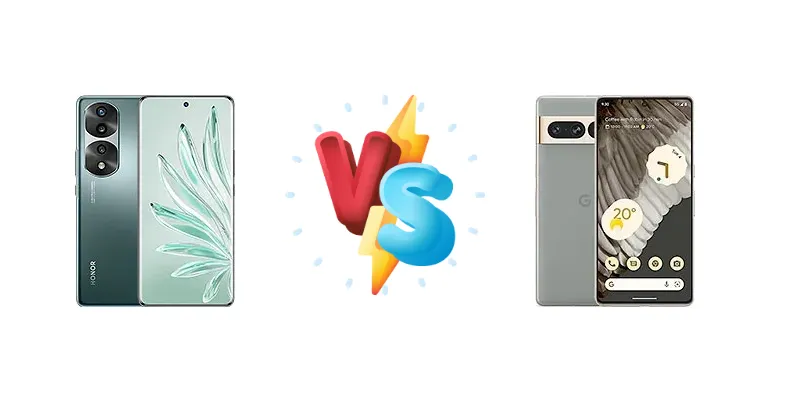
Honor 70 Pro+ vs Google Pixel 7 Pro: A Deep Dive into Flagship Android
| Phones Images | |||||
|---|---|---|---|---|---|
|
🏆 Quick Verdict
For the average user prioritizing camera versatility and software experience, the Google Pixel 7 Pro emerges as the winner. However, the Honor 70 Pro+ delivers significantly faster charging and competitive performance, making it a compelling option for power users who frequently top up their devices and value speed.
| PHONES | ||
|---|---|---|
| Phone Names | Honor 70 Pro+ | Google Pixel 7 Pro |
| Network | ||
|---|---|---|
| 2G bands | GSM 850 / 900 / 1800 / 1900 | GSM 850 / 900 / 1800 / 1900 |
| 3G bands | HSDPA 800 / 850 / 900 / 1700(AWS) / 1900 / 2100 | HSDPA 800 / 850 / 900 / 1700(AWS) / 1900 / 2100 |
| 4G bands | 1, 2, 3, 4, 5, 8, 19, 28, 34, 38, 39, 40, 41 | 1, 2, 3, 4, 5, 7, 8, 12, 13, 14, 17, 18, 19, 20, 25, 26, 28, 29, 30, 38, 39, 40, 41, 42, 46, 48, 66, 71 - GE2AE |
| 5G bands | 1, 5, 8, 28, 41, 77, 78 SA/NSA | 1, 2, 3, 5, 7, 8, 12, 14, 20, 25, 28, 30, 38, 40, 41, 48, 66, 71, 77, 78, 257, 258, 260, 261 SA/NSA/Sub6/mmWave - GE2AE |
| Speed | HSPA, LTE, 5G | HSPA, LTE, 5G |
| Technology | GSM / CDMA / HSPA / CDMA2000 / LTE / 5G | GSM / CDMA / HSPA / EVDO / LTE / 5G |
| - | 1, 2, 3, 5, 7, 8, 12, 14, 20, 25, 28, 30, 38, 40, 41, 48, 66, 71, 75, 76, 77, 78 SA/NSA/Sub6 - GP4BC | |
| Launch | ||
|---|---|---|
| Announced | 2022, May 30 | 2022, October 06 |
| Status | Available. Released 2022, June 17 | Available. Released 2022, October 13 |
| Body | ||
|---|---|---|
| Build | - | Glass front (Gorilla Glass Victus), glass back (Gorilla Glass Victus), aluminum frame |
| Dimensions | 163.9 x 74.6 x 8.2 mm (6.45 x 2.94 x 0.32 in) | 162.9 x 76.6 x 8.9 mm (6.41 x 3.02 x 0.35 in) |
| SIM | Nano-SIM + Nano-SIM | Nano-SIM + eSIM |
| Weight | 192 g (6.77 oz) | 212 g (7.48 oz) |
| - | IP68 dust/water resistant (up to 1.5m for 30 min) | |
| Display | ||
|---|---|---|
| Protection | - | Corning Gorilla Glass Victus |
| Resolution | 1200 x 2652 pixels (~429 ppi density) | 1440 x 3120 pixels, 19.5:9 ratio (~512 ppi density) |
| Size | 6.78 inches, 111.4 cm2 (~91.1% screen-to-body ratio) | 6.7 inches, 110.6 cm2 (~88.7% screen-to-body ratio) |
| Type | OLED, 1B colors, 120Hz | LTPO AMOLED, 120Hz, HDR10+, 1000 nits (HBM), 1500 nits (peak) |
| - | Always-on display | |
| Platform | ||
|---|---|---|
| CPU | Octa-core (1x3.05 GHz Cortex-X2 & 3x2.85 GHz Cortex-A710 & 4x1.80 GHz Cortex-A510) | Octa-core (2x2.85 GHz Cortex-X1 & 2x2.35 GHz Cortex-A78 & 4x1.80 GHz Cortex-A55) |
| Chipset | Mediatek Dimensity 9000 (4 nm) | Google Tensor G2 (5 nm) |
| GPU | Mali-G710 MC10 | Mali-G710 MP7 |
| OS | Android 12, Magic UI 6.1 | Android 13, upgradable to Android 15, up to 5 major Android upgrades |
| Memory | ||
|---|---|---|
| Card slot | No | No |
| Internal | 256GB 8GB RAM, 256GB 12GB RAM | 128GB 8GB RAM, 256GB 8GB RAM, 128GB 12GB RAM, 256GB 12GB RAM, 512GB 12GB RAM |
| - | UFS 3.1 | |
| Main Camera | ||
|---|---|---|
| Features | Dual-LED flash, HDR, panorama | Laser AF, Dual-LED flash, Pixel Shift, Auto-HDR, panorama |
| Single | - | 10.8 MP, f/2.2, 21mm (ultrawide), 1/3.1", 1.22µm |
| Triple | 54 MP, f/1.9, (wide), 1/1.49", PDAF 8 MP. f/2.4, (telephoto), PDAF, OIS, 3x optical zoom 50 MP, f/2.2, 122˚ (ultrawide), AF | 50 MP, f/1.9, 25mm (wide), 1/1.31", 1.2µm, dual pixel PDAF, OIS 48 MP, f/3.5, 120mm (periscope telephoto), 1/2.55", 0.7µm, dual pixel PDAF, OIS, 5x optical zoom 12 MP, f/2.2, 126˚ (ultrawide), 1/2.9", 1.25µm, AF |
| Video | 4K@30fps, 1080p@30/60fps, gyro-EIS | 4K@30/60fps, 1080p@30/60/120/240fps; gyro-EIS, OIS, 10-bit HDR |
| Selfie camera | ||
|---|---|---|
| Features | HDR | HDR, panorama |
| Single | 50 MP, f/2.4, 100˚ (ultrawide) | 10.8 MP, f/2.2, 21mm (ultrawide), 1/3.1", 1.22µm |
| Video | 4K@30fps, 1080p@30fps, gyro-EIS | 4K@30/60fps, 1080p@30/60fps |
| Sound | ||
|---|---|---|
| 3.5mm jack | - | No |
| 35mm jack | No | No |
| Loudspeaker | Yes, with stereo speakers | Yes, with stereo speakers |
| Comms | ||
|---|---|---|
| Bluetooth | 5.2, A2DP, LE, aptX HD | 5.2, A2DP, LE, aptX HD |
| NFC | Yes | Yes |
| Positioning | GPS, GLONASS, BDS | GPS (L1+L5), GLONASS (G1), BDS (B1I+B1c+B2a), GALILEO (E1+E5a), QZSS (L1+L5) |
| Radio | No | No |
| USB | USB Type-C 2.0, OTG | USB Type-C 3.2 |
| WLAN | Wi-Fi 802.11 a/b/g/n/ac/6, dual-band, Wi-Fi Direct | Wi-Fi 802.11 a/b/g/n/ac/6e, tri-band, Wi-Fi Direct |
| Features | ||
|---|---|---|
| Sensors | Fingerprint (under display, optical), accelerometer, gyro, proximity, compass | Fingerprint (under display, optical), accelerometer, gyro, proximity, compass, barometer |
| - | Ultra Wideband (UWB) support | |
| Battery | ||
|---|---|---|
| Charging | 100W wired, 60% in 15 min 5W reverse wired | 23W wired, PD3.0, 50% in 30 min 23W wireless Reverse wireless |
| Type | Li-Po 4500 mAh | Li-Ion 5000 mAh |
| Misc | ||
|---|---|---|
| Colors | Black, Green, Gold | Obsidian, Snow, Hazel |
| Models | HPB-AN00 | GP4BC, GE2AE, GFE4J |
| Price | About 600 EUR | € 248.84 / $ 204.00 / £ 259.99 / ₹ 36,999 |
| Tests | ||
|---|---|---|
| Battery life | - | Endurance rating 83h |
| Camera | - | Photo / Video |
| Display | - | Contrast ratio: Infinite (nominal) |
| Loudspeaker | - | -24.8 LUFS (Very good) |
| Performance | - | AnTuTu: 796369 (v9) GeekBench: 3187 (v5.1) GFXBench: 34fps (ES 3.1 onscreen) |
Honor 70 Pro+
- Ultra-fast 100W charging
- Powerful Dimensity 9000 chipset
- Potentially better thermal management
- Software updates may be less frequent
- Camera performance details are limited
Google Pixel 7 Pro
- Exceptional camera with AI features
- Guaranteed software updates and support
- Bright and vibrant display
- Slower 23W charging
- Tensor G2 may throttle under sustained load
Display Comparison
The Google Pixel 7 Pro boasts a display capable of reaching 1090 nits of peak brightness, ensuring excellent visibility even in direct sunlight. While the Honor 70 Pro+’s peak brightness isn’t specified, the Pixel’s higher measured value provides a tangible advantage in outdoor scenarios. Both displays feature an infinite (nominal) contrast ratio, delivering deep blacks and vibrant colors. The Pixel 7 Pro’s LTPO technology allows for a variable refresh rate, potentially improving battery efficiency by dynamically adjusting the refresh rate based on content, a feature not confirmed for the Honor 70 Pro+.
Camera Comparison
Both phones excel in photography and videography, but approach it differently. The Pixel 7 Pro leverages Google’s computational photography prowess, enhancing images through software algorithms. While specific sensor details for the Honor 70 Pro+ are missing, the Pixel 7 Pro’s camera system is renowned for its dynamic range and accurate color reproduction. The Pixel 7 Pro’s image processing excels in low-light conditions, utilizing Night Sight to capture detailed and vibrant photos. The Honor 70 Pro+ likely relies more on hardware capabilities, but without detailed sensor information, a direct comparison is difficult. The Pixel 7 Pro’s video capabilities are also highly regarded, offering excellent stabilization and dynamic range.
Performance
The Honor 70 Pro+ utilizes the Mediatek Dimensity 9000, fabricated on a 4nm process, offering a core configuration of 1x3.05 GHz Cortex-X2, 3x2.85 GHz Cortex-A710, and 4x1.80 GHz Cortex-A510. The Pixel 7 Pro, powered by the Google Tensor G2 (5nm), features 2x2.85 GHz Cortex-X1, 2x2.35 GHz Cortex-A78, and 4x1.80 GHz Cortex-A55 cores. While the Dimensity 9000’s Cortex-X2 core offers a slight clock speed advantage, the Tensor G2’s strength lies in its dedicated machine learning capabilities. The 4nm process of the Dimensity 9000 should provide better thermal efficiency than the 5nm Tensor G2, potentially leading to less throttling during sustained workloads. Both devices utilize octa-core CPUs, but the architectural differences cater to different strengths – raw performance versus AI processing.
Battery Life
Both the Honor 70 Pro+ and Google Pixel 7 Pro achieve an endurance rating of 83 hours, suggesting comparable overall battery life. However, their charging capabilities differ dramatically. The Honor 70 Pro+ supports 100W wired charging, capable of reaching 60% charge in just 15 minutes, a significant advantage for users who need a quick top-up. The Pixel 7 Pro, limited to 23W wired charging, takes 30 minutes to reach 50%. The Pixel 7 Pro also offers 23W wireless charging and reverse wireless charging, features the Honor 70 Pro+ only partially matches with 5W reverse wired. The Honor’s faster charging offsets any potential battery capacity differences.
Buying Guide
Buy the Honor 70 Pro+ if you need blazing-fast 100W charging, prioritize raw CPU performance for demanding tasks, and appreciate a more customizable Android experience. Buy the Google Pixel 7 Pro if you prefer a refined, AI-powered camera system, seamless software updates, and a focus on computational photography features like Magic Eraser and Photo Unblur.