
Honor 70 Pro vs Xiaomi 13T: A Deep Dive into Mid-Range Power
| Phones Images | |||||
|---|---|---|---|---|---|
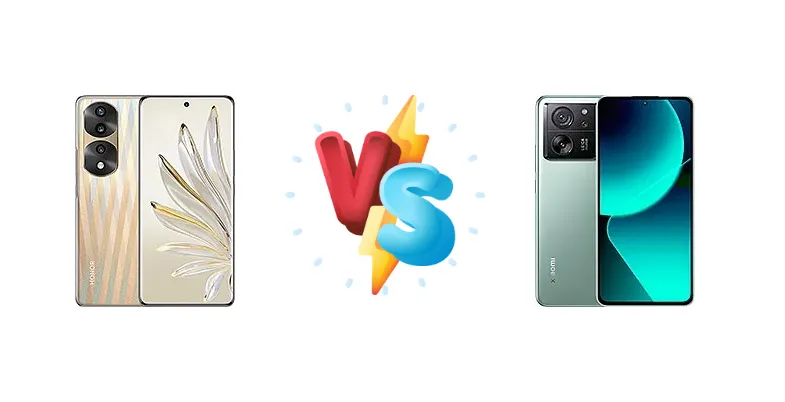
|
🏆 Quick Verdict
For most users, the Xiaomi 13T emerges as the stronger choice. Its Dimensity 8200 Ultra provides a noticeable performance uplift over the Honor 70 Pro’s Dimensity 8000, and the superior battery endurance, evidenced by its 12:23h active use score, makes it a more reliable daily driver. While the Honor 70 Pro’s 100W charging is impressive, the 13T’s overall package is more compelling.
| PHONES | ||
|---|---|---|
| Phone Names | Honor 70 Pro | Xiaomi 13T |
| Network | ||
|---|---|---|
| 2G bands | GSM 850 / 900 / 1800 / 1900 | GSM 850 / 900 / 1800 / 1900 |
| 3G bands | HSDPA 800 / 850 / 900 / 1700(AWS) / 1900 / 2100 | HSDPA 800 / 850 / 900 / 1700(AWS) / 1900 / 2100 |
| 4G bands | 1, 2, 3, 4, 5, 8, 19, 28, 34, 38, 39, 40, 41 | 1, 2, 3, 4, 5, 7, 8, 12, 13, 17, 18, 19, 20, 26, 28, 32, 38, 40, 41, 66 |
| 5G bands | 1, 5, 8, 28, 41, 77, 78 SA/NSA | 1, 3, 5, 7, 8, 20, 28, 38, 40, 41, 66, 77, 78 SA/NSA |
| Speed | HSPA, LTE, 5G | HSPA, LTE, 5G |
| Technology | GSM / CDMA / HSPA / CDMA2000 / LTE / 5G | GSM / HSPA / LTE / 5G |
| CDMA2000 1x | - | |
| Launch | ||
|---|---|---|
| Announced | 2022, May 30 | 2023, September 26 |
| Status | Available. Released 2022, June 13 | Available. Released 2023, September 26 |
| Body | ||
|---|---|---|
| Build | - | Glass front (Gorilla Glass 5), glass back or silicone polymer back, plastic frame |
| Dimensions | 163.9 x 74.6 x 8.2 mm (6.45 x 2.94 x 0.32 in) | 162.2 x 75.7 x 8.5 mm (6.39 x 2.98 x 0.33 in) |
| SIM | Nano-SIM + Nano-SIM | · Nano-SIM + eSIM· Nano-SIM + Nano-SIM |
| Weight | 192 g (6.77 oz) | 193 g or 197 g (6.81 oz) |
| Display | ||
|---|---|---|
| Protection | - | Corning Gorilla Glass 5 |
| Resolution | 1200 x 2652 pixels (~429 ppi density) | 1220 x 2712 pixels, 20:9 ratio (~446 ppi density) |
| Size | 6.78 inches, 111.4 cm2 (~91.1% screen-to-body ratio) | 6.67 inches, 107.4 cm2 (~87.5% screen-to-body ratio) |
| Type | OLED, 1B colors, 120Hz | AMOLED, 68B colors, 144Hz, Dolby Vision, HDR10+, 1200 nits (HBM), 2600 nits (peak) |
| Platform | ||
|---|---|---|
| CPU | Octa-core (4x2.75 GHz Cortex-A78 & 4x2.0 GHz Cortex-A55) | Octa-core (1x3.1 GHz Cortex-A78 & 3x3.0 GHz Cortex-A78 & 4x2.0 GHz Cortex-A55) |
| Chipset | Mediatek Dimensity 8000 (5 nm) | Mediatek Dimensity 8200 Ultra (4 nm) |
| GPU | Mali-G610 | Mali-G610 MC6 |
| OS | Android 12, Magic UI 6.1 | Android 13, up to 4 major Android upgrades, HyperOS |
| Memory | ||
|---|---|---|
| Card slot | No | No |
| Internal | 256GB 8GB RAM, 256GB 12GB RAM, 512GB 12GB RAM | 256GB 8GB RAM, 256GB 12GB RAM |
| Main Camera | ||
|---|---|---|
| Features | Dual-LED flash, HDR, panorama | Leica lens, color spectrum sensor, LED flash, HDR, panorama |
| Single | 50 MP, f/2.4, 100˚ (ultrawide) | - |
| Triple | 54 MP, f/1.9, (wide), 1/1.49", PDAF 8 MP, f/2.4, (telephoto), PDAF, OIS, 3x optical zoom 50 MP, f/2.2, 122˚ (ultrawide), AF | 50 MP, f/1.9, 24mm (wide), 1/1.28", 1.22µm, PDAF, OIS 50 MP, f/1.9, 50mm (telephoto), 1/2.88", 0.61µm, PDAF, 2x optical zoom 12 MP, f/2.2, 15mm (ultrawide), 1/3.06", 1.12µm |
| Video | 4K@30fps, 1080p@30/60fps, gyro-EIS | 4K@30fps (HDR10+), 1080p@30/60/120fps, gyro-EIS |
| Selfie camera | ||
|---|---|---|
| Features | HDR | HDR |
| Single | 50 MP, f/2.4, 100˚ (ultrawide) | 20 MP, f/2.2, (wide), 0.8µm |
| Video | 4K@30fps, 1080p@30fps, gyro-EIS | 1080p@30fps, HDR10+ |
| Sound | ||
|---|---|---|
| 3.5mm jack | No | - |
| 35mm jack | No | No |
| Loudspeaker | Yes, with stereo speakers | Yes, with stereo speakers |
| Comms | ||
|---|---|---|
| Bluetooth | 5.2, A2DP, LE, aptX HD | 5.4, A2DP, LE |
| Infrared port | - | Yes |
| NFC | Yes | Yes (market/region dependent) |
| Positioning | GPS, GLONASS, BDS | GPS (L1+L5), GLONASS (G1), GALILEO (E1+E5a), QZSS (L1+L5), NavIC (L5), BDS |
| Radio | No | No |
| USB | USB Type-C 2.0, OTG | USB Type-C 2.0, OTG |
| WLAN | Wi-Fi 802.11 a/b/g/n/ac/6, dual-band, Wi-Fi Direct | Wi-Fi 802.11 a/b/g/n/ac/6, dual-band |
| Features | ||
|---|---|---|
| Sensors | Fingerprint (under display, optical), accelerometer, gyro, proximity, compass | Fingerprint (under display, optical), accelerometer, gyro, proximity, compass |
| Battery | ||
|---|---|---|
| Charging | 100W wired, 60% in 15 min 5W reverse wired | 67W wired, PD3.0, QC4, 100% in 42 min |
| Type | Li-Po 4500 mAh | Li-Po 5000 mAh |
| Misc | ||
|---|---|---|
| Colors | Black, Green, Gold, Silver | Alpine Blue, Meadow Green, Black |
| Models | SDY-AN00 | 2306EPN60G |
| Price | About 520 EUR | $ 255.96 / £ 326.27 / € 204.18 |
| SAR EU | - | 0.99 W/kg (head) 0.99 W/kg (body) |
Honor 70 Pro
- Incredibly fast 100W wired charging
- Potentially more affordable (depending on market)
- Sleek design (based on brand aesthetic)
- Older chipset (Dimensity 8000)
- Likely lower battery endurance
- Display likely less bright than Xiaomi 13T
Xiaomi 13T
- More powerful Dimensity 8200 Ultra chipset
- Superior battery life (12:23h active use)
- Brighter display (1264 nits)
- Slower charging speed (67W)
- Potentially higher price point
- Larger size/weight (typical for Xiaomi)
Display Comparison
The Xiaomi 13T boasts a significantly brighter display, reaching a measured peak of 1264 nits, compared to an unspecified brightness for the Honor 70 Pro. This higher peak brightness translates to better visibility outdoors under direct sunlight. While both likely utilize OLED panels, the 13T’s brightness advantage is a clear win. Details regarding PWM dimming frequency are absent for both, but this is a crucial factor for users sensitive to flicker.
Camera Comparison
Context data lacks detailed camera specifications for both devices beyond 'Photo / Video' capability. However, given the market positioning, it’s reasonable to assume both feature multi-camera systems. The Xiaomi 13T likely benefits from newer image processing algorithms and potentially larger sensor sizes, common trends in recent Xiaomi releases. Without specific sensor details, a definitive camera comparison is impossible, but the 13T’s newer chipset likely provides more processing power for computational photography.
Performance
The Xiaomi 13T’s Mediatek Dimensity 8200 Ultra, fabricated on a 4nm process, represents a clear architectural advantage over the Honor 70 Pro’s 5nm Dimensity 8000. The 8200 Ultra features a more refined CPU configuration – a 1x3.1 GHz Cortex-A78 core alongside 3x3.0 GHz Cortex-A78 cores, versus the 70 Pro’s 4x2.75 GHz Cortex-A78 and 4x2.0 GHz Cortex-A55. This translates to faster single-core and multi-core performance, particularly noticeable in demanding applications and gaming. The 4nm node also contributes to improved thermal efficiency, potentially reducing throttling during extended use.
Battery Life
The Xiaomi 13T demonstrates a significant advantage in battery endurance, achieving an active use score of 12:23h and an endurance rating of 101h. While the Honor 70 Pro’s battery capacity is unknown, the 13T’s performance suggests a larger battery or more efficient power management. The Honor 70 Pro compensates with its 100W wired charging, capable of reaching 60% charge in just 15 minutes, while the 13T takes 42 minutes for a full charge at 67W. This trade-off favors the 13T for all-day use and the 70 Pro for those prioritizing rapid top-ups.
Buying Guide
Buy the Honor 70 Pro if you prioritize the absolute fastest charging speeds and frequently need to top up your phone quickly. Its 100W charging is a significant advantage. Buy the Xiaomi 13T if you value sustained performance, longer battery life, and a brighter, more visible display, making it ideal for power users and media consumers.