
Honor 70 Pro vs Xiaomi 12T: A Detailed Showdown
| Phones Images | |||||
|---|---|---|---|---|---|
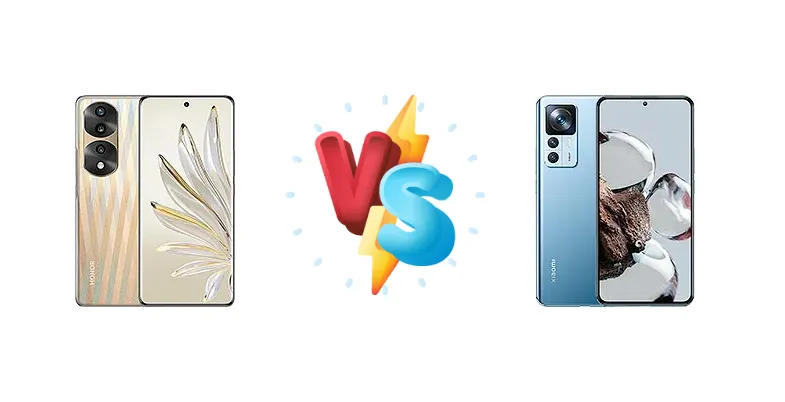
|
🏆 Quick Verdict
The Xiaomi 12T edges out the Honor 70 Pro thanks to its faster charging, brighter display, and slightly more powerful chipset. However, the Honor 70 Pro might appeal to users prioritizing design and a potentially more refined software experience. Ultimately, it depends on your priorities.
| PHONES | ||
|---|---|---|
| Phone Names | Honor 70 Pro | Xiaomi 12T |
| Network | ||
|---|---|---|
| 2G bands | GSM 850 / 900 / 1800 / 1900 | GSM 850 / 900 / 1800 / 1900 |
| 3G bands | HSDPA 800 / 850 / 900 / 1700(AWS) / 1900 / 2100 | HSDPA 800 / 850 / 900 / 1700(AWS) / 1900 / 2100 |
| 4G bands | 1, 2, 3, 4, 5, 8, 19, 28, 34, 38, 39, 40, 41 | 1, 2, 3, 4, 5, 7, 8, 12, 13, 17, 18, 19, 20, 26, 28, 32, 38, 40, 41, 66 |
| 5G bands | 1, 5, 8, 28, 41, 77, 78 SA/NSA | 1, 3, 5, 7, 8, 20, 28, 38, 40, 41, 66, 77, 78 SA/NSA |
| Speed | HSPA, LTE, 5G | HSPA, LTE, 5G |
| Technology | GSM / CDMA / HSPA / CDMA2000 / LTE / 5G | GSM / HSPA / LTE / 5G |
| CDMA2000 1x | - | |
| Launch | ||
|---|---|---|
| Announced | 2022, May 30 | 2022, October 04 |
| Status | Available. Released 2022, June 13 | Available. Released 2022, October 06 |
| Body | ||
|---|---|---|
| Dimensions | 163.9 x 74.6 x 8.2 mm (6.45 x 2.94 x 0.32 in) | 163.1 x 75.9 x 8.6 mm (6.42 x 2.99 x 0.34 in) |
| SIM | Nano-SIM + Nano-SIM | Nano-SIM + Nano-SIM |
| Weight | 192 g (6.77 oz) | 202 g (7.13 oz) |
| Display | ||
|---|---|---|
| Protection | - | Corning Gorilla Glass 5 |
| Resolution | 1200 x 2652 pixels (~429 ppi density) | 1220 x 2712 pixels, 20:9 ratio (~446 ppi density) |
| Size | 6.78 inches, 111.4 cm2 (~91.1% screen-to-body ratio) | 6.67 inches, 107.4 cm2 (~86.7% screen-to-body ratio) |
| Type | OLED, 1B colors, 120Hz | AMOLED, 68B colors, 120Hz, HDR10+, 500 nits (typ), 900 nits (peak) |
| Platform | ||
|---|---|---|
| CPU | Octa-core (4x2.75 GHz Cortex-A78 & 4x2.0 GHz Cortex-A55) | Octa-core (4x2.85 GHz Cortex-A78 & 4x2.0 GHz Cortex-A55) |
| Chipset | Mediatek Dimensity 8000 (5 nm) | Mediatek Dimensity 8100 Ultra (5 nm) |
| GPU | Mali-G610 | Mali-G610 MC6 |
| OS | Android 12, Magic UI 6.1 | Android 12, upgradable to Android 14, MIUI 14 |
| Memory | ||
|---|---|---|
| Card slot | No | No |
| Internal | 256GB 8GB RAM, 256GB 12GB RAM, 512GB 12GB RAM | 128GB 8GB RAM, 256GB 8GB RAM |
| - | UFS 3.1 | |
| Main Camera | ||
|---|---|---|
| Features | Dual-LED flash, HDR, panorama | Color spectrum sensor, Dual-LED dual-tone flash, HDR, panorama |
| Single | 50 MP, f/2.4, 100˚ (ultrawide) | - |
| Triple | 54 MP, f/1.9, (wide), 1/1.49", PDAF 8 MP, f/2.4, (telephoto), PDAF, OIS, 3x optical zoom 50 MP, f/2.2, 122˚ (ultrawide), AF | 108 MP, f/1.7, 24mm (wide), 1/1.67", 0.64µm, PDAF, OIS 8 MP, f/2.2, 120˚ (ultrawide), 1/4.0", 1.12µm 2 MP (macro) |
| Video | 4K@30fps, 1080p@30/60fps, gyro-EIS | 4K@30fps, 1080p@30/60/120/240fps, HDR |
| Selfie camera | ||
|---|---|---|
| Features | HDR | HDR, panorama |
| Single | 50 MP, f/2.4, 100˚ (ultrawide) | 20 MP, f/2.2, (wide), 1/3.47", 0.8µm |
| Video | 4K@30fps, 1080p@30fps, gyro-EIS | 1080p@30/60fps, HDR |
| Sound | ||
|---|---|---|
| 3.5mm jack | No | No |
| 35mm jack | No | No |
| Loudspeaker | Yes, with stereo speakers | Yes, with stereo speakers |
| - | 24-bit/192kHz audio | |
| Comms | ||
|---|---|---|
| Bluetooth | 5.2, A2DP, LE, aptX HD | 5.3, A2DP, LE |
| Infrared port | - | Yes |
| NFC | Yes | Yes (market/region dependent) |
| Positioning | GPS, GLONASS, BDS | GPS (L1+L5), GLONASS (L1), BDS (B1I+B1c+B2a), GALILEO (E1+E5a), QZSS (L1+L5), NavIC (L5) |
| Radio | No | No |
| USB | USB Type-C 2.0, OTG | USB Type-C 2.0, OTG |
| WLAN | Wi-Fi 802.11 a/b/g/n/ac/6, dual-band, Wi-Fi Direct | Wi-Fi 802.11 a/b/g/n/ac/6, dual-band, Wi-Fi Direct |
| Features | ||
|---|---|---|
| Sensors | Fingerprint (under display, optical), accelerometer, gyro, proximity, compass | Fingerprint (under display, optical), accelerometer, gyro, proximity, compass |
| Battery | ||
|---|---|---|
| Charging | 100W wired, 60% in 15 min 5W reverse wired | 120W wired, 100% in 19 min |
| Type | Li-Po 4500 mAh | Li-Po 5000 mAh |
| Misc | ||
|---|---|---|
| Colors | Black, Green, Gold, Silver | Black, Silver, Blue |
| Models | SDY-AN00 | 22071212AG |
| Price | About 520 EUR | € 181.96 / £ 283.32 |
| SAR | - | 1.09 W/kg (head) 1.09 W/kg (body) |
| SAR EU | - | 0.99 W/kg (head) 0.99 W/kg (body) |
| Tests | ||
|---|---|---|
| Battery life | - | Endurance rating 104h |
| Camera | - | Photo / Video |
| Display | - | Contrast ratio: Infinite (nominal) |
| Loudspeaker | - | -25.0 LUFS (Very good) |
| Performance | - | AnTuTu: 780204 (v9) GeekBench: 3756 (v5.1) |
Honor 70 Pro
- Stylish Design
- Good Selfie Camera
- Fast Charging (100W)
- Potentially Smoother Software
- Slightly Less Powerful Chipset
- Lower Display Brightness
- Charging not as fast as Xiaomi 12T
Xiaomi 12T
- Faster Charging (120W)
- Brighter Display
- More Powerful Chipset (Dimensity 8100 Ultra)
- Excellent Battery Life
- Design may be less appealing to some
- Software experience can be inconsistent
Display Comparison
The Xiaomi 12T boasts a significant advantage with its 954 nits max brightness, making it far more usable outdoors. While the Honor 70 Pro's display is good, it lacks the same level of visibility in bright sunlight. The Xiaomi 12T's 'infinite' contrast ratio (though nominal) suggests excellent blacks and vibrant colors. Both likely use AMOLED panels with smooth refresh rates.
Camera Comparison
Both phones feature capable camera systems, but specifics are missing. The Xiaomi 12T likely has a versatile setup with a main sensor, ultrawide, and potentially a telephoto lens. The Honor 70 Pro is known for its selfie camera capabilities. Image quality will depend on software processing and sensor size, requiring further testing to determine a clear winner.
Performance
The Xiaomi 12T's Dimensity 8100 Ultra holds a slight edge over the Honor 70 Pro's Dimensity 8000. While both are capable chips, the 8100 Ultra generally offers better sustained performance and slightly faster processing speeds, especially in demanding games and multitasking scenarios. Both phones will handle everyday tasks with ease.
Battery Life
The Xiaomi 12T's 120W charging is a game-changer, allowing for a full charge in under 20 minutes. The Honor 70 Pro's 100W charging is still fast, but not as impressive. Both phones have large batteries, and the Xiaomi 12T's endurance rating of 104h suggests excellent battery life, potentially exceeding the Honor 70 Pro's.
Buying Guide
The Honor 70 Pro is ideal for users who value aesthetics, a good camera system, and a potentially smoother software experience. The Xiaomi 12T is a better choice for those prioritizing raw performance, incredibly fast charging, and a vibrant, high-brightness display.