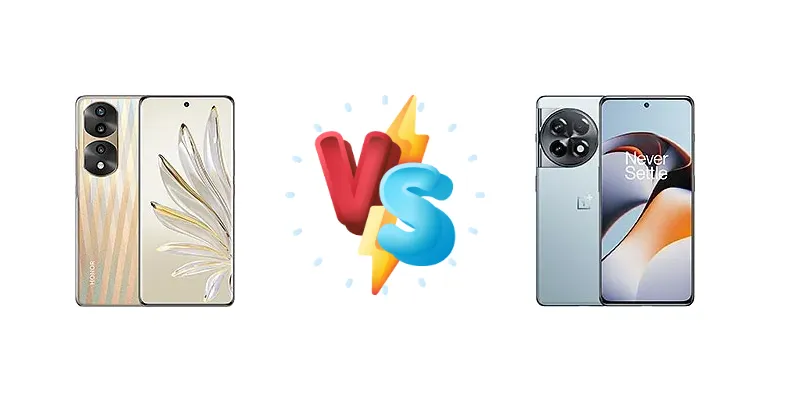
The Honor 70 Pro and OnePlus 11R represent compelling options in the increasingly competitive mid-range to upper-mid-range smartphone market. The Honor 70 Pro aims for a balance of style and speed, while the OnePlus 11R aggressively targets performance enthusiasts with a flagship-level chipset at a more accessible price point. This comparison dissects their key differences to determine which device delivers the best value.
🏆 Quick Verdict
For most users, the OnePlus 11R emerges as the stronger choice. Its Snapdragon 8+ Gen 1 chipset provides a significant performance advantage, particularly in demanding tasks like gaming, and its 100W charging is equally rapid. While the Honor 70 Pro offers a refined experience, the 11R’s raw power justifies its slight compromises.
| Network |
|---|
| 2G bands | GSM 850 / 900 / 1800 / 1900 | GSM 850 / 900 / 1800 / 1900 |
| 3G bands | HSDPA 800 / 850 / 900 / 1700(AWS) / 1900 / 2100 | HSDPA 850 / 900 / 1700(AWS) / 2100 |
| 4G bands | 1, 2, 3, 4, 5, 8, 19, 28, 34, 38, 39, 40, 41 | 1, 3, 4, 5, 8, 28, 34, 38, 39, 40, 41 |
| 5G bands | 1, 5, 8, 28, 41, 77, 78 SA/NSA | 1, 3, 5, 8, 28, 40, 41, 77, 78 SA/NSA |
| Speed | HSPA, LTE, 5G | HSPA, LTE (3CA), 5G |
| Technology | GSM / CDMA / HSPA / CDMA2000 / LTE / 5G | GSM / CDMA / HSPA / LTE / 5G |
| | CDMA2000 1x | CDMA 800 |
| Launch |
|---|
| Announced | 2022, May 30 | 2023, February 07 |
| Status | Available. Released 2022, June 13 | Available. Released 2023, February 21 |
| Body |
|---|
| Build | - | Glass front, glass back (Gorilla Glass 5), plastic frame |
| Dimensions | 163.9 x 74.6 x 8.2 mm (6.45 x 2.94 x 0.32 in) | 163.4 x 74.3 x 8.7 mm (6.43 x 2.93 x 0.34 in) |
| SIM | Nano-SIM + Nano-SIM | Nano-SIM + Nano-SIM |
| Weight | 192 g (6.77 oz) | 204 g (7.20 oz) |
| Display |
|---|
| Resolution | 1200 x 2652 pixels (~429 ppi density) | 1240 x 2772 pixels, 20:9 ratio (~451 ppi density) |
| Size | 6.78 inches, 111.4 cm2 (~91.1% screen-to-body ratio) | 6.74 inches, 109.2 cm2 (~90.0% screen-to-body ratio) |
| Type | OLED, 1B colors, 120Hz | Fluid AMOLED, 1B colors, 120Hz, HDR10+, 1450 nits (peak) |
| Platform |
|---|
| CPU | Octa-core (4x2.75 GHz Cortex-A78 & 4x2.0 GHz Cortex-A55) | Octa-core (1x3.0 GHz Cortex-X2 & 3x2.5 GHz Cortex-A710 & 4x1.80 GHz Cortex-A510) |
| Chipset | Mediatek Dimensity 8000 (5 nm) | Qualcomm SM8475 Snapdragon 8+ Gen 1 (4 nm) |
| GPU | Mali-G610 | Adreno 730 |
| OS | Android 12, Magic UI 6.1 | Android 13, upgradable to Android 15, OxygenOS 15 |
| Memory |
|---|
| Card slot | No | No |
| Internal | 256GB 8GB RAM, 256GB 12GB RAM, 512GB 12GB RAM | 128GB 8GB RAM, 256GB 16GB RAM, 512GB 18GB RAM |
| | - | UFS 3.1 |
| Main Camera |
|---|
| Features | Dual-LED flash, HDR, panorama | Color spectrum sensor, LED flash, HDR, panorama |
| Single | 50 MP, f/2.4, 100˚ (ultrawide) | 16 MP, f/2.4, 24mm (wide), 1/3.09", 1.0µm |
| Triple | 54 MP, f/1.9, (wide), 1/1.49", PDAF
8 MP, f/2.4, (telephoto), PDAF, OIS, 3x optical zoom
50 MP, f/2.2, 122˚ (ultrawide), AF | 50 MP, f/1.8, 24mm (wide), 1/1.56", 1.0µm, multi-directional PDAF, OIS
8 MP, f/2.2, 120˚ (ultrawide), 1/4.0", 1.12µm
2 MP (macro) |
| Video | 4K@30fps, 1080p@30/60fps, gyro-EIS | 4K@30/60fps, 1080p@30/60/240fps, gyro-EIS |
| Selfie camera |
|---|
| Features | HDR | HDR |
| Single | 50 MP, f/2.4, 100˚ (ultrawide) | 16 MP, f/2.4, 24mm (wide), 1/3.09", 1.0µm |
| Video | 4K@30fps, 1080p@30fps, gyro-EIS | 1080p@30fps |
| Sound |
|---|
| 3.5mm jack | No | No |
| 35mm jack | No | No |
| Loudspeaker | Yes, with stereo speakers | Yes, with stereo speakers |
| | - | 24-bit/192kHz audio |
| Comms |
|---|
| Bluetooth | 5.2, A2DP, LE, aptX HD | 5.3, A2DP, LE, aptX HD |
| Infrared port | - | Yes |
| NFC | Yes | Yes |
| Positioning | GPS, GLONASS, BDS | GPS (L1+L5), GLONASS (G1), BDS (B1I+B1c+B2a), GALILEO (E1+E5a), QZSS (L1+L5) |
| Radio | No | No |
| USB | USB Type-C 2.0, OTG | USB Type-C 2.0 |
| WLAN | Wi-Fi 802.11 a/b/g/n/ac/6, dual-band, Wi-Fi Direct | Wi-Fi 802.11 a/b/g/n/ac/6, dual-band |
| Features |
|---|
| Sensors | Fingerprint (under display, optical), accelerometer, gyro, proximity, compass | Fingerprint (under display, optical), accelerometer, gyro, proximity, compass |
| Battery |
|---|
| Charging | 100W wired, 60% in 15 min
5W reverse wired | 100W wired |
| Type | Li-Po 4500 mAh | Li-Po 5000 mAh |
| Misc |
|---|
| Colors | Black, Green, Gold, Silver | Galactic Silver, Sonic Black, Solar Red |
| Models | SDY-AN00 | CPH2487 |
| Price | About 520 EUR | About 600 EUR |
| SAR | - | 1.16 W/kg (head) 0.61 W/kg (body) |
Honor 70 Pro
- Extremely fast 100W charging
- Potentially more refined design aesthetic
- Likely optimized image processing for social media
- Dimensity 8000 chipset is outperformed by Snapdragon 8+ Gen 1
- May exhibit more throttling under sustained load
OnePlus 11R
- Snapdragon 8+ Gen 1 delivers superior performance
- Excellent thermal efficiency for sustained gaming
- 100W charging for rapid top-ups
- Design may be less visually striking than the Honor 70 Pro
- Image processing may prioritize accuracy over social media appeal
Display Comparison
Neither device boasts a standout display, but differences exist. While both likely feature AMOLED panels (based on brand history), the specifications don't detail refresh rates or peak brightness. The Honor 70 Pro's focus on aesthetics suggests a potentially more color-accurate display, but without concrete data, this remains speculative. The OnePlus 11R, geared towards gaming, may prioritize refresh rate for smoother visuals, though this is unconfirmed. Bezels are likely comparable, given both phones target a similar price bracket.
Camera Comparison
Without detailed sensor information, a direct camera comparison is challenging. However, the market positioning suggests the OnePlus 11R will likely prioritize overall image quality with a larger main sensor, while the Honor 70 Pro may lean towards a more stylized, social-media-friendly aesthetic. Both phones likely include standard wide and ultrawide lenses. The absence of telephoto lenses on either device suggests a focus on versatility over zoom capabilities. Image processing algorithms will be key; OnePlus typically aims for natural colors, while Honor often boosts saturation.
Performance
The performance gap is the most significant differentiator. The OnePlus 11R’s Snapdragon 8+ Gen 1 (4nm) is a substantial upgrade over the Honor 70 Pro’s Dimensity 8000 (5nm). The Snapdragon 8+ Gen 1 features a Cortex-X2 prime core clocked at 3.0 GHz, offering superior single-core performance crucial for responsiveness. The Dimensity 8000’s Cortex-A78 cores, while capable, peak at 2.75 GHz. The 4nm process of the Snapdragon 8+ Gen 1 also translates to better thermal efficiency, mitigating throttling during prolonged gaming sessions. The OnePlus 11R will demonstrably outperform the Honor 70 Pro in GPU-intensive tasks.
Battery Life
Both devices feature 100W wired charging, promising incredibly fast top-ups. Honor claims 60% charge in 15 minutes, while OnePlus also advertises similar speeds. This effectively negates any significant advantage based solely on charging speed. Battery capacity is not specified, but the OnePlus 11R’s more power-hungry chipset will likely require a larger battery to achieve comparable battery life. The Snapdragon 8+ Gen 1’s efficiency gains partially offset this, but the Honor 70 Pro may still offer slightly longer endurance for light to moderate users.
Buying Guide
Buy the Honor 70 Pro if you prioritize a sleek design and extremely fast charging, and your usage primarily revolves around social media, everyday tasks, and casual gaming. Buy the OnePlus 11R if you are a power user, gamer, or frequently engage in resource-intensive applications, and demand the highest possible performance for your money. The 11R is the clear choice for those who value speed above all else.
Frequently Asked Questions
❓ Will the Snapdragon 8+ Gen 1 in the OnePlus 11R overheat during extended gaming sessions?
The Snapdragon 8+ Gen 1 is built on a 4nm process, which significantly improves thermal efficiency compared to older chipsets. While some heat generation is inevitable during prolonged gaming, the OnePlus 11R is expected to manage temperatures effectively, minimizing throttling and maintaining consistent performance. The phone likely incorporates vapor chamber cooling to further enhance thermal management.
❓ Is the 100W charging on both phones compatible with all USB-PD chargers?
While both phones support 100W charging, they utilize proprietary charging protocols (SuperVOOC for OnePlus, and a similar implementation for Honor). To achieve the full 100W charging speed, you must use the included charger. Standard USB-PD chargers will still work, but at a slower charging rate. Using a compatible charger is crucial for maximizing charging speed and preventing potential compatibility issues.
❓ Does the OnePlus 11R support high refresh rate gaming, like 90fps or 120fps in popular titles?
The OnePlus 11R's powerful Snapdragon 8+ Gen 1 chipset and Adreno 730 GPU are capable of delivering high frame rates in many popular games. Support for 90fps or 120fps will depend on the specific game and its optimization. Many titles offer adjustable graphics settings, allowing you to prioritize frame rate over visual fidelity to achieve smoother gameplay.