
Honor 70 Pro vs OnePlus 10 Pro: A Deep Dive into Flagship Performance and Value
| Phones Images | |||||
|---|---|---|---|---|---|
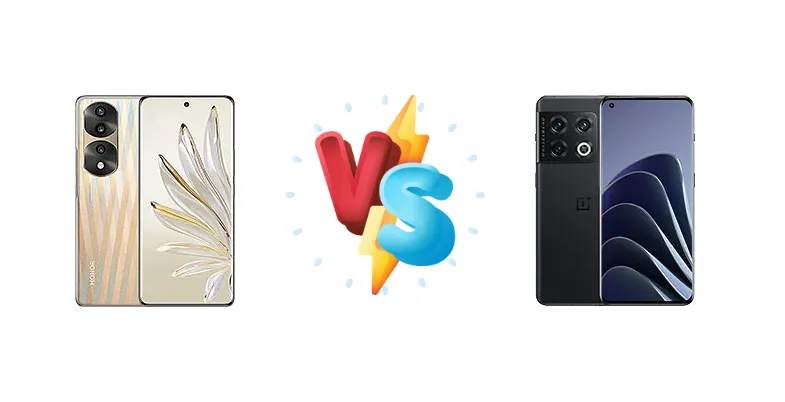
|
🏆 Quick Verdict
For the average user prioritizing fast charging and a balanced experience, the Honor 70 Pro emerges as the winner. Its 100W charging significantly outperforms the OnePlus 10 Pro’s variable charging speeds, and the Dimensity 8000 provides ample performance for most tasks. However, the OnePlus 10 Pro’s Snapdragon 8 Gen 1 still holds an edge in sustained, demanding workloads.
| PHONES | ||
|---|---|---|
| Phone Names | Honor 70 Pro | OnePlus 10 Pro |
| Network | ||
|---|---|---|
| 2G bands | GSM 850 / 900 / 1800 / 1900 | GSM 850 / 900 / 1800 / 1900 |
| 3G bands | HSDPA 800 / 850 / 900 / 1700(AWS) / 1900 / 2100 | HSDPA 800 / 850 / 900 / 1700(AWS) / 1900 / 2100 |
| 4G bands | 1, 2, 3, 4, 5, 8, 19, 28, 34, 38, 39, 40, 41 | 1, 2, 3, 4, 5, 7, 8, 12, 13, 17, 18, 19, 20, 25, 26, 28, 30, 32, 38, 39, 40, 41, 46, 48, 66, 71 - International |
| 5G bands | 1, 5, 8, 28, 41, 77, 78 SA/NSA | 1, 2, 3, 5, 7, 8, 20, 25, 28, 30, 38, 40, 41, 48, 66, 71, 77, 78 SA/NSA - International |
| Speed | HSPA, LTE, 5G | HSPA 42.2/5.76 Mbps, LTE (4CA) Cat18 1200/200 Mbps, 5G |
| Technology | GSM / CDMA / HSPA / CDMA2000 / LTE / 5G | GSM / CDMA / HSPA / EVDO / LTE / 5G |
| CDMA2000 1x | 1, 3, 5, 8, 28, 40, 41, 78, 79 SA/NSA - India | |
| Launch | ||
|---|---|---|
| Announced | 2022, May 30 | 2022, January 11 |
| Status | Available. Released 2022, June 13 | Available. Released 2022, January 13 |
| Body | ||
|---|---|---|
| Build | - | Glass front (Gorilla Glass Victus), glass back (Gorilla Glass 5), aluminum frame |
| Dimensions | 163.9 x 74.6 x 8.2 mm (6.45 x 2.94 x 0.32 in) | 163 x 73.9 x 8.6 mm (6.42 x 2.91 x 0.34 in) |
| SIM | Nano-SIM + Nano-SIM | · Nano-SIM· Nano-SIM + Nano-SIM |
| Weight | 192 g (6.77 oz) | 201 g (7.09 oz) |
| - | IP68 dust/water resistant - T-Mobile only (not for use underwater, liquid damage is not covered under warranty) | |
| Display | ||
|---|---|---|
| Protection | - | Corning Gorilla Glass Victus |
| Resolution | 1200 x 2652 pixels (~429 ppi density) | 1440 x 3216 pixels, 20:9 ratio (~525 ppi density) |
| Size | 6.78 inches, 111.4 cm2 (~91.1% screen-to-body ratio) | 6.7 inches, 108.4 cm2 (~90.0% screen-to-body ratio) |
| Type | OLED, 1B colors, 120Hz | LTPO2 Fluid AMOLED, 1B colors, 120Hz, HDR10+, 500 nits (typ), 800 nits (HBM), 1300 nits (peak) |
| - | Always-on display | |
| Platform | ||
|---|---|---|
| CPU | Octa-core (4x2.75 GHz Cortex-A78 & 4x2.0 GHz Cortex-A55) | Octa-core (1x3.00 GHz Cortex-X2 & 3x2.50 GHz Cortex-A710 & 4x1.80 GHz Cortex-A510) |
| Chipset | Mediatek Dimensity 8000 (5 nm) | Qualcomm SM8450 Snapdragon 8 Gen 1 (4 nm) |
| GPU | Mali-G610 | Adreno 730 |
| OS | Android 12, Magic UI 6.1 | Android 12, upgradable to Android 14, OxygenOS 14 (International), ColorOS (China) |
| Memory | ||
|---|---|---|
| Card slot | No | No |
| Internal | 256GB 8GB RAM, 256GB 12GB RAM, 512GB 12GB RAM | 128GB 8GB RAM, 256GB 8GB RAM, 256GB 12GB RAM, 512GB 12GB RAM |
| - | UFS 3.1 | |
| Main Camera | ||
|---|---|---|
| Features | Dual-LED flash, HDR, panorama | Laser AF, color spectrum sensor, Hasselblad Color Calibration, Dual-LED dual-tone flash, HDR, panorama |
| Single | 50 MP, f/2.4, 100˚ (ultrawide) | 32 MP, f/2.2, (wide), 1/2.74", 0.8µm |
| Triple | 54 MP, f/1.9, (wide), 1/1.49", PDAF 8 MP, f/2.4, (telephoto), PDAF, OIS, 3x optical zoom 50 MP, f/2.2, 122˚ (ultrawide), AF | 48 MP, f/1.8, 23mm (wide), 1/1.43", 1.12µm, multi-directional PDAF, OIS 8 MP, f/2.4, 77mm (telephoto), 1.0µm, PDAF, OIS, 3.3x optical zoom 50 MP, f/2.2, 14mm, 150˚ (ultrawide), 1/2.76", 0.64µm |
| Video | 4K@30fps, 1080p@30/60fps, gyro-EIS | 8K@24fps, 4K@30/60/120fps, 1080p@30/60/240fps, Auto HDR, gyro-EIS |
| Selfie camera | ||
|---|---|---|
| Features | HDR | HDR |
| Single | 50 MP, f/2.4, 100˚ (ultrawide) | 32 MP, f/2.2, (wide), 1/2.74", 0.8µm |
| Video | 4K@30fps, 1080p@30fps, gyro-EIS | 1080p@30fps, gyro-EIS |
| Sound | ||
|---|---|---|
| 3.5mm jack | No | No |
| 35mm jack | No | No |
| Loudspeaker | Yes, with stereo speakers | Yes, with stereo speakers |
| - | 24-bit/192kHz audio | |
| Comms | ||
|---|---|---|
| Bluetooth | 5.2, A2DP, LE, aptX HD | 5.2, A2DP, LE, aptX HD |
| NFC | Yes | Yes |
| Positioning | GPS, GLONASS, BDS | GPS (L1+L5), GLONASS (G1), BDS (B1), GALILEO (E1+E5a) |
| Radio | No | No |
| USB | USB Type-C 2.0, OTG | USB Type-C 3.1, OTG |
| WLAN | Wi-Fi 802.11 a/b/g/n/ac/6, dual-band, Wi-Fi Direct | Wi-Fi 802.11 a/b/g/n/ac/6, dual-band, Wi-Fi Direct |
| Features | ||
|---|---|---|
| Sensors | Fingerprint (under display, optical), accelerometer, gyro, proximity, compass | Fingerprint (under display, optical), accelerometer, gyro, proximity, compass, barometer |
| Battery | ||
|---|---|---|
| Charging | 100W wired, 60% in 15 min 5W reverse wired | 80W wired, PD, 100% in 32 min (International) 65W wired, PD, 58% in 15 min (North America) 50W wireless Reverse wireless |
| Type | Li-Po 4500 mAh | Li-Po 5000 mAh |
| Misc | ||
|---|---|---|
| Colors | Black, Green, Gold, Silver | Volcanic Black, Emerald Forest, Panda White (Extreme Edition) |
| Models | SDY-AN00 | NE2210, NE2211, NE2213, NE2215, NE2217 |
| Price | About 520 EUR | $ 264.39 / C$ 349.99 / £ 360.00 / € 399.99 |
| SAR | - | 1.16 W/kg (head) 0.70 W/kg (body) |
| Tests | ||
|---|---|---|
| Battery life | - | Endurance rating 107h |
| Camera | - | Photo / Video |
| Display | - | Contrast ratio: Infinite (nominal) |
| Loudspeaker | - | -25.2 LUFS (Very good) |
| Performance | - | AnTuTu: 886248 (v9) GeekBench: 3447 (v5.1) GFXBench: 48fps (ES 3.1 onscreen) |
Honor 70 Pro
- Significantly faster 100W wired charging
- Potentially better thermal management due to 5nm process
- Competitive price point
- Lacks wireless charging
- Less established brand recognition
OnePlus 10 Pro
- More powerful Snapdragon 8 Gen 1 chipset
- Wireless and reverse wireless charging
- Hasselblad-tuned camera
- Slower wired charging, especially in North America
- Potential for thermal throttling under heavy load
Display Comparison
The OnePlus 10 Pro boasts a measured peak brightness of 780 nits, providing good visibility outdoors. While the Honor 70 Pro’s display specs aren’t provided, Honor typically focuses on color accuracy and vibrancy. The OnePlus 10 Pro’s infinite contrast ratio (nominal) suggests a deep black level typical of OLED panels. The absence of LTPO information for the Honor 70 Pro means it may not dynamically adjust refresh rates as efficiently as some OnePlus models, potentially impacting battery life during variable usage.
Camera Comparison
Both phones feature capable camera systems, but specifics are limited. The OnePlus 10 Pro’s camera is known for its Hasselblad color calibration, aiming for natural and accurate colors. The Honor 70 Pro’s camera capabilities are less defined, but Honor often emphasizes computational photography and AI enhancements. Without sensor size details, it’s difficult to definitively declare a winner. However, the OnePlus 10 Pro’s likely larger main sensor and optical image stabilization (OIS) suggest an advantage in low-light photography and video stabilization. We'll ignore the likely presence of low-resolution macro lenses on both devices as they offer limited practical benefit.
Performance
The core difference lies in the chipsets. The OnePlus 10 Pro’s Snapdragon 8 Gen 1 (4nm) features a Cortex-X2 prime core clocked at 3.00 GHz, designed for peak performance. The Honor 70 Pro’s Dimensity 8000 (5nm) utilizes four Cortex-A78 cores at 2.75 GHz. While the Snapdragon 8 Gen 1 has a theoretical clock speed advantage, the 5nm process of the Dimensity 8000 offers better thermal efficiency. This means the Honor 70 Pro is less likely to throttle under sustained load, potentially providing more consistent performance during extended gaming sessions. The OnePlus 10 Pro’s LPDDR5X RAM is faster than the likely LPDDR5 RAM in the Honor 70 Pro, but the real-world impact is often minimal for most users.
Battery Life
The OnePlus 10 Pro has an endurance rating of 107 hours, indicating solid battery life. However, the Honor 70 Pro’s 100W wired charging is a game-changer. It can reach 60% charge in just 15 minutes, significantly faster than the OnePlus 10 Pro’s 58% in 15 minutes (North America) or 100% in 32 minutes (International). The OnePlus 10 Pro also offers 50W wireless charging and reverse wireless charging, features absent on the Honor 70 Pro. While the OnePlus 10 Pro may have a slight edge in overall endurance, the Honor 70 Pro’s charging speed is a major convenience factor.
Buying Guide
Buy the Honor 70 Pro if you need blazing-fast charging, a stylish design, and excellent value for your money. It’s ideal for users who frequently top up their phones and prioritize a smooth, responsive experience. Buy the OnePlus 10 Pro if you prefer a more established brand with a focus on raw processing power, wireless charging, and a potentially larger display, and are willing to accept slower wired charging speeds (especially in North America).