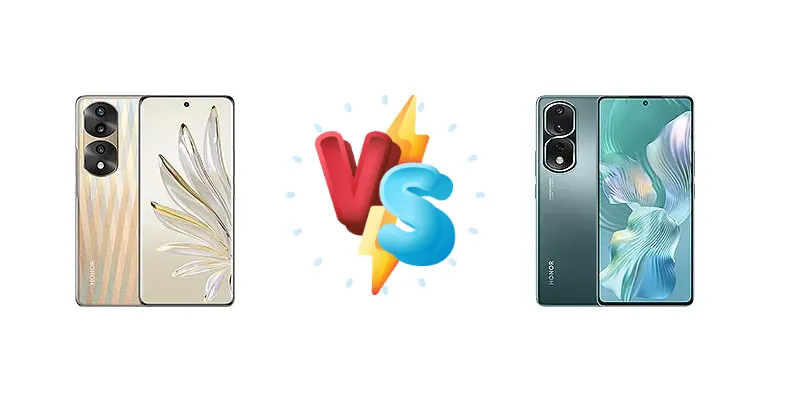
The Honor 70 Pro and 80 Pro Flat represent Honor's continued push into the upper-midrange smartphone market. While both aim for a premium experience, they diverge significantly in their core processing power. The 70 Pro relies on the Mediatek Dimensity 8000, while the 80 Pro Flat boasts the Qualcomm Snapdragon 8+ Gen 1. This comparison dissects these differences, alongside battery life, charging speeds, and overall user experience, to determine which device offers the best value.
🏆 Quick Verdict
For most users, the Honor 80 Pro Flat emerges as the superior choice. The Snapdragon 8+ Gen 1 delivers a noticeable performance uplift, particularly in demanding tasks like gaming and video editing, and its 4nm process offers better thermal efficiency. While the 70 Pro’s 100W charging is faster, the 80 Pro Flat’s overall package justifies the price difference.
| Network |
|---|
| 2G bands | GSM 850 / 900 / 1800 / 1900 | GSM 850 / 900 / 1800 / 1900 |
| 3G bands | HSDPA 800 / 850 / 900 / 1700(AWS) / 1900 / 2100 | HSDPA 800 / 850 / 900 / 1700(AWS) / 1900 / 2100 |
| 4G bands | 1, 2, 3, 4, 5, 8, 19, 28, 34, 38, 39, 40, 41 | LTE |
| 5G bands | 1, 5, 8, 28, 41, 77, 78 SA/NSA | SA/NSA |
| Speed | HSPA, LTE, 5G | HSPA, LTE, 5G |
| Technology | GSM / CDMA / HSPA / CDMA2000 / LTE / 5G | GSM / CDMA / HSPA / CDMA2000 / LTE / 5G |
| | CDMA2000 1x | CDMA2000 1x |
| Launch |
|---|
| Announced | 2022, May 30 | 2023, January 06 |
| Status | Available. Released 2022, June 13 | Available. Released 2023, January 06 |
| Body |
|---|
| Dimensions | 163.9 x 74.6 x 8.2 mm (6.45 x 2.94 x 0.32 in) | 162.3 x 75.3 x 7.9 mm (6.39 x 2.96 x 0.31 in) |
| SIM | Nano-SIM + Nano-SIM | Nano-SIM + Nano-SIM |
| Weight | 192 g (6.77 oz) | 186 g or 193 g (6.56 oz) |
| Display |
|---|
| Resolution | 1200 x 2652 pixels (~429 ppi density) | 1080 x 2400 pixels, 20:9 ratio (~395 ppi density) |
| Size | 6.78 inches, 111.4 cm2 (~91.1% screen-to-body ratio) | 6.67 inches, 107.4 cm2 (~87.9% screen-to-body ratio) |
| Type | OLED, 1B colors, 120Hz | OLED, 1B colors, 120Hz, HDR, 1000 nits (peak) |
| Platform |
|---|
| CPU | Octa-core (4x2.75 GHz Cortex-A78 & 4x2.0 GHz Cortex-A55) | Octa-core (1x3.0 GHz Cortex-X2 & 3x2.5 GHz Cortex-A710 & 4x1.80 GHz Cortex-A510) |
| Chipset | Mediatek Dimensity 8000 (5 nm) | Qualcomm SM8475 Snapdragon 8+ Gen 1 (4 nm) |
| GPU | Mali-G610 | Adreno 730 |
| OS | Android 12, Magic UI 6.1 | Android 12, MagicOS 7 |
| Memory |
|---|
| Card slot | No | No |
| Internal | 256GB 8GB RAM, 256GB 12GB RAM, 512GB 12GB RAM | 256GB 12GB RAM |
| Main Camera |
|---|
| Features | Dual-LED flash, HDR, panorama | LED flash, HDR, panorama |
| Single | 50 MP, f/2.4, 100˚ (ultrawide) | 32 MP, f/2.4, (wide) |
| Triple | 54 MP, f/1.9, (wide), 1/1.49", PDAF
8 MP, f/2.4, (telephoto), PDAF, OIS, 3x optical zoom
50 MP, f/2.2, 122˚ (ultrawide), AF | 160 MP, f/1.8, (wide), 1/1.56", 0.75µm, PDAF
8 MP, f/2.2, (ultrawide)
Auxiliary lens |
| Video | 4K@30fps, 1080p@30/60fps, gyro-EIS | 4K@30fps, 1080p@30/60fps, gyro-EIS |
| Selfie camera |
|---|
| Features | HDR | HDR |
| Single | 50 MP, f/2.4, 100˚ (ultrawide) | 32 MP, f/2.4, (wide) |
| Video | 4K@30fps, 1080p@30fps, gyro-EIS | 1080p@30fps, gyro-EIS |
| Sound |
|---|
| 3.5mm jack | No | No |
| 35mm jack | No | No |
| Loudspeaker | Yes, with stereo speakers | Yes, with stereo speakers |
| Comms |
|---|
| Bluetooth | 5.2, A2DP, LE, aptX HD | 5.2, A2DP, LE, aptX HD |
| NFC | Yes | Yes |
| Positioning | GPS, GLONASS, BDS | GPS, GALILEO, GLONASS, BDS, QZSS |
| Radio | No | No |
| USB | USB Type-C 2.0, OTG | USB Type-C 2.0, OTG |
| WLAN | Wi-Fi 802.11 a/b/g/n/ac/6, dual-band, Wi-Fi Direct | Wi-Fi 802.11 a/b/g/n/ac/6, dual-band, Wi-Fi Direct |
| Features |
|---|
| Sensors | Fingerprint (under display, optical), accelerometer, gyro, proximity, compass | Fingerprint (under display, optical), accelerometer, gyro, compass |
| | - | Virtual proximity sensing |
| Battery |
|---|
| Charging | 100W wired, 60% in 15 min
5W reverse wired | 66W wired, 3-50% in 15 min
5W reverse wired |
| Type | Li-Po 4500 mAh | Li-Po 4800 mAh |
| Misc |
|---|
| Colors | Black, Green, Gold, Silver | Black, Green, Pink |
| Models | SDY-AN00 | - |
| Price | About 520 EUR | About 450 EUR |
Honor 70 Pro
- Extremely fast 100W charging
- Competitive price point
- Solid all-around performance for everyday tasks
- Dimensity 8000 chipset is less powerful than Snapdragon 8+ Gen 1
- Potential for throttling under sustained load
Honor 80 Pro Flat
- Superior performance with Snapdragon 8+ Gen 1
- Better thermal management and reduced throttling
- Flat display appeals to a wider audience
- Slower 66W charging compared to the 70 Pro
- Potentially higher price tag
Display Comparison
Both devices likely feature OLED panels, though specific details like peak brightness and color gamut coverage aren't provided. However, the 'Flat' designation of the 80 Pro is significant; users who dislike curved screens will find it more appealing. The absence of LTPO technology in either device suggests a standard 120Hz refresh rate, potentially impacting battery life compared to adaptive refresh rate displays. Bezels are expected to be minimal on both, aligning with current design trends.
Camera Comparison
Without detailed sensor information, a direct comparison is limited. However, the Snapdragon 8+ Gen 1’s image signal processor (ISP) is generally more advanced, offering improved image processing capabilities, particularly in low-light conditions. Both phones likely feature multi-camera systems, but the 80 Pro Flat’s superior processing power will likely result in faster image capture and more refined post-processing. The 70 Pro’s camera performance will be good, but the 80 Pro Flat has the potential for a more versatile and higher-quality camera experience.
Performance
The core difference lies in the chipsets. The Snapdragon 8+ Gen 1 (4nm) in the Honor 80 Pro Flat represents a substantial upgrade over the Dimensity 8000 (5nm) in the 70 Pro. The 8+ Gen 1’s Cortex-X2 prime core clocked at 3.0 GHz provides a significant single-core performance boost, crucial for responsiveness and app loading times. The Adreno 730 GPU in the Snapdragon also offers superior graphics performance. While the Dimensity 8000 is capable, the 8+ Gen 1’s 4nm process translates to better thermal management, reducing the likelihood of throttling during extended gaming sessions. The 80 Pro Flat will handle demanding games at higher settings with greater consistency.
Battery Life
The Honor 70 Pro’s 100W wired charging is a clear advantage, capable of charging from 0 to 60% in just 15 minutes. The 80 Pro Flat’s 66W charging, while still fast, takes slightly longer (3-50% in 15 minutes). However, the Snapdragon 8+ Gen 1’s improved power efficiency may offset the 70 Pro’s faster charging. Real-world battery life will depend on usage patterns, but the 80 Pro Flat is likely to offer comparable or even better endurance due to its more efficient chipset.
Buying Guide
Buy the Honor 70 Pro if you prioritize extremely fast charging and are primarily a casual user who doesn't heavily tax the processor. It's a solid all-rounder for everyday tasks and social media. Buy the Honor 80 Pro Flat if you demand smoother performance in games, resource-intensive apps, and future-proofed processing power. It’s the better option for power users and mobile gamers.
Frequently Asked Questions
❓ Will the Snapdragon 8+ Gen 1 in the Honor 80 Pro Flat get noticeably hotter than the Dimensity 8000 during extended gaming?
While both chips can generate heat, the Snapdragon 8+ Gen 1’s 4nm process is inherently more efficient. This means it will produce less heat for a given level of performance, resulting in lower temperatures and less thermal throttling during prolonged gaming sessions compared to the 5nm Dimensity 8000.
❓ Is the 66W charging on the Honor 80 Pro Flat slow compared to the 100W on the 70 Pro, and will I notice a big difference in daily use?
While 100W is faster on paper, 66W is still considered rapid charging. The difference in daily use might not be drastic. The 70 Pro will charge faster from 0%, but the 80 Pro Flat’s more efficient chipset may mean you need to charge less frequently overall. The convenience of a slightly faster top-up is weighed against the overall efficiency.
❓ Does the Honor 80 Pro Flat support high frame rate gaming (90fps or 120fps) in popular titles like PUBG Mobile or Genshin Impact?
The Snapdragon 8+ Gen 1 is capable of supporting high frame rates in most mobile games. While specific optimization depends on the game developers, the 80 Pro Flat should be able to achieve 60fps consistently and likely push towards 90fps or even 120fps in less demanding titles with appropriate settings adjustments.