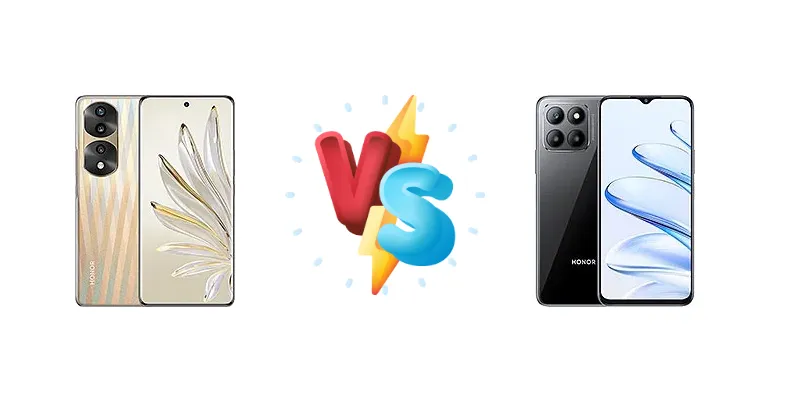
Honor's 70 series presents a clear segmentation: the Pro model aims for enthusiast-level performance, while the Lite version prioritizes affordability and essential features. This comparison dissects the core differences between the Honor 70 Pro, powered by the Mediatek Dimensity 8000, and the Honor 70 Lite, utilizing the Qualcomm Snapdragon 480+ 5G, to determine which device delivers the best experience for your needs.
🏆 Quick Verdict
For users prioritizing performance and fast charging, the Honor 70 Pro is the clear winner. Its Dimensity 8000 chipset offers significantly more processing power, and the 100W charging is a game-changer. However, the Honor 70 Lite provides a compelling value proposition for budget-conscious users who need 5G connectivity and a reliable daily driver.
| Network |
|---|
| 2G bands | GSM 850 / 900 / 1800 / 1900 | GSM 850 / 900 / 1800 / 1900 |
| 3G bands | HSDPA 800 / 850 / 900 / 1700(AWS) / 1900 / 2100 | HSDPA 850 / 900 / 1900 / 2100 |
| 4G bands | 1, 2, 3, 4, 5, 8, 19, 28, 34, 38, 39, 40, 41 | LTE |
| 5G bands | 1, 5, 8, 28, 41, 77, 78 SA/NSA | SA/NSA |
| Speed | HSPA, LTE, 5G | HSPA, LTE, 5G |
| Technology | GSM / CDMA / HSPA / CDMA2000 / LTE / 5G | GSM / HSPA / LTE / 5G |
| | CDMA2000 1x | - |
| Launch |
|---|
| Announced | 2022, May 30 | 2023, March 20 |
| Status | Available. Released 2022, June 13 | Available. Released 2023, March 31 |
| Body |
|---|
| Dimensions | 163.9 x 74.6 x 8.2 mm (6.45 x 2.94 x 0.32 in) | 163.7 x 75.1 x 8.7 mm (6.44 x 2.96 x 0.34 in) |
| SIM | Nano-SIM + Nano-SIM | Nano-SIM + Nano-SIM |
| Weight | 192 g (6.77 oz) | 194 g (6.84 oz) |
| Display |
|---|
| Resolution | 1200 x 2652 pixels (~429 ppi density) | 720 x 1600 pixels, 20:9 ratio (~270 ppi density) |
| Size | 6.78 inches, 111.4 cm2 (~91.1% screen-to-body ratio) | 6.5 inches, 102.0 cm2 (~83.0% screen-to-body ratio) |
| Type | OLED, 1B colors, 120Hz | TFT LCD, 90Hz |
| Platform |
|---|
| CPU | Octa-core (4x2.75 GHz Cortex-A78 & 4x2.0 GHz Cortex-A55) | Octa-core (2x2.2 GHz Kryo 460 & 6x1.9 GHz Kryo 460) |
| Chipset | Mediatek Dimensity 8000 (5 nm) | Qualcomm SM4350-AC Snapdragon 480+ 5G (8 nm) |
| GPU | Mali-G610 | Adreno 619 |
| OS | Android 12, Magic UI 6.1 | Android 12, upgradable to Android 14, Magic UI 8 |
| Memory |
|---|
| Card slot | No | Unspecified |
| Internal | 256GB 8GB RAM, 256GB 12GB RAM, 512GB 12GB RAM | 128GB 4GB RAM |
| Main Camera |
|---|
| Features | Dual-LED flash, HDR, panorama | LED flash, HDR, panorama |
| Single | 50 MP, f/2.4, 100˚ (ultrawide) | 8 MP, f/2.0, (wide) |
| Triple | 54 MP, f/1.9, (wide), 1/1.49", PDAF
8 MP, f/2.4, (telephoto), PDAF, OIS, 3x optical zoom
50 MP, f/2.2, 122˚ (ultrawide), AF | 50 MP, f/1.8, (wide), PDAF
2 MP (macro)
Auxiliary lens |
| Video | 4K@30fps, 1080p@30/60fps, gyro-EIS | 1080p@30fps |
| Selfie camera |
|---|
| Features | HDR | - |
| Single | 50 MP, f/2.4, 100˚ (ultrawide) | 8 MP, f/2.0, (wide) |
| Video | 4K@30fps, 1080p@30fps, gyro-EIS | 1080p@30fps |
| Sound |
|---|
| 3.5mm jack | No | Yes |
| 35mm jack | No | Yes |
| Loudspeaker | Yes, with stereo speakers | Yes |
| Comms |
|---|
| Bluetooth | 5.2, A2DP, LE, aptX HD | 5.1, A2DP, LE |
| NFC | Yes | Yes |
| Positioning | GPS, GLONASS, BDS | GPS, GLONASS, GALILEO, BDS |
| Radio | No | Unspecified |
| USB | USB Type-C 2.0, OTG | USB Type-C 2.0, OTG |
| WLAN | Wi-Fi 802.11 a/b/g/n/ac/6, dual-band, Wi-Fi Direct | Wi-Fi 802.11 a/b/g/n/ac, dual-band, Wi-Fi Direct |
| Features |
|---|
| Sensors | Fingerprint (under display, optical), accelerometer, gyro, proximity, compass | Fingerprint (side-mounted), accelerometer, proximity |
| | - | 24-bit/192kHz audio |
| Battery |
|---|
| Charging | 100W wired, 60% in 15 min
5W reverse wired | 22.5W wired |
| Type | Li-Po 4500 mAh | Li-Po 5000 mAh |
| Misc |
|---|
| Colors | Black, Green, Gold, Silver | Ocean Blue, Titanium Silver, Midnight Black |
| Models | SDY-AN00 | RBN-NX1 |
| Price | About 520 EUR | About 120 EUR |
Honor 70 Pro
- Significantly faster processor for gaming and multitasking
- Ultra-fast 100W charging
- Potentially superior camera performance due to ISP capabilities
- Likely higher price point
- Potentially shorter battery life if battery capacity is smaller
Honor 70 Lite
- More affordable price
- 5G connectivity
- Potentially longer battery life due to efficient chipset
- Slower processor for demanding tasks
- Significantly slower charging speed
- Limited gaming performance
Display Comparison
While both phones likely feature LCD panels (data not provided), the core difference lies in the processing power driving them. The Honor 70 Pro’s Dimensity 8000 will handle graphically demanding tasks with ease, resulting in smoother animations and a more responsive user experience. The Snapdragon 480+ in the 70 Lite, while capable, will show its limitations with more complex visuals. We anticipate the Pro model will have a higher peak brightness and potentially better color accuracy, though this is unconfirmed.
Camera Comparison
Without detailed camera specifications, it’s difficult to make a definitive judgment. However, the chipset difference suggests the Honor 70 Pro will have a more powerful image signal processor (ISP), enabling faster image processing and potentially better low-light performance. The Pro model is likely to support more advanced camera features, such as higher resolution video recording and more sophisticated computational photography algorithms. The 70 Lite will likely focus on providing adequate image quality for social media and casual photography.
Performance
The Mediatek Dimensity 8000 (5nm) in the Honor 70 Pro represents a substantial leap in performance over the Qualcomm Snapdragon 480+ (8nm) found in the 70 Lite. The Dimensity 8000’s octa-core configuration, with four Cortex-A78 cores clocked at 2.75 GHz, delivers significantly faster CPU performance. The 8nm process node of the Snapdragon 480+ is less efficient, meaning the 70 Lite will likely experience more thermal throttling under sustained load. This translates to a noticeable difference in gaming performance and app loading times, favoring the 70 Pro.
Battery Life
The Honor 70 Pro’s 100W wired charging is a standout feature, capable of charging the battery to 60% in just 15 minutes. This is a massive advantage over the 70 Lite’s 22.5W charging. While battery capacity isn’t specified, the faster charging of the Pro model mitigates any potential disadvantage from a smaller battery size. The 70 Lite will offer more gradual charging, requiring significantly longer to reach a full charge.
Buying Guide
Buy the Honor 70 Pro if you demand smooth multitasking, enjoy graphically intensive games, and value incredibly fast charging. This phone is for power users and content creators. Buy the Honor 70 Lite if you prioritize affordability, 5G connectivity for basic tasks, and a long-lasting battery for everyday use. It’s ideal for students, casual users, and those on a tight budget.
Frequently Asked Questions
❓ Will the Snapdragon 480+ in the Honor 70 Lite struggle with demanding games like PUBG Mobile?
Yes, the Snapdragon 480+ is an entry-level 5G chipset. While it can run PUBG Mobile, you'll likely need to lower the graphics settings to achieve a playable frame rate. Expect occasional stuttering and longer loading times compared to the Honor 70 Pro.
❓ How much faster is the 100W charging on the Honor 70 Pro compared to the 22.5W charging on the 70 Lite in real-world use?
The 100W charging on the 70 Pro is a game-changer. You can expect to go from 0% to 60% in around 15 minutes, while the 70 Lite will take well over an hour to reach a full charge. This makes a significant difference for users who frequently need to top up their battery quickly.
❓ Is the difference in chipset performance between the Dimensity 8000 and Snapdragon 480+ noticeable for everyday tasks like browsing and social media?
For basic tasks like browsing and social media, the difference won't be dramatically noticeable. However, the Dimensity 8000 will provide a smoother and more responsive experience when multitasking or switching between apps. The 70 Lite may exhibit slight lag when handling multiple apps simultaneously.