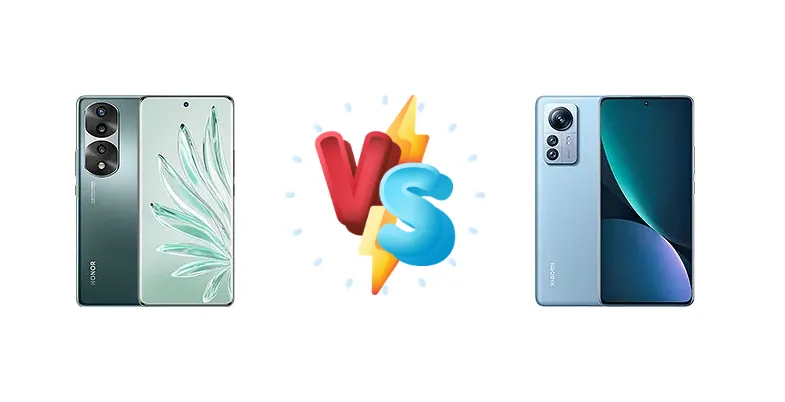
Both the Honor 70 Pro+ and the Xiaomi 12 Pro (Dimensity variant) represent compelling options in the upper-midrange to flagship smartphone space. While both leverage Mediatek’s Dimensity 9000 series, they diverge significantly in charging speed and overall feature set, making a direct comparison crucial for discerning buyers. This analysis will dissect their key differences to determine which device delivers the best value.
🏆 Quick Verdict
For users prioritizing blazing-fast charging and a potentially more refined software experience, the Honor 70 Pro+ emerges as the winner. Its 100W charging significantly outperforms the Xiaomi 12 Pro’s 67W, and while the chipset difference is marginal, the Honor’s software optimizations may provide a smoother daily experience.
| Network |
|---|
| 2G bands | GSM 850 / 900 / 1800 / 1900 - SIM 1 & SIM 2 | GSM 850 / 900 / 1800 / 1900 |
| 3G bands | HSDPA 800 / 850 / 900 / 1700(AWS) / 1900 / 2100 | HSDPA 800 / 850 / 900 / 1700(AWS) / 1900 / 2100 |
| 4G bands | 1, 2, 3, 4, 5, 8, 19, 28, 34, 38, 39, 40, 41 | 1, 2, 3, 4, 5, 7, 8, 18, 19, 26, 34, 38, 39, 40, 41, 42 |
| 5G bands | 1, 5, 8, 28, 41, 77, 78 SA/NSA | 1, 3, 5, 8, 28, 38, 40, 41, 77, 78 SA/NSA |
| Speed | HSPA, LTE-A, 5G | HSPA, LTE, 5G |
| Technology | GSM / CDMA / HSPA / CDMA2000 / LTE / 5G | GSM / CDMA / HSPA / EVDO / LTE / 5G |
| | CDMA2000 1x | CDMA2000 1xEV-DO |
| Launch |
|---|
| Announced | 2022, May 30 | 2022, July 04 |
| Status | Available. Released 2022, June 17 | Available. Released 2022, July 13 |
| Body |
|---|
| Dimensions | 163.9 x 74.6 x 8.2 mm (6.45 x 2.94 x 0.32 in) | 163.6 x 74.6 x 8.2 mm (6.44 x 2.94 x 0.32 in) |
| SIM | Dual SIM (Nano-SIM, dual stand-by) | Nano-SIM + Nano-SIM |
| Weight | 192 g (6.77 oz) | 201 g (7.09 oz) |
| Display |
|---|
| Protection | - | Corning Gorilla Glass Victus |
| Resolution | 1200 x 2652 pixels (~429 ppi density) | 1440 x 3200 pixels, 20:9 ratio (~521 ppi density) |
| Size | 6.78 inches, 111.4 cm2 (~91.1% screen-to-body ratio) | 6.73 inches, 109.4 cm2 (~89.6% screen-to-body ratio) |
| Type | OLED, 1B colors, 120Hz | LTPO2 AMOLED, 1B colors, 120Hz, Dolby Vision, HDR10+, 1000 nits (HBM), 1500 nits (peak) |
| Platform |
|---|
| CPU | Octa-core (1x3.05 GHz Cortex-X2 & 3x2.85 GHz Cortex-A710 & 4x1.80 GHz Cortex-A510) | Octa-core (1x3.20 GHz Cortex-X2 & 3x2.85 GHz Cortex-A710 & 4x1.80 GHz Cortex-A510) |
| Chipset | Mediatek MT6983 Dimensity 9000 (4 nm) | Mediatek Dimensity 9000+ (4 nm) |
| GPU | Mali-G710 MC10 | Mali-G710 MC10 |
| OS | Android 12, Magic UI 6.1 | Android 12, MIUI 13 |
| Memory |
|---|
| Card slot | No | No |
| Internal | 256GB 8GB RAM, 256GB 12GB RAM | 128GB 8GB RAM, 256GB 12GB RAM |
| | - | UFS 3.1 |
| Main Camera |
|---|
| Features | Dual-LED flash, HDR, panorama | Color spectrum sensor, Dual-LED dual-tone flash, HDR, panorama |
| Single | 50 MP, f/2.4, 100˚ (ultrawide) | 32 MP, f/2.5, 26mm (wide), 0.7µm |
| Triple | 54 MP, f/1.9, (wide), 1/1.49", PDAF
8 MP. f/2.4, (telephoto), PDAF, OIS, 3x optical zoom
50 MP, f/2.2, 122˚ (ultrawide), AF | 50 MP, f/1.9, 24mm (wide), 1/1.28", 1.22µm, dual pixel PDAF, OIS
13 MP, f/2.4, 15mm, 123˚ (ultrawide), 1/3.06", 1.12µm
5 MP, f/2.4, 50mm (telephoto macro), AF |
| Video | 4K@30fps, 1080p@30/60fps, gyro-EIS | 4K@30/60fps, 1080p@30/60/120fps, gyro-EIS |
| Selfie camera |
|---|
| Features | HDR | HDR, panorama |
| Single | 50 MP, f/2.4, 100˚ (ultrawide) | 32 MP, f/2.5, 26mm (wide), 0.7µm |
| Video | 4K@30fps, 1080p@30fps, gyro-EIS | 1080p@30/60fps, 720p@120fps |
| Sound |
|---|
| 3.5mm jack | No | No |
| 35mm jack | - | No |
| Loudspeaker | Yes, with stereo speakers | Yes, with stereo speakers |
| | - | 24-bit/192kHz audio
Tuned by Harman Kardon |
| Comms |
|---|
| Bluetooth | 5.2, A2DP, LE, aptX HD | 5.3, A2DP, LE |
| Infrared port | - | Yes |
| NFC | Yes | Yes |
| Positioning | GPS, GLONASS, BDS | GPS (L1+L5), GLONASS (L1), BDS (B1I+B1c+B2a), GALILEO (E1+E5a), QZSS (L1+L5), NavIC (L5) |
| Radio | No | No |
| USB | USB Type-C 2.0, OTG | USB Type-C 2.0, OTG |
| WLAN | Wi-Fi 802.11 a/b/g/n/ac/6, dual-band, Wi-Fi Direct | Wi-Fi 802.11 a/b/g/n/ac/6, dual-band, Wi-Fi Direct |
| Features |
|---|
| Sensors | Fingerprint (under display, optical), accelerometer, gyro, proximity, compass | Fingerprint (under display, optical), accelerometer, gyro, proximity, compass |
| Battery |
|---|
| Charging | 100W wired, 60% in 15 min (advertised)
5W reverse wired | 67W wired, PD3.0, QC4 |
| Type | Li-Po 4500 mAh, non-removable | Li-Po 5160 mAh |
| Misc |
|---|
| Colors | Black, Green, Gold | Gray, Blue |
| Models | HPB-AN00 | 2207122MC |
| Price | About 600 EUR | About 570 EUR |
Honor 70 Pro+
- Significantly faster 100W charging
- Potentially optimized software experience
- Likely strong camera focus
- Slightly lower CPU clock speed
- Less established brand recognition
Xiaomi 12 Pro (Dimensity)
- Higher CPU clock speed (Dimensity 9000+)
- Established brand with wider ecosystem
- PD3.0 and QC4 charging compatibility
- Slower 67W charging
- Potentially less aggressive camera innovation
Display Comparison
Neither device’s display specifications were provided, so a direct comparison is limited. However, given their positioning, both likely feature high-refresh-rate AMOLED panels. The Xiaomi 12 Pro, historically, has prioritized display quality, often incorporating LTPO technology for adaptive refresh rates and improved efficiency. Honor, while improving, typically focuses more on camera and charging innovations. Expect both to deliver vibrant colors and sharp visuals, but the Xiaomi may have an edge in smoothness and power efficiency due to potential LTPO implementation.
Camera Comparison
Without specific camera specs beyond the presence of the chipsets, a detailed comparison is challenging. However, Honor has been aggressively pushing camera technology, particularly in its Pro+ models. It’s reasonable to assume the 70 Pro+ prioritizes camera capabilities, potentially featuring a larger main sensor or more advanced image processing algorithms. Xiaomi’s 12 Pro, while capable, typically focuses on a balanced camera system. The image processing style will likely differ – Honor often leans towards vibrant, social media-ready images, while Xiaomi aims for more natural color reproduction. The absence of details on OIS and lens apertures prevents a more granular assessment.
Performance
The core of the performance difference lies in the chipsets: the Honor 70 Pro+ utilizes the Mediatek MT6983 Dimensity 9000, while the Xiaomi 12 Pro features the Dimensity 9000+. The ‘+’ variant boasts a slightly higher CPU clock speed (3.20 GHz vs 3.05 GHz on the X2 core), potentially offering a marginal performance boost in CPU-intensive tasks. Both chips share the same core configuration (1x Cortex-X2, 3x Cortex-A710, 4x Cortex-A510) and are built on a 4nm process. However, the Dimensity 9000+’s improved efficiency could translate to slightly better sustained performance under heavy load. Both devices likely utilize LPDDR5X RAM, ensuring ample memory bandwidth for multitasking and gaming.
Battery Life
The Honor 70 Pro+’s 100W wired charging is its standout feature, advertised to reach 60% charge in just 15 minutes. This is a significant advantage over the Xiaomi 12 Pro’s 67W charging, which, while still fast, will take considerably longer for a full charge. While battery capacity wasn’t specified, the faster charging of the Honor 70 Pro+ mitigates the impact of a potentially smaller battery. The Xiaomi 12 Pro supports PD3.0 and QC4, offering broader compatibility with chargers, while the Honor 70 Pro+ includes 5W reverse wired charging, a useful feature for topping up accessories.
Buying Guide
Buy the Honor 70 Pro+ if you need the absolute fastest charging speeds available, frequently top up your phone throughout the day, and appreciate a potentially more polished user interface. Buy the Xiaomi 12 Pro (Dimensity) if you prefer a more established brand with a wider ecosystem, and value the slightly higher CPU clock speed for demanding tasks, while still benefiting from fast charging and flagship-level performance.
Frequently Asked Questions
❓ Does the Dimensity 9000+ in the Xiaomi 12 Pro offer a noticeable gaming advantage over the Dimensity 9000 in the Honor 70 Pro+?
While the Dimensity 9000+ has a slightly higher clock speed, the real-world gaming difference will likely be minimal. Both chips are incredibly powerful and capable of handling demanding games at high settings. Thermal management and software optimization will play a larger role in sustained gaming performance than the small CPU clock speed difference.
❓ How much faster is the 100W charging on the Honor 70 Pro+ compared to the 67W charging on the Xiaomi 12 Pro in a typical use case?
The Honor 70 Pro+ can realistically charge from 0-100% in around 30-40 minutes, while the Xiaomi 12 Pro will likely take closer to 45-60 minutes. The biggest difference is in the initial charging phase – the Honor 70 Pro+ will gain a significant percentage of battery life in just 15 minutes, making it ideal for quick top-ups.
❓ Is the reverse wired charging feature on the Honor 70 Pro+ useful for charging accessories like earbuds or smartwatches?
Yes, the 5W reverse wired charging is a convenient feature for topping up smaller accessories. While not as fast as dedicated chargers, it's a handy solution when you're on the go and don't have access to a power outlet.