
Honor 70 Pro+ vs vivo X80 Pro: A Deep Dive into Flagship Performance and Features
| Phones Images | |||||
|---|---|---|---|---|---|
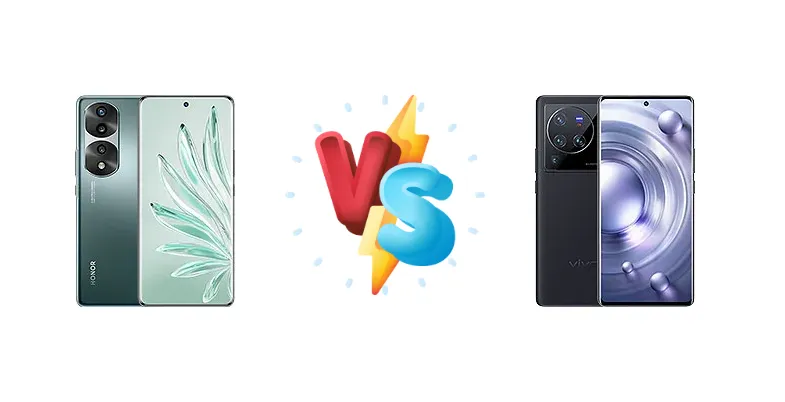
|
🏆 Quick Verdict
For most users, the Honor 70 Pro+ emerges as the slightly better choice. Its Dimensity 9000 chipset offers comparable performance to the Snapdragon 8 Gen 1, often with better thermal management, coupled with incredibly fast 100W charging. While the vivo X80 Pro boasts wireless charging, the Honor’s overall package provides a more compelling value.
| PHONES | ||
|---|---|---|
| Phone Names | Honor 70 Pro+ | vivo X80 Pro |
| Network | ||
|---|---|---|
| 2G bands | GSM 850 / 900 / 1800 / 1900 - SIM 1 & SIM 2 | GSM 850 / 900 / 1800 / 1900 |
| 3G bands | HSDPA 800 / 850 / 900 / 1700(AWS) / 1900 / 2100 | HSDPA 800 / 850 / 900 / 1700(AWS) / 1900 / 2100 |
| 4G bands | 1, 2, 3, 4, 5, 8, 19, 28, 34, 38, 39, 40, 41 | 1, 2, 3, 4, 5, 7, 8, 12, 13, 17, 18, 19, 20, 26, 28, 32, 38, 39, 40, 41, 42, 66 - International |
| 5G bands | 1, 5, 8, 28, 41, 77, 78 SA/NSA | 1, 2, 3, 5, 7, 8, 20, 28, 38, 40, 41, 66, 77, 78 SA/NSA - International |
| Speed | HSPA, LTE-A, 5G | HSPA, LTE, 5G |
| Technology | GSM / CDMA / HSPA / CDMA2000 / LTE / 5G | GSM / CDMA / HSPA / EVDO / LTE / 5G |
| CDMA2000 1x | 1, 3, 5, 7, 8, 12, 20, 28, 66, 38, 40, 41, 77, 78, 79 SA/NSA - China | |
| Launch | ||
|---|---|---|
| Announced | 2022, May 30 | 2022, April 25 |
| Status | Available. Released 2022, June 17 | Available. Released 2022, April 29 |
| Body | ||
|---|---|---|
| Build | - | Glass front (Schott Xensation Up), glass back or ceramic back or eco leather back, aluminum frame |
| Dimensions | 163.9 x 74.6 x 8.2 mm (6.45 x 2.94 x 0.32 in) | 164.6 x 75.3 x 9.1 mm (6.48 x 2.96 x 0.36 in) |
| SIM | Dual SIM (Nano-SIM, dual stand-by) | Nano-SIM + Nano-SIM |
| Weight | 192 g (6.77 oz) | 215 g / 219 g (7.58 oz) |
| - | IP68 dust/water resistant (up to 1.5m for 30 min) | |
| Display | ||
|---|---|---|
| Protection | - | Schott Xensation Up |
| Resolution | 1200 x 2652 pixels (~429 ppi density) | 1440 x 3200 pixels, 20:9 ratio (~517 ppi density) |
| Size | 6.78 inches, 111.4 cm2 (~91.1% screen-to-body ratio) | 6.78 inches, 111.4 cm2 (~89.9% screen-to-body ratio) |
| Type | OLED, 1B colors, 120Hz | LTPO3 AMOLED, 1B colors, 120Hz, HDR10+, 1500 nits (peak) |
| Platform | ||
|---|---|---|
| CPU | Octa-core (1x3.05 GHz Cortex-X2 & 3x2.85 GHz Cortex-A710 & 4x1.80 GHz Cortex-A510) | Octa-core (1x3.00 GHz Cortex-X2 & 3x2.50 GHz Cortex-A710 & 4x1.80 GHz Cortex-A510)Octa-core (1x3.05 GHz Cortex-X2 & 3x2.85 GHz Cortex-A710 & 4x1.80 GHz Cortex-A510) |
| Chipset | Mediatek MT6983 Dimensity 9000 (4 nm) | Qualcomm SM8450 Snapdragon 8 Gen 1 (4 nm)Mediatek Dimensity 9000 (4 nm) |
| GPU | Mali-G710 MC10 | Adreno 730Mali-G710 MC10 |
| OS | Android 12, Magic UI 6.1 | Android 12, upgradable to Android 14, Funtouch 14 (Global), OriginOS Ocean (China) |
| Memory | ||
|---|---|---|
| Card slot | No | No |
| Internal | 256GB 8GB RAM, 256GB 12GB RAM | 256GB 8GB RAM, 256GB 12GB RAM, 512GB 12GB RAM |
| - | UFS 3.1 | |
| Main Camera | ||
|---|---|---|
| Features | Dual-LED flash, HDR, panorama | Laser AF, color spectrum sensor, Zeiss optics, Zeiss T* lens coating, Pixel Shift, dual-LED dual-tone flash, HDR, panorama |
| Quad | - | 50 MP, f/1.6, (wide), 1/1.3", PDAF, OIS 8 MP, f/3.4, (periscope telephoto), 1/4.4", 1.0µm, PDAF, OIS, 5x optical zoom 12 MP, f/1.9, 50mm (telephoto), 1/2.93", 1.22µm, dual pixel PDAF, 2x optical zoom, gimbal OIS 48 MP, f/2.2, 114˚ (ultrawide), 1/2.0", AF |
| Single | 50 MP, f/2.4, 100˚ (ultrawide) | 32 MP, f/2.5, 24mm (wide), 1/2.8", 0.8µm |
| Triple | 54 MP, f/1.9, (wide), 1/1.49", PDAF 8 MP. f/2.4, (telephoto), PDAF, OIS, 3x optical zoom 50 MP, f/2.2, 122˚ (ultrawide), AF | - |
| Video | 4K@30fps, 1080p@30/60fps, gyro-EIS | 8K@30fps, 4K@30/60fps, 1080p@30/60fps, gyro-EIS |
| Selfie camera | ||
|---|---|---|
| Features | HDR | HDR |
| Single | 50 MP, f/2.4, 100˚ (ultrawide) | 32 MP, f/2.5, 24mm (wide), 1/2.8", 0.8µm |
| Video | 4K@30fps, 1080p@30fps, gyro-EIS | 1080p@30fps |
| Sound | ||
|---|---|---|
| 3.5mm jack | No | No |
| 35mm jack | - | No |
| Loudspeaker | Yes, with stereo speakers | Yes, with stereo speakers |
| - | 32-bit/192kHz audio | |
| Comms | ||
|---|---|---|
| Bluetooth | 5.2, A2DP, LE, aptX HD | 5.2 (Snapdragon)/ 5.3 (Dimensity), A2DP, LE, aptX HD, aptX Adaptive, aptX Lossless |
| Infrared port | - | Yes |
| NFC | Yes | Yes |
| Positioning | GPS, GLONASS, BDS | GPS (L1+L5), GLONASS, BDS, GALILEO, QZSS, NavIC |
| Radio | No | No |
| USB | USB Type-C 2.0, OTG | USB Type-C 3.1 (Global)/ 3.2 (China), OTG |
| WLAN | Wi-Fi 802.11 a/b/g/n/ac/6, dual-band, Wi-Fi Direct | Wi-Fi 802.11 a/b/g/n/ac/6, dual-band, Wi-Fi Direct |
| Features | ||
|---|---|---|
| Sensors | Fingerprint (under display, optical), accelerometer, gyro, proximity, compass | Fingerprint (under display, ultrasonic), accelerometer, gyro, proximity, compass |
| Battery | ||
|---|---|---|
| Charging | 100W wired, 60% in 15 min (advertised) 5W reverse wired | 80W wired, 100% in 38 min 50W wireless, 100% in 50 min Reverse wired |
| Type | Li-Po 4500 mAh, non-removable | 4700 mAh |
| Misc | ||
|---|---|---|
| Colors | Black, Green, Gold | Cosmic Black, Blue, Orange |
| Models | HPB-AN00 | V2185A, V2145 |
| Price | About 600 EUR | About 850 EUR |
| Tests | ||
|---|---|---|
| Battery life | - | Endurance rating 79h |
| Camera | - | Photo / Video |
| Display | - | Contrast ratio: Infinite (nominal) |
| Loudspeaker | - | -25.1 LUFS (Very good) |
Honor 70 Pro+
- Significantly faster 100W wired charging
- Potentially better thermal management with Dimensity 9000
- Competitive performance for the price
- Lacks wireless charging
- Camera specs are currently unknown
vivo X80 Pro
- 50W wireless charging support
- High peak display brightness (1014 nits)
- Potentially refined software experience
- Snapdragon 8 Gen 1 prone to thermal throttling
- Slower wired charging compared to Honor
Display Comparison
Both phones lack detailed display specifications in the provided data, but the vivo X80 Pro is noted for a peak brightness of 1014 nits, a strong figure indicating excellent outdoor visibility. Without comparable data for the Honor 70 Pro+, it’s difficult to definitively state a display advantage. However, both are likely to employ high-refresh-rate OLED panels common in this price bracket. The 'Infinite' contrast ratio of the vivo suggests a typical OLED implementation, and the absence of LTPO information suggests neither phone dynamically adjusts refresh rates for power saving.
Camera Comparison
Both devices are listed as having 'Photo / Video' capabilities, lacking specific details. Without sensor size, aperture, or OIS information, a direct comparison is impossible. However, the market positioning of both phones suggests a focus on versatile camera systems. The absence of mention of a telephoto lens on either device is notable, implying a reliance on digital zoom. Ignoring the likely inclusion of low-resolution macro lenses, the primary camera performance will hinge on sensor size and image processing algorithms, areas where detailed specs are needed for a proper assessment.
Performance
The core difference lies in the chipsets. Both the Mediatek Dimensity 9000 (Honor 70 Pro+) and Qualcomm Snapdragon 8 Gen 1 (vivo X80 Pro) are built on a 4nm process, but architectural nuances matter. The Dimensity 9000 features a 1x3.05 GHz Cortex-X2 prime core, slightly faster than the Snapdragon’s 1x3.00 GHz Cortex-X2. Both have the same Cortex-A710 and A510 configuration. However, the Snapdragon 8 Gen 1 is known to be more prone to thermal throttling under sustained load, potentially giving the Dimensity 9000 an edge in prolonged gaming sessions. The provided data doesn't specify RAM speeds, but both are expected to utilize LPDDR5x for fast memory access.
Battery Life
Both phones achieve an endurance rating of 79 hours, suggesting similar real-world battery life despite unspecified battery capacities. However, the charging speeds are significantly different. The Honor 70 Pro+ boasts 100W wired charging, claiming 60% charge in 15 minutes, while the vivo X80 Pro offers 80W wired (100% in 38 minutes) and 50W wireless (100% in 50 minutes). This makes the Honor significantly faster for wired charging, a crucial advantage for users who frequently need to top up quickly. The vivo X80 Pro’s wireless charging is a unique benefit, catering to those who prefer cable-free power.
Buying Guide
Buy the Honor 70 Pro+ if you prioritize sustained performance during demanding tasks like gaming and video editing, and value exceptionally fast wired charging. Buy the vivo X80 Pro if wireless charging is a must-have feature, and you appreciate a potentially more refined software experience (based on vivo’s historical software polish).