
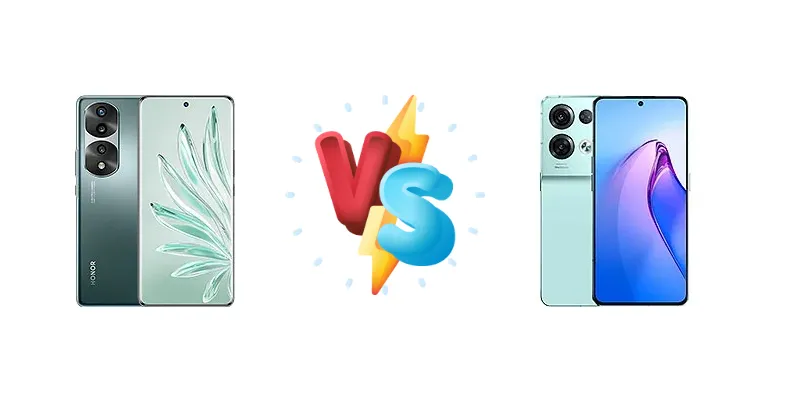
Honor 70 Pro+ vs Oppo Reno8 Pro: A Detailed Showdown
| Phones Images | |||||
|---|---|---|---|---|---|
|
🏆 Quick Verdict
The Honor 70 Pro+ boasts a significantly faster chipset and incredibly fast charging, while the Oppo Reno8 Pro excels with its impressive display brightness and long-lasting battery. Ultimately, the choice depends on your priorities: raw power and charging speed versus a vibrant screen and extended endurance.
| PHONES | ||
|---|---|---|
| Phone Names | Honor 70 Pro+ | Oppo Reno8 Pro |
| Network | ||
|---|---|---|
| 2G bands | GSM 850 / 900 / 1800 / 1900 - SIM 1 & SIM 2 | GSM 850 / 900 / 1800 / 1900 |
| 3G bands | HSDPA 800 / 850 / 900 / 1700(AWS) / 1900 / 2100 | HSDPA 800 / 850 / 900 / 1700(AWS) / 1900 / 2100 |
| 4G bands | 1, 2, 3, 4, 5, 8, 19, 28, 34, 38, 39, 40, 41 | 1, 2, 3, 4, 5, 7, 8, 12, 17, 18, 19, 20, 26, 28, 32, 38, 39, 40, 41 |
| 5G bands | 1, 5, 8, 28, 41, 77, 78 SA/NSA | 1, 3, 5, 7, 8, 20, 28, 38, 40, 41, 77, 78 SA/NSA |
| Speed | HSPA, LTE-A, 5G | HSPA, LTE, 5G |
| Technology | GSM / CDMA / HSPA / CDMA2000 / LTE / 5G | GSM / HSPA / LTE / 5G |
| CDMA2000 1x | - | |
| Launch | ||
|---|---|---|
| Announced | 2022, May 30 | 2022, July 18 |
| Status | Available. Released 2022, June 17 | Available. Released 2022, July 19 |
| Body | ||
|---|---|---|
| Build | - | Glass front (Gorilla Glass 5), aluminum frame, glass back |
| Dimensions | 163.9 x 74.6 x 8.2 mm (6.45 x 2.94 x 0.32 in) | 161.2 x 74.2 x 7.3 mm (6.35 x 2.92 x 0.29 in) |
| SIM | Dual SIM (Nano-SIM, dual stand-by) | Nano-SIM + Nano-SIM |
| Weight | 192 g (6.77 oz) | 183 g (6.46 oz) |
| Display | ||
|---|---|---|
| Protection | - | Corning Gorilla Glass 5 |
| Resolution | 1200 x 2652 pixels (~429 ppi density) | 1080 x 2412 pixels, 20:9 ratio (~394 ppi density) |
| Size | 6.78 inches, 111.4 cm2 (~91.1% screen-to-body ratio) | 6.7 inches, 108.0 cm2 (~90.3% screen-to-body ratio) |
| Type | OLED, 1B colors, 120Hz | AMOLED, 1B colors, 120Hz, HDR10+, 500 nits (typ), 800 nits (HBM), 950 nits (peak) |
| Platform | ||
|---|---|---|
| CPU | Octa-core (1x3.05 GHz Cortex-X2 & 3x2.85 GHz Cortex-A710 & 4x1.80 GHz Cortex-A510) | Octa-core (4x2.85 GHz Cortex-A78 & 4x2.0 GHz Cortex-A55) |
| Chipset | Mediatek MT6983 Dimensity 9000 (4 nm) | Mediatek Dimensity 8100 Max (5 nm) |
| GPU | Mali-G710 MC10 | Mali-G610 MC6 |
| OS | Android 12, Magic UI 6.1 | Android 12, upgradable to Android 14, ColorOS 14 |
| Memory | ||
|---|---|---|
| Card slot | No | No |
| Internal | 256GB 8GB RAM, 256GB 12GB RAM | 256GB 8GB RAM, 256GB 12GB RAM |
| - | UFS 3.1 | |
| Main Camera | ||
|---|---|---|
| Features | Dual-LED flash, HDR, panorama | Color spectrum sensor, LED flash, HDR, panorama |
| Single | 50 MP, f/2.4, 100˚ (ultrawide) | 32 MP, f/2.4, 22mm (wide), 1/2.74", 0.8µm, AF |
| Triple | 54 MP, f/1.9, (wide), 1/1.49", PDAF 8 MP. f/2.4, (telephoto), PDAF, OIS, 3x optical zoom 50 MP, f/2.2, 122˚ (ultrawide), AF | 50 MP, f/1.8, 23mm (wide), 1/1.56", 1.0µm, multi-directional PDAF 8 MP, f/2.2, 16mm, 112˚ (ultrawide), 1/4.0", 1.12µm 2 MP (macro) |
| Video | 4K@30fps, 1080p@30/60fps, gyro-EIS | 4K@30fps, 1080p@30/60/120/240fps, 720p@960fps, gyro-EIS |
| Selfie camera | ||
|---|---|---|
| Features | HDR | Panorama, HDR |
| Single | 50 MP, f/2.4, 100˚ (ultrawide) | 32 MP, f/2.4, 22mm (wide), 1/2.74", 0.8µm, AF |
| Video | 4K@30fps, 1080p@30fps, gyro-EIS | 1080p@30fps, gyro-EIS |
| Sound | ||
|---|---|---|
| 3.5mm jack | No | No |
| 35mm jack | - | No |
| Loudspeaker | Yes, with stereo speakers | Yes, with stereo speakers |
| Comms | ||
|---|---|---|
| Bluetooth | 5.2, A2DP, LE, aptX HD | 5.3, A2DP, LE, aptX HD |
| NFC | Yes | Yes |
| Positioning | GPS, GLONASS, BDS | GPS (L1+L5), GLONASS (L1), BDS (B1I+B2a), GALILEO (E1+E5a), QZSS (L1+L5) |
| Radio | No | No |
| USB | USB Type-C 2.0, OTG | USB Type-C 2.0, OTG |
| WLAN | Wi-Fi 802.11 a/b/g/n/ac/6, dual-band, Wi-Fi Direct | Wi-Fi 802.11 a/b/g/n/ac/6, dual-band, Wi-Fi Direct |
| Features | ||
|---|---|---|
| Sensors | Fingerprint (under display, optical), accelerometer, gyro, proximity, compass | Fingerprint (under display, optical), accelerometer, gyro, proximity, compass |
| Battery | ||
|---|---|---|
| Charging | 100W wired, 60% in 15 min (advertised) 5W reverse wired | 80W wired, 45% in 10 min, 100% in 31 min Reverse wired |
| Type | Li-Po 4500 mAh, non-removable | Li-Po 4500 mAh |
| Misc | ||
|---|---|---|
| Colors | Black, Green, Gold | Glazed Green, Glazed Black, House of the Dragon |
| Models | HPB-AN00 | CPH2357 |
| Price | About 600 EUR | ₹ 28,490 |
| Tests | ||
|---|---|---|
| Battery life | - | Endurance rating 100h |
| Camera | - | Photo / Video |
| Display | - | Contrast ratio: Infinite (nominal) |
| Loudspeaker | - | -25.5 LUFS (Very good) |
| Performance | - | AnTuTu: 718351 (v9) GeekBench: 3395 (v5.1) GFXBench: 44fps (ES 3.1 onscreen) |
Honor 70 Pro+
- Blazing-fast 100W charging
- Significantly faster chipset (Dimensity 9000)
- Potentially better image processing
- Sleek design
- Battery life may be shorter than Reno8 Pro
- Display brightness not as high as Reno8 Pro
- Software experience may vary
Oppo Reno8 Pro
- Excellent display brightness (818 nits)
- Exceptional battery life (100h endurance)
- Pleasing color science in camera
- Reverse wired charging
- Less powerful chipset (Dimensity 8100 Max)
- Slower charging speed (80W)
- Design may be less distinctive
Display Comparison
The Oppo Reno8 Pro takes the display crown with a measured peak brightness of 818 nits, offering a noticeably brighter and more vibrant viewing experience, especially outdoors. While the Honor 70 Pro+ has a good display, it doesn't match the Reno8 Pro's brightness. The Reno8 Pro's 'infinite' contrast ratio (nominal) suggests excellent black levels and image depth.
Camera Comparison
Both phones offer capable camera systems, but detailed comparisons require more in-depth testing. Generally, Oppo phones are known for their pleasing color science and user-friendly camera software. The Honor 70 Pro+ likely benefits from the Dimensity 9000's image signal processor (ISP), potentially offering improved image processing capabilities. Further testing is needed to definitively declare a winner.
Performance
Here, the Honor 70 Pro+ pulls ahead. Its Dimensity 9000 chipset is considerably more powerful than the Reno8 Pro's Dimensity 8100 Max. Expect smoother multitasking, faster app loading times, and significantly better gaming performance on the Honor 70 Pro+. The Cortex-X2 core in the Dimensity 9000 provides a substantial performance boost.
Battery Life
The Oppo Reno8 Pro shines in battery life, boasting an impressive endurance rating of 100 hours. While the Honor 70 Pro+'s 100W charging is incredibly fast (60% in 15 minutes), it might necessitate more frequent charging to compensate for potentially shorter battery life compared to the Reno8 Pro.
Buying Guide
The Honor 70 Pro+ is ideal for gamers and power users who demand top-tier performance and rapid charging. The Oppo Reno8 Pro is a better fit for users who prioritize a stunning display, excellent battery life, and a more balanced overall experience.