
Honor 70 Pro+ vs Oppo Find X5 Pro: Which Flagship Reigns Supreme?
| Phones Images | |||||
|---|---|---|---|---|---|
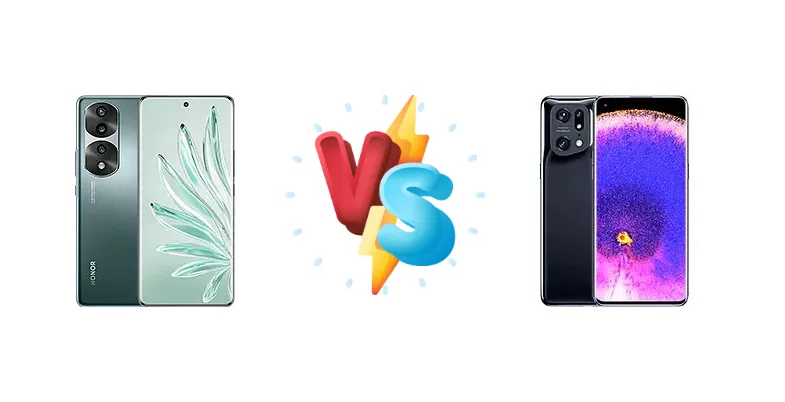
|
🏆 Quick Verdict
For most users, the Honor 70 Pro+ emerges as the stronger choice. Its 100W charging significantly outperforms the Oppo’s 80W wired and 50W wireless, and the Dimensity 9000 offers comparable performance to the Snapdragon 8 Gen 1, particularly in the Chinese variant of the Oppo. The Honor offers a faster charging experience at a potentially lower price point.
| PHONES | ||
|---|---|---|
| Phone Names | Honor 70 Pro+ | Oppo Find X5 Pro |
| Network | ||
|---|---|---|
| 2G bands | GSM 850 / 900 / 1800 / 1900 - SIM 1 & SIM 2 | GSM 850 / 900 / 1800 / 1900 |
| 3G bands | HSDPA 800 / 850 / 900 / 1700(AWS) / 1900 / 2100 | HSDPA 800 / 850 / 900 / 1700(AWS) / 1900 / 2100 |
| 4G bands | 1, 2, 3, 4, 5, 8, 19, 28, 34, 38, 39, 40, 41 | 1, 2, 3, 4, 5, 7, 8, 12, 13, 17, 18, 19, 20, 25, 26, 28, 32, 34, 38, 39, 40, 41, 42, 66 - Global |
| 5G bands | 1, 5, 8, 28, 41, 77, 78 SA/NSA | 1, 2, 3, 5, 7, 8, 12, 13, 18, 20, 25, 26, 28, 38, 40, 41, 66, 77, 78, 79 SA/NSA - Global |
| Speed | HSPA, LTE-A, 5G | HSPA, LTE, 5G |
| Technology | GSM / CDMA / HSPA / CDMA2000 / LTE / 5G | GSM / CDMA / HSPA / CDMA2000 / LTE / 5G |
| CDMA2000 1x | 1, 2, 3, 5, 8, 20, 28, 38, 41, 66, 77, 78, 79 SA/NSA - China | |
| Launch | ||
|---|---|---|
| Announced | 2022, May 30 | 2022, February 24 |
| Status | Available. Released 2022, June 17 | Available. Released 2022, March 14 |
| Body | ||
|---|---|---|
| Build | - | Glass front (Gorilla Glass Victus), ceramic back or eco leather back, aluminum frame |
| Dimensions | 163.9 x 74.6 x 8.2 mm (6.45 x 2.94 x 0.32 in) | 163.7 x 73.9 x 8.5 or 8.8 mm |
| SIM | Dual SIM (Nano-SIM, dual stand-by) | Nano-SIM + eSIM |
| Weight | 192 g (6.77 oz) | 218 g or 195 g (6.88 oz) |
| - | IP68 dust/water resistant (up to 1.5m for 30 min) | |
| Display | ||
|---|---|---|
| Protection | - | Corning Gorilla Glass Victus |
| Resolution | 1200 x 2652 pixels (~429 ppi density) | 1440 x 3216 pixels, 20:9 ratio (~525 ppi density) |
| Size | 6.78 inches, 111.4 cm2 (~91.1% screen-to-body ratio) | 6.7 inches, 108.4 cm2 (~89.6% screen-to-body ratio) |
| Type | OLED, 1B colors, 120Hz | LTPO2 AMOLED, 1B colors, 120Hz, HDR10+, BT.2020, 500 nits (typ), 800 nits (HBM), 1300 nits (peak) |
| Platform | ||
|---|---|---|
| CPU | Octa-core (1x3.05 GHz Cortex-X2 & 3x2.85 GHz Cortex-A710 & 4x1.80 GHz Cortex-A510) | Octa-core (1x3.00 GHz Cortex-X2 & 3x2.50 GHz Cortex-A710 & 4x1.80 GHz Cortex-A510) - GlobalOcta-core (1x3.05 GHz Cortex-X2 & 3x2.85 GHz Cortex-A710 & 4x1.80 GHz Cortex-A510) - China |
| Chipset | Mediatek MT6983 Dimensity 9000 (4 nm) | Qualcomm SM8450 Snapdragon 8 Gen 1 (4 nm) - GlobalMediatek Dimensity 9000 (4 nm) - China |
| GPU | Mali-G710 MC10 | Adreno 730 - GlobalMali-G710 MC10 - China |
| OS | Android 12, Magic UI 6.1 | Android 12, upgradable to Android 14, ColorOS 14 |
| Memory | ||
|---|---|---|
| Card slot | No | No |
| Internal | 256GB 8GB RAM, 256GB 12GB RAM | 256GB 8GB RAM, 256GB 12GB RAM, 512GB 12GB RAM |
| - | UFS 3.1 | |
| Main Camera | ||
|---|---|---|
| Features | Dual-LED flash, HDR, panorama | Hasselblad Color Calibration, color spectrum sensor, LED flash, HDR, panorama |
| Single | 50 MP, f/2.4, 100˚ (ultrawide) | 32 MP, f/2.4, 21mm (wide), 1/2.74", 0.8µm |
| Triple | 54 MP, f/1.9, (wide), 1/1.49", PDAF 8 MP. f/2.4, (telephoto), PDAF, OIS, 3x optical zoom 50 MP, f/2.2, 122˚ (ultrawide), AF | 50 MP, f/1.7, 25mm (wide), 1/1.56", 1.0µm, multi-directional PDAF, OIS (3-axis sensor-shift, 2-axis lens-shift) 13 MP, f/2.4, 52mm (telephoto), 1/3.4", 2x optical zoom, PDAF 50 MP, f/2.2, 15mm, 110˚ (ultrawide), 1/1.56", 1.0µm, multi-directional PDAF |
| Video | 4K@30fps, 1080p@30/60fps, gyro-EIS | 4K@30/60fps, 1080p@30/60/240fps; gyro-EIS; HDR, 10‑bit video |
| Selfie camera | ||
|---|---|---|
| Features | HDR | Panorama |
| Single | 50 MP, f/2.4, 100˚ (ultrawide) | 32 MP, f/2.4, 21mm (wide), 1/2.74", 0.8µm |
| Video | 4K@30fps, 1080p@30fps, gyro-EIS | 1080p@30fps, gyro-EIS |
| Sound | ||
|---|---|---|
| 3.5mm jack | No | No |
| 35mm jack | - | No |
| Loudspeaker | Yes, with stereo speakers | Yes, with stereo speakers |
| Comms | ||
|---|---|---|
| Bluetooth | 5.2, A2DP, LE, aptX HD | 5.2, A2DP, LE, aptX HD |
| NFC | Yes | Yes |
| Positioning | GPS, GLONASS, BDS | GPS (L1), GLONASS (L1), BDS (B1I+B1c), GALILEO (E1+E5a), QZSS (L1) |
| Radio | No | No |
| USB | USB Type-C 2.0, OTG | USB Type-C 3.1, OTG |
| WLAN | Wi-Fi 802.11 a/b/g/n/ac/6, dual-band, Wi-Fi Direct | Wi-Fi 802.11 a/b/g/n/ac/6e, dual-band, Wi-Fi Direct |
| Features | ||
|---|---|---|
| Sensors | Fingerprint (under display, optical), accelerometer, gyro, proximity, compass | Fingerprint (under display, optical), accelerometer, gyro, proximity, compass |
| - | Oppo Find X5 Pro Dimensity model has no MariSilicon X image chip, 5-axis OIS and Hasselblad’s color calibration | |
| Battery | ||
|---|---|---|
| Charging | 100W wired, 60% in 15 min (advertised) 5W reverse wired | 80W wired, PD, 50% in 12 min 50W wireless, 100% in 47 min 10W reverse wireless |
| Type | Li-Po 4500 mAh, non-removable | Li-Po 5000 mAh |
| Misc | ||
|---|---|---|
| Colors | Black, Green, Gold | Ceramic Black, Ceramic White, Blue (eco leather) |
| Models | HPB-AN00 | PFEM10, CPH2305, PFFM20 |
| Price | About 600 EUR | € 449.00 / $ 430.24 / £ 1,049.00 |
| Tests | ||
|---|---|---|
| Battery life | - | Endurance rating 101h |
| Camera | - | Photo / Video |
| Display | - | Contrast ratio: Infinite (nominal) |
| Loudspeaker | - | -24.7 LUFS (Very good) |
| Performance | - | AnTuTu: 1012896 (v9) GeekBench: 3433 (v5.1) GFXBench: 44fps (ES 3.1 onscreen) |
Honor 70 Pro+
- Significantly faster 100W wired charging
- Competitive Dimensity 9000 performance
- Potentially better thermal management than Snapdragon 8 Gen 1
- Likely more affordable price point
- Limited display specifications available
- Less established brand reputation than Oppo
Oppo Find X5 Pro
- Established brand and software support
- 762 nits peak brightness for better outdoor visibility
- 50W wireless charging convenience
- Potentially refined camera image processing
- Slower charging speeds compared to Honor 70 Pro+
- Snapdragon 8 Gen 1 prone to thermal throttling
- Higher price point likely
Display Comparison
Both phones lack detailed display specs beyond the Oppo’s measured 762 nits peak brightness. While the Oppo boasts an infinite contrast ratio (typical for OLED), the Honor’s display characteristics remain largely unknown. The absence of refresh rate information for the Honor is a significant omission. Users prioritizing outdoor visibility will likely lean towards the Oppo, given its confirmed brightness level. Without more data on the Honor’s panel, it’s difficult to assess color accuracy or viewing angles.
Camera Comparison
Both phones are advertised as having strong camera systems, but specific details are scarce. The lack of sensor size information makes a direct comparison difficult. Both phones offer photo and video capabilities, but the image processing style will likely differ. Oppo is known for its vibrant, often saturated images, while Honor’s processing tends to be more natural. The absence of details regarding OIS and lens apertures further complicates the analysis. Ignoring the typical 2MP macro lens found on both devices, the main sensor and ultrawide performance will be the deciding factors for most users.
Performance
The chipset choice is a key differentiator. The Honor 70 Pro+ utilizes the Mediatek MT6983 Dimensity 9000 (4nm), while the Oppo Find X5 Pro ships with either the Qualcomm SM8450 Snapdragon 8 Gen 1 (4nm) globally or the Dimensity 9000 in China. Both CPUs feature the same core configuration – 1x Cortex-X2, 3x Cortex-A710, and 4x Cortex-A510 – but the Snapdragon 8 Gen 1 is clocked slightly higher on its A710 cores (2.50 GHz vs 2.85 GHz). However, the Snapdragon 8 Gen 1 is known to be more prone to thermal throttling under sustained load, potentially giving the Dimensity 9000 an edge in prolonged gaming sessions. Both devices utilize LPDDR5X RAM, ensuring fast memory access.
Battery Life
The Oppo Find X5 Pro has an endurance rating of 101 hours, suggesting solid battery life. However, the Honor 70 Pro+’s 100W wired charging is a game-changer. Advertised to reach 60% charge in just 15 minutes, it drastically reduces downtime compared to the Oppo’s 80W charging (50% in 12 minutes). The Oppo also offers 50W wireless charging (100% in 47 minutes) and 10W reverse wireless charging, while the Honor provides only 5W reverse wired charging. The Honor’s charging speed is a significant advantage for users who frequently need to top up their battery quickly.
Buying Guide
Buy the Honor 70 Pro+ if you prioritize blazing-fast charging speeds and want a phone that can top up from 0-60% in just 15 minutes. It’s ideal for power users who need minimal downtime. Buy the Oppo Find X5 Pro if you value a more established brand reputation, potentially better camera software processing, and the convenience of 50W wireless charging, even if it comes at a slower overall charging pace.