
Honor 70 Pro+ vs OnePlus 10 Pro: A Deep Dive into Flagship Performance and Charging
| Phones Images | |||||
|---|---|---|---|---|---|
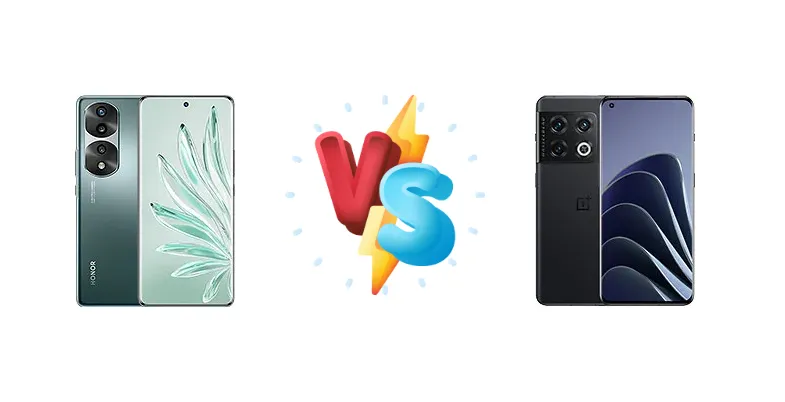
|
🏆 Quick Verdict
For the average user prioritizing charging speed and potentially better sustained performance, the Honor 70 Pro+ emerges as the winner. Its 100W charging significantly outperforms the OnePlus 10 Pro, and the Dimensity 9000 offers competitive performance with potentially better thermal management. However, the OnePlus 10 Pro's established ecosystem and wireless charging remain strong advantages.
| PHONES | ||
|---|---|---|
| Phone Names | Honor 70 Pro+ | OnePlus 10 Pro |
| Network | ||
|---|---|---|
| 2G bands | GSM 850 / 900 / 1800 / 1900 - SIM 1 & SIM 2 | GSM 850 / 900 / 1800 / 1900 |
| 3G bands | HSDPA 800 / 850 / 900 / 1700(AWS) / 1900 / 2100 | HSDPA 800 / 850 / 900 / 1700(AWS) / 1900 / 2100 |
| 4G bands | 1, 2, 3, 4, 5, 8, 19, 28, 34, 38, 39, 40, 41 | 1, 2, 3, 4, 5, 7, 8, 12, 13, 17, 18, 19, 20, 25, 26, 28, 30, 32, 38, 39, 40, 41, 46, 48, 66, 71 - International |
| 5G bands | 1, 5, 8, 28, 41, 77, 78 SA/NSA | 1, 2, 3, 5, 7, 8, 20, 25, 28, 30, 38, 40, 41, 48, 66, 71, 77, 78 SA/NSA - International |
| Speed | HSPA, LTE-A, 5G | HSPA 42.2/5.76 Mbps, LTE (4CA) Cat18 1200/200 Mbps, 5G |
| Technology | GSM / CDMA / HSPA / CDMA2000 / LTE / 5G | GSM / CDMA / HSPA / EVDO / LTE / 5G |
| CDMA2000 1x | 1, 3, 5, 8, 28, 40, 41, 78, 79 SA/NSA - India | |
| Launch | ||
|---|---|---|
| Announced | 2022, May 30 | 2022, January 11 |
| Status | Available. Released 2022, June 17 | Available. Released 2022, January 13 |
| Body | ||
|---|---|---|
| Build | - | Glass front (Gorilla Glass Victus), glass back (Gorilla Glass 5), aluminum frame |
| Dimensions | 163.9 x 74.6 x 8.2 mm (6.45 x 2.94 x 0.32 in) | 163 x 73.9 x 8.6 mm (6.42 x 2.91 x 0.34 in) |
| SIM | Dual SIM (Nano-SIM, dual stand-by) | · Nano-SIM· Nano-SIM + Nano-SIM |
| Weight | 192 g (6.77 oz) | 201 g (7.09 oz) |
| - | IP68 dust/water resistant - T-Mobile only (not for use underwater, liquid damage is not covered under warranty) | |
| Display | ||
|---|---|---|
| Protection | - | Corning Gorilla Glass Victus |
| Resolution | 1200 x 2652 pixels (~429 ppi density) | 1440 x 3216 pixels, 20:9 ratio (~525 ppi density) |
| Size | 6.78 inches, 111.4 cm2 (~91.1% screen-to-body ratio) | 6.7 inches, 108.4 cm2 (~90.0% screen-to-body ratio) |
| Type | OLED, 1B colors, 120Hz | LTPO2 Fluid AMOLED, 1B colors, 120Hz, HDR10+, 500 nits (typ), 800 nits (HBM), 1300 nits (peak) |
| - | Always-on display | |
| Platform | ||
|---|---|---|
| CPU | Octa-core (1x3.05 GHz Cortex-X2 & 3x2.85 GHz Cortex-A710 & 4x1.80 GHz Cortex-A510) | Octa-core (1x3.00 GHz Cortex-X2 & 3x2.50 GHz Cortex-A710 & 4x1.80 GHz Cortex-A510) |
| Chipset | Mediatek MT6983 Dimensity 9000 (4 nm) | Qualcomm SM8450 Snapdragon 8 Gen 1 (4 nm) |
| GPU | Mali-G710 MC10 | Adreno 730 |
| OS | Android 12, Magic UI 6.1 | Android 12, upgradable to Android 14, OxygenOS 14 (International), ColorOS (China) |
| Memory | ||
|---|---|---|
| Card slot | No | No |
| Internal | 256GB 8GB RAM, 256GB 12GB RAM | 128GB 8GB RAM, 256GB 8GB RAM, 256GB 12GB RAM, 512GB 12GB RAM |
| - | UFS 3.1 | |
| Main Camera | ||
|---|---|---|
| Features | Dual-LED flash, HDR, panorama | Laser AF, color spectrum sensor, Hasselblad Color Calibration, Dual-LED dual-tone flash, HDR, panorama |
| Single | 50 MP, f/2.4, 100˚ (ultrawide) | 32 MP, f/2.2, (wide), 1/2.74", 0.8µm |
| Triple | 54 MP, f/1.9, (wide), 1/1.49", PDAF 8 MP. f/2.4, (telephoto), PDAF, OIS, 3x optical zoom 50 MP, f/2.2, 122˚ (ultrawide), AF | 48 MP, f/1.8, 23mm (wide), 1/1.43", 1.12µm, multi-directional PDAF, OIS 8 MP, f/2.4, 77mm (telephoto), 1.0µm, PDAF, OIS, 3.3x optical zoom 50 MP, f/2.2, 14mm, 150˚ (ultrawide), 1/2.76", 0.64µm |
| Video | 4K@30fps, 1080p@30/60fps, gyro-EIS | 8K@24fps, 4K@30/60/120fps, 1080p@30/60/240fps, Auto HDR, gyro-EIS |
| Selfie camera | ||
|---|---|---|
| Features | HDR | HDR |
| Single | 50 MP, f/2.4, 100˚ (ultrawide) | 32 MP, f/2.2, (wide), 1/2.74", 0.8µm |
| Video | 4K@30fps, 1080p@30fps, gyro-EIS | 1080p@30fps, gyro-EIS |
| Sound | ||
|---|---|---|
| 3.5mm jack | No | No |
| 35mm jack | - | No |
| Loudspeaker | Yes, with stereo speakers | Yes, with stereo speakers |
| - | 24-bit/192kHz audio | |
| Comms | ||
|---|---|---|
| Bluetooth | 5.2, A2DP, LE, aptX HD | 5.2, A2DP, LE, aptX HD |
| NFC | Yes | Yes |
| Positioning | GPS, GLONASS, BDS | GPS (L1+L5), GLONASS (G1), BDS (B1), GALILEO (E1+E5a) |
| Radio | No | No |
| USB | USB Type-C 2.0, OTG | USB Type-C 3.1, OTG |
| WLAN | Wi-Fi 802.11 a/b/g/n/ac/6, dual-band, Wi-Fi Direct | Wi-Fi 802.11 a/b/g/n/ac/6, dual-band, Wi-Fi Direct |
| Features | ||
|---|---|---|
| Sensors | Fingerprint (under display, optical), accelerometer, gyro, proximity, compass | Fingerprint (under display, optical), accelerometer, gyro, proximity, compass, barometer |
| Battery | ||
|---|---|---|
| Charging | 100W wired, 60% in 15 min (advertised) 5W reverse wired | 80W wired, PD, 100% in 32 min (International) 65W wired, PD, 58% in 15 min (North America) 50W wireless Reverse wireless |
| Type | Li-Po 4500 mAh, non-removable | Li-Po 5000 mAh |
| Misc | ||
|---|---|---|
| Colors | Black, Green, Gold | Volcanic Black, Emerald Forest, Panda White (Extreme Edition) |
| Models | HPB-AN00 | NE2210, NE2211, NE2213, NE2215, NE2217 |
| Price | About 600 EUR | $ 264.39 / C$ 349.99 / £ 360.00 / € 399.99 |
| SAR | - | 1.16 W/kg (head) 0.70 W/kg (body) |
| Tests | ||
|---|---|---|
| Battery life | - | Endurance rating 107h |
| Camera | - | Photo / Video |
| Display | - | Contrast ratio: Infinite (nominal) |
| Loudspeaker | - | -25.2 LUFS (Very good) |
| Performance | - | AnTuTu: 886248 (v9) GeekBench: 3447 (v5.1) GFXBench: 48fps (ES 3.1 onscreen) |
Honor 70 Pro+
- Significantly faster 100W wired charging
- Potentially better sustained performance due to Dimensity 9000's thermal efficiency
- Competitive chipset performance
- Battery capacity not specified
- No wireless charging
OnePlus 10 Pro
- Established software ecosystem and support
- 50W wireless charging and reverse wireless charging
- Hasselblad-tuned camera
- Snapdragon 8 Gen 1 prone to throttling
- Slower wired charging compared to Honor 70 Pro+
Display Comparison
Both phones feature high-quality displays, but direct comparison data is limited. The OnePlus 10 Pro is confirmed to reach 780 nits of peak brightness, a respectable figure. While the Honor 70 Pro+'s peak brightness isn't specified, it's likely comparable. The OnePlus 10 Pro's 'Infinite' contrast ratio suggests a typical OLED panel, while details on the Honor's panel technology (LTPO, PWM dimming rate) are missing. Users sensitive to flicker will need to investigate the Honor 70 Pro+'s PWM frequency.
Camera Comparison
Both devices are advertised as having strong camera systems, but specifics are limited. Without detailed sensor size and aperture information, a direct comparison is difficult. Both phones offer photo and video capabilities, but the Honor 70 Pro+’s camera system is a key selling point, though details beyond marketing claims are scarce. The OnePlus 10 Pro benefits from Hasselblad color calibration, aiming for more natural image processing. We can assume both phones will include standard features like OIS on the main sensor, but the quality of image stabilization and low-light performance will depend on sensor size and software algorithms.
Performance
The core battle lies between the Mediatek Dimensity 9000 in the Honor 70 Pro+ and the Qualcomm Snapdragon 8 Gen 1 in the OnePlus 10 Pro. Both are 4nm chips with similar core configurations – 1x Cortex-X2, 3x Cortex-A710, and 4x Cortex-A510. However, the Dimensity 9000 boasts a slightly higher peak Cortex-X2 clock speed (3.05 GHz vs 3.00 GHz). More crucially, the Dimensity 9000 is generally regarded as more thermally efficient, potentially leading to less throttling under sustained load. The OnePlus 10 Pro's Snapdragon 8 Gen 1 is known to run hot, impacting long-term performance. Both likely utilize LPDDR5X RAM, ensuring fast memory access.
Battery Life
The OnePlus 10 Pro has an endurance rating of 107 hours, indicating solid battery life. However, the Honor 70 Pro+’s battery capacity is not specified. The real differentiator is charging speed. The Honor 70 Pro+ supports 100W wired charging, claiming 60% charge in 15 minutes. The OnePlus 10 Pro offers 80W wired (International) or 65W (North America) charging, taking 32 minutes for a full charge (International) and achieving 58% in 15 minutes (North America). The Honor’s charging is significantly faster. The OnePlus 10 Pro also offers 50W wireless charging and reverse wireless charging, features absent in the Honor 70 Pro+.
Buying Guide
Buy the Honor 70 Pro+ if you need the absolute fastest charging available, value sustained performance during extended gaming sessions, and are comfortable with Honor's Magic UI. Buy the OnePlus 10 Pro if you prefer a more refined software experience, prioritize wireless charging convenience, and appreciate the broader OnePlus ecosystem of accessories and support.