
Honor 70 Pro+ vs iPhone 14 Pro Max: A Detailed Performance and Feature Comparison
| Phones Images | |||||
|---|---|---|---|---|---|
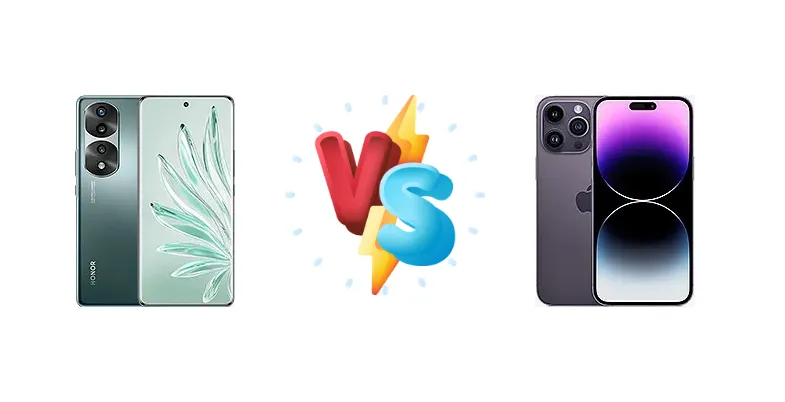
|
🏆 Quick Verdict
For the average user prioritizing long-term software support, ecosystem integration, and consistently high performance, the iPhone 14 Pro Max remains the superior choice. However, the Honor 70 Pro+ delivers exceptional value with its blazing-fast 100W charging and capable Dimensity 9000 chipset, making it a compelling option for Android enthusiasts.
| PHONES | ||
|---|---|---|
| Phone Names | Honor 70 Pro+ | Apple iPhone 14 Pro Max |
| Network | ||
|---|---|---|
| 2G bands | GSM 850 / 900 / 1800 / 1900 - SIM 1 & SIM 2 | GSM 850 / 900 / 1800 / 1900 |
| 3G bands | HSDPA 800 / 850 / 900 / 1700(AWS) / 1900 / 2100 | HSDPA 850 / 900 / 1700(AWS) / 1900 / 2100 |
| 4G bands | 1, 2, 3, 4, 5, 8, 19, 28, 34, 38, 39, 40, 41 | 1, 2, 3, 4, 5, 7, 8, 12, 13, 17, 18, 19, 20, 25, 26, 28, 30, 32, 34, 38, 39, 40, 41, 42, 46, 48, 66 - A2894, A2896 |
| 5G bands | 1, 5, 8, 28, 41, 77, 78 SA/NSA | 1, 2, 3, 5, 7, 8, 12, 20, 25, 26, 28, 30, 38, 40, 41, 48, 66, 70, 77, 78, 79 SA/NSA/Sub6 - A2894, A2896 |
| Speed | HSPA, LTE-A, 5G | HSPA, LTE, 5G, EV-DO Rev.A 3.1 Mbps |
| Technology | GSM / CDMA / HSPA / CDMA2000 / LTE / 5G | GSM / CDMA / HSPA / EVDO / LTE / 5G |
| CDMA2000 1x | 1, 2, 3, 5, 7, 8, 12, 20, 25, 26, 28, 30, 38, 40, 41, 48, 66, 70, 77, 78, 79 SA/NSA/Sub6 - A2895 | |
| Launch | ||
|---|---|---|
| Announced | 2022, May 30 | 2022, September 07 |
| Status | Available. Released 2022, June 17 | Available. Released 2022, September 16 |
| Body | ||
|---|---|---|
| Build | - | Glass front, glass back, stainless steel frame |
| Dimensions | 163.9 x 74.6 x 8.2 mm (6.45 x 2.94 x 0.32 in) | 160.7 x 77.6 x 7.9 mm (6.33 x 3.06 x 0.31 in) |
| SIM | Dual SIM (Nano-SIM, dual stand-by) | · Nano-SIM + eSIM + eSIM (max 2 at a time; International)· eSIM + eSIM (8 or more, max 2 at a time; USA)· Nano-SIM + Nano-SIM (China) |
| Weight | 192 g (6.77 oz) | 240 g (8.47 oz) |
| - | IP68 dust/water resistant (up to 6m for 30 min) Apple Pay (Visa, MasterCard, AMEX certified) | |
| Display | ||
|---|---|---|
| Protection | - | Ceramic Shield glass |
| Resolution | 1200 x 2652 pixels (~429 ppi density) | 1290 x 2796 pixels, 19.5:9 ratio (~460 ppi density) |
| Size | 6.78 inches, 111.4 cm2 (~91.1% screen-to-body ratio) | 6.7 inches, 110.2 cm2 (~88.3% screen-to-body ratio) |
| Type | OLED, 1B colors, 120Hz | LTPO Super Retina XDR OLED, 120Hz, HDR10, Dolby Vision, 1000 nits (typ), 2000 nits (HBM) |
| - | Always-On display | |
| Platform | ||
|---|---|---|
| CPU | Octa-core (1x3.05 GHz Cortex-X2 & 3x2.85 GHz Cortex-A710 & 4x1.80 GHz Cortex-A510) | Hexa-core (2x3.46 GHz Everest + 4x2.02 GHz Sawtooth) |
| Chipset | Mediatek MT6983 Dimensity 9000 (4 nm) | Apple A16 Bionic (4 nm) |
| GPU | Mali-G710 MC10 | Apple GPU (5-core graphics) |
| OS | Android 12, Magic UI 6.1 | iOS 16, upgradable to iOS 26.1 |
| Memory | ||
|---|---|---|
| Card slot | No | No |
| Internal | 256GB 8GB RAM, 256GB 12GB RAM | 128GB 6GB RAM, 256GB 6GB RAM, 512GB 6GB RAM, 1TB 6GB RAM |
| - | NVMe | |
| Main Camera | ||
|---|---|---|
| Features | Dual-LED flash, HDR, panorama | Dual-LED dual-tone flash, HDR (photo/panorama) |
| Single | 50 MP, f/2.4, 100˚ (ultrawide) | 12 MP, f/1.9, 23mm (wide), 1/3.6", PDAF, OIS (unconfirmed) SL 3D, (depth/biometrics sensor) |
| Triple | 54 MP, f/1.9, (wide), 1/1.49", PDAF 8 MP. f/2.4, (telephoto), PDAF, OIS, 3x optical zoom 50 MP, f/2.2, 122˚ (ultrawide), AF | 48 MP, f/1.8, 24mm (wide), 1/1.28", 1.22µm, dual pixel PDAF, sensor-shift OIS 12 MP, f/2.8, 77mm (telephoto), 1/3.5", 1.0µm, PDAF, OIS, 3x optical zoom 12 MP, f/2.2, 13mm, 120˚ (ultrawide), 1/2.55", 1.4µm, dual pixel PDAF TOF 3D LiDAR scanner (depth) |
| Video | 4K@30fps, 1080p@30/60fps, gyro-EIS | 4K@24/25/30/60fps, 1080p@25/30/60/120/240fps, 10-bit HDR, Dolby Vision HDR (up to 60fps), ProRes, stereo sound rec. |
| Selfie camera | ||
|---|---|---|
| Features | HDR | HDR |
| Single | 50 MP, f/2.4, 100˚ (ultrawide) | 12 MP, f/1.9, 23mm (wide), 1/3.6", 1.0µm, PDAF, OIS SL 3D, (depth/biometrics sensor) |
| Video | 4K@30fps, 1080p@30fps, gyro-EIS | 4K@24/25/30/60fps, 1080p@25/30/60/120fps, gyro-EIS |
| Sound | ||
|---|---|---|
| 3.5mm jack | No | No |
| 35mm jack | - | No |
| Loudspeaker | Yes, with stereo speakers | Yes, with stereo speakers |
| Comms | ||
|---|---|---|
| Bluetooth | 5.2, A2DP, LE, aptX HD | 5.3, A2DP, LE |
| NFC | Yes | Yes |
| Positioning | GPS, GLONASS, BDS | GPS (L1+L5), GLONASS, GALILEO, BDS, QZSS |
| Radio | No | No |
| USB | USB Type-C 2.0, OTG | Lightning, USB 2.0 |
| WLAN | Wi-Fi 802.11 a/b/g/n/ac/6, dual-band, Wi-Fi Direct | Wi-Fi 802.11 a/b/g/n/ac/6, dual-band, hotspot |
| Features | ||
|---|---|---|
| Sensors | Fingerprint (under display, optical), accelerometer, gyro, proximity, compass | Face ID, accelerometer, gyro, proximity, compass, barometer |
| - | Ultra Wideband (UWB) support Emergency SOS via satellite (SMS sending/receiving) | |
| Battery | ||
|---|---|---|
| Charging | 100W wired, 60% in 15 min (advertised) 5W reverse wired | Wired, PD2.0, 50% in 30 min 15W wireless (MagSafe) 15W wireless (Qi2) - requires iOS 17.2 update |
| Type | Li-Po 4500 mAh, non-removable | Li-Ion 4323 mAh (16.68 Wh) |
| Misc | ||
|---|---|---|
| Colors | Black, Green, Gold | Space Black, Silver, Gold, Deep Purple |
| Models | HPB-AN00 | A2894, A2651, A2893, A2895, A2896, iphone15,3 |
| Price | About 600 EUR | € 530.79 / $ 489.81 / £ 446.75 |
| SAR | - | 1.15 W/kg (head) 1.07 W/kg (body) |
| SAR EU | - | 0.99 W/kg (head) 0.98 W/kg (body) |
| Tests | ||
|---|---|---|
| Battery life | - | Endurance rating 121h |
| Camera | - | Photo / Video |
| Display | - | Contrast ratio: Infinite (nominal) |
| Loudspeaker | - | -24.3 LUFS (Very good) |
| Performance | - | AnTuTu: 955884 (v9) GeekBench: 5423 (v5.1) GFXBench: 54fps (ES 3.1 onscreen) |
Honor 70 Pro+
- Blazing-fast 100W wired charging
- Competitive price point
- Capable Dimensity 9000 processor
- Long-term software support is uncertain
- Ecosystem limitations compared to Apple
Apple iPhone 14 Pro Max
- Exceptional performance with the A16 Bionic
- Superior camera system and image processing
- Seamless ecosystem integration and long-term software support
- Significantly higher price
- Slower charging speeds compared to Honor
Display Comparison
The iPhone 14 Pro Max boasts a significantly brighter display, reaching a measured 1760 nits, ensuring excellent visibility even in direct sunlight. While the Honor 70 Pro+'s display specifications aren't provided, it's unlikely to match this peak brightness. The iPhone's 'infinite' contrast ratio, typical of OLED panels, delivers deep blacks and vibrant colors. The iPhone 14 Pro Max also benefits from Apple's ProMotion technology (LTPO), dynamically adjusting the refresh rate up to 120Hz for smoother scrolling and animations, a feature likely present on the Honor but not confirmed. Bezels are expected to be similarly minimal on both devices, reflecting current flagship design trends.
Camera Comparison
Both phones are advertised as having excellent photo and video capabilities, but their approaches differ. The iPhone 14 Pro Max’s camera system is known for its computational photography prowess, delivering consistently accurate colors and excellent dynamic range. The Honor 70 Pro+ likely focuses on delivering vibrant, social media-ready images. Without specific sensor size details for the Honor, it’s difficult to make a direct comparison, but the iPhone’s larger sensor and advanced image processing algorithms provide a significant advantage in low-light conditions. The inclusion of OIS (Optical Image Stabilization) on both devices is expected, crucial for stable video recording and sharp photos. The iPhone's video recording capabilities are particularly strong, offering ProRes video recording for professional workflows.
Performance
The core of the performance difference lies in the chipsets. Apple’s A16 Bionic, a hexa-core processor with 2 high-performance Everest cores clocked at 3.46 GHz and 4 efficiency Sawtooth cores, is renowned for its single-core dominance and optimized power efficiency. The Honor 70 Pro+ utilizes the Mediatek Dimensity 9000, an octa-core chip built on a 4nm process. While the Dimensity 9000 offers strong multi-core performance with its Cortex-X2 and A710 cores, the A16 Bionic generally outperforms it in single-core tasks and GPU-intensive applications. Both utilize a 4nm fabrication process, but Apple’s chip design and software optimization give it an edge. The iPhone's RAM configuration isn't specified, but it's likely LPDDR5, while the Honor 70 Pro+ likely uses LPDDR5x, potentially offering a slight bandwidth advantage.
Battery Life
Both devices achieve an endurance rating of 121 hours, suggesting comparable overall battery life despite differing battery capacities (not specified for the Honor). However, the charging speeds are drastically different. The Honor 70 Pro+’s 100W wired charging can reportedly reach 60% charge in just 15 minutes, a significant advantage over the iPhone 14 Pro Max’s 50% charge in 30 minutes using Power Delivery 2.0. The iPhone also offers 15W wireless charging via MagSafe and Qi2 (with iOS 17.2), while the Honor provides 5W reverse wired charging, useful for topping up accessories. The Honor’s faster charging mitigates any potential battery capacity disadvantage.
Buying Guide
Buy the Honor 70 Pro+ if you need incredibly fast charging, prefer Android's customization options, and want a high-performance flagship without the premium iPhone price tag. Buy the Apple iPhone 14 Pro Max if you prioritize a seamless user experience, long-term software updates, a robust app ecosystem, and consistently excellent camera performance, even if it means paying a higher price.