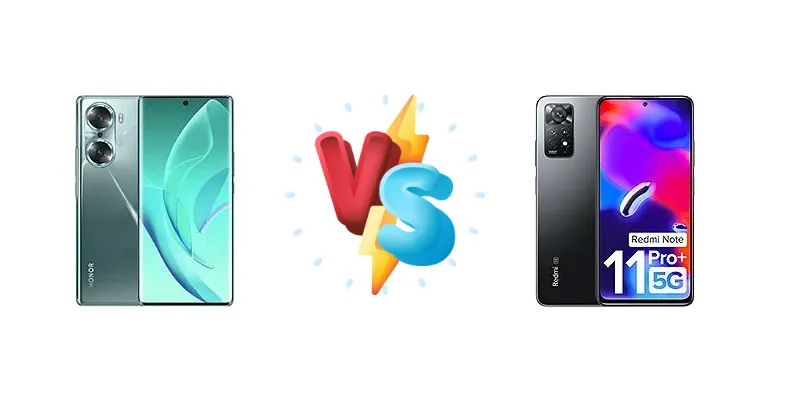
The Honor 60 and Xiaomi Redmi Note 11 Pro+ 5G (India) represent compelling options in the increasingly competitive mid-range smartphone market. While both aim to deliver 5G connectivity and fast charging at accessible price points, they diverge significantly in their core processing power. This comparison dissects these differences, focusing on how the Snapdragon 778G in the Honor 60 stacks up against the Snapdragon 695 in the Redmi Note 11 Pro+ 5G.
🏆 Quick Verdict
For the average user prioritizing consistent performance and smoother multitasking, the Honor 60 is the better choice. Its Snapdragon 778G 5G chipset offers a noticeable advantage over the Redmi Note 11 Pro+ 5G’s Snapdragon 695, making it more suitable for demanding applications and gaming. However, the Redmi Note 11 Pro+ 5G offers competitive charging speeds and may appeal to budget-conscious buyers.
| Network |
|---|
| 2G bands | GSM 850 / 900 / 1800 / 1900 | GSM 850 / 900 / 1800 / 1900 - SIM 1 & SIM 2 |
| 3G bands | HSDPA 800 / 850 / 900 / 1700(AWS) / 1900 / 2100 | HSDPA 850 / 900 / 1900 / 2100 |
| 4G bands | 1, 2, 3, 4, 5, 8, 18, 19, 26, 28, 34, 38, 39, 40, 41 | 1, 3, 5, 8, 40, 41 |
| 5G bands | 1, 5, 8, 28, 41, 77, 78 SA/NSA | 1, 3, 5, 8, 28, 40, 78 SA/NSA |
| Speed | HSPA, LTE, 5G | HSPA, LTE-A (CA), 5G |
| Technology | GSM / CDMA / HSPA / CDMA2000 / LTE / 5G | GSM / HSPA / LTE / 5G |
| Launch |
|---|
| Announced | 2021, December 01 | 2022, March 09 |
| Status | Available. Released 2021, December 10 | Available. Released 2022, March 15 |
| Body |
|---|
| Build | - | Glass front (Gorilla Glass 5), glass back |
| Dimensions | 161.4 x 73.3 x 8 mm (6.35 x 2.89 x 0.31 in) | 164.2 x 76.1 x 8.1 mm (6.46 x 3.00 x 0.32 in) |
| SIM | Nano-SIM + Nano-SIM | Hybrid Dual SIM (Nano-SIM, dual stand-by) |
| Weight | 179 g (6.31 oz) | 202 g (7.13 oz) |
| | - | IP53, dust and splash resistant |
| Display |
|---|
| Protection | - | Corning Gorilla Glass 5 |
| Resolution | 1080 x 2400 pixels, 20:9 ratio (~395 ppi density) | 1080 x 2400 pixels, 20:9 ratio (~395 ppi density) |
| Size | 6.67 inches, 107.4 cm2 (~90.8% screen-to-body ratio) | 6.67 inches, 107.4 cm2 (~86.0% screen-to-body ratio) |
| Type | OLED, 1B colors, 120Hz, HDR10 | Super AMOLED, 120Hz, 700 nits, 1200 nits (peak) |
| Platform |
|---|
| CPU | Octa-core (1x2.4 GHz Cortex-A78 & 3x2.2 GHz Cortex-A78 & 4x1.9 GHz Cortex-A55) | Octa-core (2x2.2 GHz Kryo 660 Gold & 6x1.7 GHz Kryo 660 Silver) |
| Chipset | Qualcomm SM7325 Snapdragon 778G 5G (6 nm) | Qualcomm SM6375 Snapdragon 695 5G (6 nm) |
| GPU | Adreno 642L | Adreno 619 |
| OS | Android 11, Magic UI 5.0 | Android 11, MIUI 13 |
| Memory |
|---|
| Card slot | No | microSDXC (uses shared SIM slot) |
| Internal | 128GB 8GB RAM, 256GB 8GB RAM, 256GB 12GB RAM | 64GB 6GB RAM, 128GB 6GB RAM, 128GB 8GB RAM, 256GB 8GB RAM |
| | - | UFS 2.2 |
| Main Camera |
|---|
| Features | Dual-LED flash, HDR, panorama | LED flash, HDR, panorama |
| Triple | 108 MP, f/1.9, (wide), 1/1.52", 0.7µm, PDAF
8 MP, f/2.2, 112˚ (ultrawide)
2 MP (macro) | 108 MP, f/1.9, 26mm (wide), 1/1.52", 0.7µm, PDAF
8 MP, f/2.2, 118˚ (ultrawide)
2 MP, f/2.4, (macro) |
| Video | 4K@30fps, 1080p@30/60fps, gyro-EIS | 1080p@30fps |
| Selfie camera |
|---|
| Single | 32 MP, f/2.4, (wide) | 16 MP, f/2.5, (wide), 1/3.06" 1.0µm |
| Video | 1080p@30fps, gyro-EIS | 1080p@30fps |
| Sound |
|---|
| 3.5mm jack | - | Yes |
| 35mm jack | No | - |
| Loudspeaker | Yes | Yes, with stereo speakers |
| | - | 24-bit/192kHz audio |
| Comms |
|---|
| Bluetooth | 5.2, A2DP, LE, aptX HD | 5.1, A2DP, LE |
| Infrared port | - | Yes |
| NFC | Yes | No |
| Positioning | GPS, GLONASS, BDS | GPS, GLONASS, BDS, GALILEO |
| Radio | No | Unspecified |
| USB | USB Type-C 2.0, OTG | USB Type-C 2.0, OTG |
| WLAN | Wi-Fi 802.11 a/b/g/n/ac/6, dual-band, Wi-Fi Direct | Wi-Fi 802.11 a/b/g/n/ac, dual-band, Wi-Fi Direct |
| Features |
|---|
| Sensors | Fingerprint (under display, optical), accelerometer, gyro, proximity, compass | Fingerprint (side-mounted), accelerometer, gyro, proximity, compass |
| Battery |
|---|
| Charging | 66W wired, 50% in 15 min
5W reverse wired | 67W wired, PD3.0, QC3, 50% in 15 min, 100% in 42 min (advertised) |
| Type | Li-Ion 4800 mAh | Li-Po 5000 mAh, non-removable |
| Misc |
|---|
| Colors | Black, Green, Blue, Pink | Mirage Blue, Phantom White, Stealth Black |
| Models | LSA-AN00 | 2201116SI |
| Price | About 500 EUR | About 250 EUR |
Honor 60
- Superior processing power with Snapdragon 778G 5G
- Potentially better low-light camera performance
- 5W reverse wired charging
- Battery capacity is unknown
- May be slightly more expensive than the Redmi Note 11 Pro+ 5G
Xiaomi Redmi Note 11 Pro+ 5G (India)
- Fast 67W charging with PD3.0 and QC3 support
- Potentially lower price point
- Likely larger main camera sensor (based on brand trends)
- Less powerful Snapdragon 695 chipset
- No reverse wireless charging
- Image processing may be overly saturated for some users
Display Comparison
Neither device's display specifications are provided, so a direct comparison is limited. However, given the market positioning, both likely utilize AMOLED panels. The key differentiator will be peak brightness and color accuracy. Honor typically focuses on color science, while Xiaomi often prioritizes maximizing brightness. Without specific data, it's reasonable to assume both offer acceptable viewing experiences for their price range, but the Honor 60 may have a slight edge in color fidelity.
Camera Comparison
Camera details are absent beyond the presence of sensors. Assuming typical configurations for these brands, the Redmi Note 11 Pro+ 5G may feature a higher megapixel count main sensor, potentially 108MP or even 200MP, but megapixel count isn't everything. The Honor 60’s image processing pipeline is likely tuned for more natural colors, while Xiaomi often leans towards more saturated, social-media-friendly images. Without sensor size and aperture information, it’s difficult to definitively declare a winner, but the Honor 60’s stronger processing power could provide an advantage in low-light scenarios and image stabilization.
Performance
The core difference lies in the chipsets. The Honor 60’s Qualcomm SM7325 Snapdragon 778G 5G (6 nm) features a more powerful CPU configuration – an octa-core setup with 1x2.4 GHz Cortex-A78, 3x2.2 GHz Cortex-A78, and 4x1.9 GHz Cortex-A55 cores. This contrasts with the Redmi Note 11 Pro+ 5G’s Snapdragon 695 (6 nm) with 2x2.2 GHz Kryo 660 Gold & 6x1.7 GHz Kryo 660 Silver cores. The 778G’s inclusion of more performance-oriented Cortex-A78 cores translates to significantly better multi-core and single-core performance, impacting app launch speeds and overall system responsiveness. While both are 6nm chips, the architectural differences favor the 778G. The Redmi Note 11 Pro+ 5G will be adequate for everyday tasks, but the Honor 60 will handle heavier workloads with greater ease.
Battery Life
Both devices offer remarkably similar charging speeds: 66W and 67W respectively, both claiming a 50% charge in 15 minutes. The Redmi Note 11 Pro+ 5G advertises a full charge in 42 minutes, while the Honor 60’s 0-100% time isn’t specified. The actual battery capacity is unknown for both, but the comparable charging speeds suggest a similar user experience in terms of topping up the battery. The Honor 60 also offers 5W reverse wired charging, a feature absent from the Redmi Note 11 Pro+ 5G.
Buying Guide
Buy the Honor 60 if you need a phone capable of handling demanding apps, enjoy mobile gaming, and value a more responsive user experience. Buy the Xiaomi Redmi Note 11 Pro+ 5G (India) if you prioritize fast charging, are on a tighter budget, and primarily use your phone for basic tasks like social media, calls, and light web browsing.
Frequently Asked Questions
❓ Will the Snapdragon 695 in the Redmi Note 11 Pro+ 5G struggle with graphically intensive games like PUBG or Call of Duty?
The Snapdragon 695 is capable of running PUBG and Call of Duty, but you'll likely need to lower the graphics settings to achieve a consistently smooth frame rate. The Honor 60’s Snapdragon 778G 5G offers significantly more headroom for gaming, allowing for higher settings and more stable performance.
❓ Does the 67W charging on the Redmi Note 11 Pro+ 5G actually take 42 minutes to fully charge the phone, as advertised?
Real-world charging times can vary depending on factors like battery temperature and background app activity. While Xiaomi advertises a 42-minute full charge, expect slightly longer times in typical usage scenarios. Both phones offer very fast charging, minimizing downtime.
❓ Is the difference in performance between the Snapdragon 778G and 695 noticeable for everyday tasks like browsing and social media?
For basic tasks, the difference will be minimal. However, the Snapdragon 778G in the Honor 60 will provide a snappier and more responsive experience when multitasking, switching between apps, or loading heavier web pages. The 778G’s superior CPU architecture makes a difference in overall system fluidity.