
Honor 60 vs Samsung Galaxy A73 5G: A Deep Dive into Mid-Range Performance and Charging
| Phones Images | |||||
|---|---|---|---|---|---|
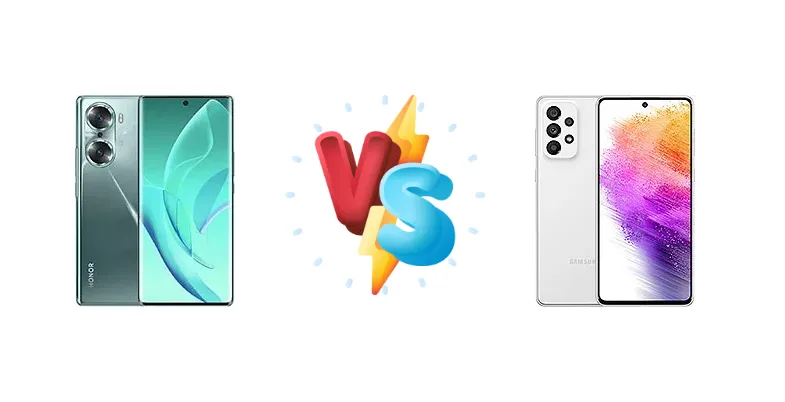
|
🏆 Quick Verdict
For the average user prioritizing rapid replenishment, the Honor 60 emerges as the winner. Its 66W wired charging dramatically reduces downtime compared to the Galaxy A73 5G’s 25W charging, despite both phones sharing the same core processing power. This makes the Honor 60 ideal for power users.
| PHONES | ||
|---|---|---|
| Phone Names | Honor 60 | Samsung Galaxy A73 5G |
| Network | ||
|---|---|---|
| 2G bands | GSM 850 / 900 / 1800 / 1900 | GSM 850 / 900 / 1800 / 1900 |
| 3G bands | HSDPA 800 / 850 / 900 / 1700(AWS) / 1900 / 2100 | HSDPA 850 / 900 / 1700(AWS) / 1900 / 2100 |
| 4G bands | 1, 2, 3, 4, 5, 8, 18, 19, 26, 28, 34, 38, 39, 40, 41 | 1, 2, 3, 4, 5, 7, 8, 12, 13, 17, 20, 26, 28, 32, 38, 40, 41, 66 |
| 5G bands | 1, 5, 8, 28, 41, 77, 78 SA/NSA | 1, 3, 5, 7, 28, 40, 41, 66, 78 SA/NSA/Sub6 |
| Speed | HSPA, LTE, 5G | HSPA, LTE, 5G |
| Technology | GSM / CDMA / HSPA / CDMA2000 / LTE / 5G | GSM / HSPA / LTE / 5G |
| Launch | ||
|---|---|---|
| Announced | 2021, December 01 | 2022, March 17 |
| Status | Available. Released 2021, December 10 | Available. Released 2022, April 22 |
| Body | ||
|---|---|---|
| Dimensions | 161.4 x 73.3 x 8 mm (6.35 x 2.89 x 0.31 in) | 163.7 x 76.1 x 7.6 mm (6.44 x 3.00 x 0.30 in) |
| SIM | Nano-SIM + Nano-SIM | · Nano-SIM· Nano-SIM + Nano-SIM |
| Weight | 179 g (6.31 oz) | 181 g (6.38 oz) |
| - | IP67 dust/water resistant (up to 1m for 30 min) | |
| Display | ||
|---|---|---|
| Protection | - | Corning Gorilla Glass 5 |
| Resolution | 1080 x 2400 pixels, 20:9 ratio (~395 ppi density) | 1080 x 2400 pixels, 20:9 ratio (~393 ppi density) |
| Size | 6.67 inches, 107.4 cm2 (~90.8% screen-to-body ratio) | 6.7 inches, 108.4 cm2 (~87.0% screen-to-body ratio) |
| Type | OLED, 1B colors, 120Hz, HDR10 | Super AMOLED Plus, 120Hz, 800 nits (HBM) |
| Platform | ||
|---|---|---|
| CPU | Octa-core (1x2.4 GHz Cortex-A78 & 3x2.2 GHz Cortex-A78 & 4x1.9 GHz Cortex-A55) | Octa-core (1x2.4 GHz Cortex-A78 & 3x2.2 GHz Cortex-A78 & 4x1.9 GHz Cortex-A55) |
| Chipset | Qualcomm SM7325 Snapdragon 778G 5G (6 nm) | Qualcomm SM7325 Snapdragon 778G 5G (6 nm) |
| GPU | Adreno 642L | Adreno 642L |
| OS | Android 11, Magic UI 5.0 | Android 12, up to 4 major Android upgrades, One UI 6.1 |
| Memory | ||
|---|---|---|
| Card slot | No | microSDXC (uses shared SIM slot) |
| Internal | 128GB 8GB RAM, 256GB 8GB RAM, 256GB 12GB RAM | 128GB 6GB RAM, 128GB 8GB RAM, 256GB 8GB RAM |
| Main Camera | ||
|---|---|---|
| Features | Dual-LED flash, HDR, panorama | LED flash, panorama, HDR |
| Quad | - | 108 MP, f/1.8, (wide), PDAF, OIS 12 MP, f/2.2, (ultrawide) 5 MP (macro) Auxiliary lens |
| Single | - | 32 MP, f/2.2, 26mm (wide), 1/2.8", 0.8µm |
| Triple | 108 MP, f/1.9, (wide), 1/1.52", 0.7µm, PDAF 8 MP, f/2.2, 112˚ (ultrawide) 2 MP (macro) | - |
| Video | 4K@30fps, 1080p@30/60fps, gyro-EIS | 4K@30fps, 1080p@30/60fps; gyro-EIS |
| Selfie camera | ||
|---|---|---|
| Features | - | HDR |
| Single | 32 MP, f/2.4, (wide) | 32 MP, f/2.2, 26mm (wide), 1/2.8", 0.8µm |
| Video | 1080p@30fps, gyro-EIS | 4K@30fps, 1080p@30fps |
| Sound | ||
|---|---|---|
| 3.5mm jack | - | No |
| 35mm jack | No | No |
| Loudspeaker | Yes | Yes, with stereo speakers |
| Comms | ||
|---|---|---|
| Bluetooth | 5.2, A2DP, LE, aptX HD | 5.0, A2DP, LE |
| NFC | Yes | Yes (market/region dependent) |
| Positioning | GPS, GLONASS, BDS | GPS, GLONASS, GALILEO, BDS, QZSS |
| Radio | No | Unspecified |
| USB | USB Type-C 2.0, OTG | USB Type-C 2.0, OTG |
| WLAN | Wi-Fi 802.11 a/b/g/n/ac/6, dual-band, Wi-Fi Direct | Wi-Fi 802.11 a/b/g/n/ac/6, dual-band, Wi-Fi Direct |
| Features | ||
|---|---|---|
| Sensors | Fingerprint (under display, optical), accelerometer, gyro, proximity, compass | Fingerprint (under display, optical), accelerometer, gyro, proximity, compass |
| Battery | ||
|---|---|---|
| Charging | 66W wired, 50% in 15 min 5W reverse wired | 25W wired |
| Type | Li-Ion 4800 mAh | Li-Po 5000 mAh |
| Misc | ||
|---|---|---|
| Colors | Black, Green, Blue, Pink | Gray, Mint, White |
| Models | LSA-AN00 | SM-A736B, SM-A736B/DS |
| Price | About 500 EUR | About 600 EUR |
| SAR | - | 1.14 W/kg (head) |
| SAR EU | - | 1.28 W/kg (head) 1.42 W/kg (body) |
Honor 60
- Significantly faster 66W charging
- Potentially cleaner software experience
- Compact design (likely, based on brand history)
- Less established brand recognition
- Limited carrier support in some regions
Samsung Galaxy A73 5G
- Samsung’s One UI software
- Strong brand reputation
- Wider carrier compatibility (likely)
- Slower 25W charging
- Potentially more bloatware
- Larger size may be less comfortable for some
Display Comparison
While specific display specs beyond the chipset are missing, both phones likely feature OLED panels given their market positioning. However, the A73 5G, being a larger device, may offer a slightly larger screen real estate. The absence of high refresh rate information is notable; assuming both are 60Hz, the display experience will be similar. Color accuracy and peak brightness will be key differentiators, but without data, it's difficult to assess.
Camera Comparison
Camera details are limited. Both phones likely feature multi-camera systems, but the sensor sizes and lens apertures are crucial. Without this information, it’s difficult to assess image quality. The presence of Optical Image Stabilization (OIS) on the main sensor would be a significant advantage for low-light photography and video recording. The A73 5G, given Samsung’s history, may prioritize vibrant, saturated colors in image processing, while Honor might aim for a more natural look. The inclusion of a 2MP macro camera on either device is likely a marketing gimmick with limited practical value.
Performance
Both the Honor 60 and Galaxy A73 5G are powered by the Qualcomm SM7325 Snapdragon 778G 5G (6 nm) chipset, featuring an octa-core CPU configuration identical in clock speeds (1x2.4 GHz Cortex-A78 & 3x2.2 GHz Cortex-A78 & 4x1.9 GHz Cortex-A55). This means CPU-bound tasks like app loading and general navigation will perform similarly. The performance bottleneck will likely be thermal management and sustained performance under load. While both use a 6nm process, Samsung’s larger chassis *could* allow for a more effective cooling solution, but this is speculative without testing. RAM configurations are also unknown, but LPDDR5 RAM would be expected in this price bracket.
Battery Life
The battery capacity of both devices is unknown. However, the Honor 60’s 66W wired charging is a substantial advantage over the Galaxy A73 5G’s 25W charging. This translates to a significantly faster 0-100% charge time – Honor claims 50% in 15 minutes. Even with a slightly smaller battery, the Honor 60’s faster charging could result in less perceived downtime. The A73 5G’s slower charging will require a longer connection to the wall, impacting convenience.
Buying Guide
Buy the Honor 60 if you need blazing-fast charging and a potentially cleaner software experience. This phone is ideal for users who frequently find themselves needing to top up their battery quickly throughout the day. Buy the Samsung Galaxy A73 5G if you prefer Samsung’s One UI, a more established brand reputation, and potentially wider carrier support, even if it means sacrificing charging speed.