
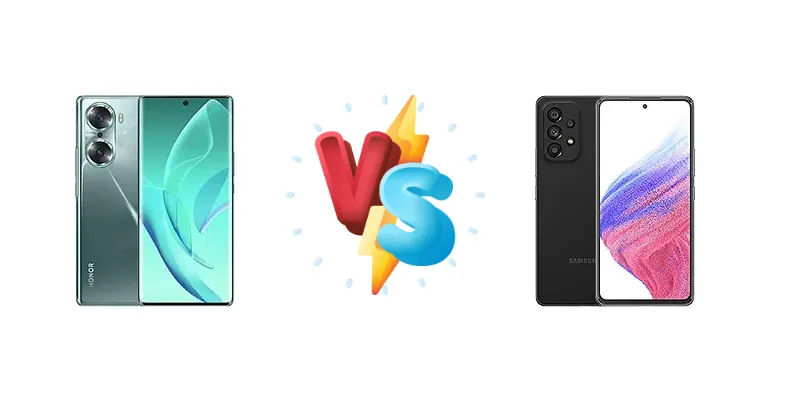
Honor 60 vs. Samsung Galaxy A53 5G: A Detailed Comparison
| Phones Images | |||||
|---|---|---|---|---|---|
|
🏆 Quick Verdict
For users prioritizing raw performance and rapid charging, the Honor 60 emerges as the winner. Its Snapdragon 778G 5G offers a noticeable edge in processing power, and the 66W charging is significantly faster than the A53’s 25W. However, the Galaxy A53 5G remains a strong contender for those deeply embedded in the Samsung ecosystem and valuing a brighter display.
| PHONES | ||
|---|---|---|
| Phone Names | Honor 60 | Samsung Galaxy A53 5G |
| Network | ||
|---|---|---|
| 2G bands | GSM 850 / 900 / 1800 / 1900 | GSM 850 / 900 / 1800 / 1900 |
| 3G bands | HSDPA 800 / 850 / 900 / 1700(AWS) / 1900 / 2100 | HSDPA 850 / 900 / 1700(AWS) / 1900 / 2100 |
| 4G bands | 1, 2, 3, 4, 5, 8, 18, 19, 26, 28, 34, 38, 39, 40, 41 | 1, 2, 3, 4, 5, 7, 12, 14, 20, 29, 30, 38, 39, 40, 41, 46, 48, 66 - SM-A536U |
| 5G bands | 1, 5, 8, 28, 41, 77, 78 SA/NSA | 2, 5, 41, 66, 77, 78 SA/NSA/Sub6/mmWave - SM-A536U |
| Speed | HSPA, LTE, 5G | HSPA, LTE, 5G |
| Technology | GSM / CDMA / HSPA / CDMA2000 / LTE / 5G | GSM / HSPA / LTE / 5G |
| - | 2, 5, 48, 66, 77, 78, 260, 261 SA/NSA/Sub6/mmWave - SM-A536V | |
| Launch | ||
|---|---|---|
| Announced | 2021, December 01 | 2022, March 17 |
| Status | Available. Released 2021, December 10 | Available. Released 2022, March 24 |
| Body | ||
|---|---|---|
| Build | - | Glass front (Gorilla Glass 5), plastic frame, plastic back |
| Dimensions | 161.4 x 73.3 x 8 mm (6.35 x 2.89 x 0.31 in) | 159.6 x 74.8 x 8.1 mm (6.28 x 2.94 x 0.32 in) |
| SIM | Nano-SIM + Nano-SIM | · Nano-SIM· Nano-SIM + Nano-SIM |
| Weight | 179 g (6.31 oz) | 189 g (6.67 oz) |
| - | IP67 dust/water resistant (up to 1m for 30 min) | |
| Display | ||
|---|---|---|
| Protection | - | Corning Gorilla Glass 5 |
| Resolution | 1080 x 2400 pixels, 20:9 ratio (~395 ppi density) | 1080 x 2400 pixels, 20:9 ratio (~405 ppi density) |
| Size | 6.67 inches, 107.4 cm2 (~90.8% screen-to-body ratio) | 6.5 inches, 102.0 cm2 (~85.4% screen-to-body ratio) |
| Type | OLED, 1B colors, 120Hz, HDR10 | Super AMOLED, 120Hz, 800 nits (HBM) |
| Platform | ||
|---|---|---|
| CPU | Octa-core (1x2.4 GHz Cortex-A78 & 3x2.2 GHz Cortex-A78 & 4x1.9 GHz Cortex-A55) | Octa-core (2x2.4 GHz Cortex-A78 & 6x2.0 GHz Cortex-A55) |
| Chipset | Qualcomm SM7325 Snapdragon 778G 5G (6 nm) | Exynos 1280 (5 nm) |
| GPU | Adreno 642L | Mali-G68 |
| OS | Android 11, Magic UI 5.0 | Android 12, up to 4 major Android upgrades, One UI 8 |
| Memory | ||
|---|---|---|
| Card slot | No | microSDXC (uses shared SIM slot) |
| Internal | 128GB 8GB RAM, 256GB 8GB RAM, 256GB 12GB RAM | 128GB 4GB RAM, 128GB 6GB RAM, 128GB 8GB RAM, 256GB 6GB RAM, 256GB 8GB RAM |
| Main Camera | ||
|---|---|---|
| Features | Dual-LED flash, HDR, panorama | LED flash, panorama, HDR |
| Quad | - | 64 MP, f/1.8, 26mm (wide), 1/1.7X", 0.8µm, PDAF, OIS 12 MP, f/2.2, 123˚ (ultrawide), 1.12µm 5 MP (macro) Auxiliary lens |
| Single | - | 32 MP, f/2.2, 26mm (wide), 1/2.8", 0.8µm |
| Triple | 108 MP, f/1.9, (wide), 1/1.52", 0.7µm, PDAF 8 MP, f/2.2, 112˚ (ultrawide) 2 MP (macro) | - |
| Video | 4K@30fps, 1080p@30/60fps, gyro-EIS | 4K@30fps, 1080p@30/60fps; gyro-EIS |
| Selfie camera | ||
|---|---|---|
| Features | - | HDR |
| Single | 32 MP, f/2.4, (wide) | 32 MP, f/2.2, 26mm (wide), 1/2.8", 0.8µm |
| Video | 1080p@30fps, gyro-EIS | 4K@30fps, 1080p@30fps |
| Sound | ||
|---|---|---|
| 3.5mm jack | - | No |
| 35mm jack | No | No |
| Loudspeaker | Yes | Yes, with stereo speakers |
| Comms | ||
|---|---|---|
| Bluetooth | 5.2, A2DP, LE, aptX HD | 5.1, A2DP, LE |
| NFC | Yes | Yes (market/region dependent) |
| Positioning | GPS, GLONASS, BDS | GPS, GLONASS, GALILEO, BDS |
| Radio | No | No |
| USB | USB Type-C 2.0, OTG | USB Type-C 2.0, OTG |
| WLAN | Wi-Fi 802.11 a/b/g/n/ac/6, dual-band, Wi-Fi Direct | Wi-Fi 802.11 a/b/g/n/ac, dual-band, Wi-Fi Direct |
| Features | ||
|---|---|---|
| Sensors | Fingerprint (under display, optical), accelerometer, gyro, proximity, compass | Fingerprint (under display, optical), accelerometer, gyro, compass, barometer (market/region dependent) |
| - | Virtual proximity sensing | |
| Battery | ||
|---|---|---|
| Charging | 66W wired, 50% in 15 min 5W reverse wired | 25W wired |
| Type | Li-Ion 4800 mAh | Li-Po 5000 mAh |
| Misc | ||
|---|---|---|
| Colors | Black, Green, Blue, Pink | Black, White, Blue, Peach |
| Models | LSA-AN00 | SM-A536B, SM-A536B/DS, SM-A536U, SM-A536U1, SM-A5360, SM-A536E, SM-A536E/DS, SM-A536V, SM-A536W, SM-A536N, SM-S536DL |
| Price | About 500 EUR | $ 151.42 / £ 185.00 / € 169.14 |
| SAR | - | 0.75 W/kg (head) 1.58 W/kg (body) |
| SAR EU | - | 0.89 W/kg (head) 1.60 W/kg (body) |
| Tests | ||
|---|---|---|
| Battery life | - | Endurance rating 113h |
| Camera | - | Photo / Video |
| Display | - | Contrast ratio: Infinite (nominal) |
| Loudspeaker | - | -26.5 LUFS (Good) |
| Performance | - | AnTuTu: 329802 (v8), 379313 (v9) GeekBench: 1891 (v5.1) GFXBench: 19fps (ES 3.1 onscreen) |
Honor 60
- Faster Snapdragon 778G 5G processor
- Significantly faster 66W charging
- Potentially more responsive gaming experience
- Display brightness likely lower than A53
- Software support may be shorter than Samsung
Samsung Galaxy A53 5G
- Brighter 830 nit display for outdoor use
- Samsung’s One UI software ecosystem
- Potentially longer software support lifecycle
- Slower Exynos 1280 processor
- Slower 25W charging speed
- May exhibit more throttling under sustained load
Display Comparison
The Samsung Galaxy A53 5G boasts a notably brighter display, reaching a measured 830 nits. This is a significant advantage for outdoor visibility. While the Honor 60’s display specs aren’t provided, it’s likely lower in peak brightness. The A53’s ‘Infinite’ contrast ratio (nominal) suggests a Super AMOLED panel, offering deeper blacks and more vivid colors compared to the likely LCD panel in the Honor 60. However, without knowing the Honor 60’s panel type and refresh rate, a definitive judgment is difficult. The A53’s larger screen size also contributes to a more immersive viewing experience.
Camera Comparison
Both phones offer photo and video capabilities, but detailed sensor information is limited. The absence of specific sensor details makes a direct comparison challenging. However, focusing on lens quality and image processing is key. Samsung’s image processing typically emphasizes vibrant colors and strong contrast, while Honor often aims for a more natural look. Without knowing the main sensor sizes and aperture values, it’s difficult to assess low-light performance. The inclusion of Optical Image Stabilization (OIS) on either device would be a significant advantage for video recording and low-light photography, but this is not specified in the provided data.
Performance
The Honor 60’s Qualcomm Snapdragon 778G 5G (6nm) and the Galaxy A53 5G’s Exynos 1280 (5nm) represent different approaches to mid-range performance. The Snapdragon 778G 5G features a more powerful prime core – a Cortex-A78 clocked at 2.4GHz – compared to the A53’s 2.4GHz Cortex-A78. The Honor 60 also utilizes three additional Cortex-A78 cores, while the A53 has six Cortex-A55 cores. This core configuration, combined with the 6nm process, gives the Snapdragon 778G 5G a performance advantage in CPU-intensive tasks and gaming. The 5nm process of the Exynos 1280 should offer better power efficiency, but the architectural differences favor the Honor 60 in raw speed.
Battery Life
Both the Honor 60 and Samsung Galaxy A53 5G achieve an endurance rating of 113 hours, suggesting similar overall battery life despite differing approaches to charging. The A53’s endurance rating is likely achieved through a combination of its 5nm Exynos 1280’s efficiency and a larger battery capacity (not specified). However, the Honor 60’s 66W wired charging is a game-changer, allowing a 50% charge in just 15 minutes. The A53’s 25W charging is considerably slower, requiring significantly more time to reach a full charge. This difference in charging speed is a major advantage for the Honor 60, especially for users who frequently need to top up their battery.
Buying Guide
Buy the Honor 60 if you need a phone that can handle demanding apps and games smoothly, and if minimizing charging downtime is crucial. Its Snapdragon 778G 5G chipset and 66W charging are ideal for power users. Buy the Samsung Galaxy A53 5G if you prefer a phone with a consistently bright and vibrant display, a familiar Samsung One UI experience, and a longer-term software support commitment, even if it means sacrificing some processing power.