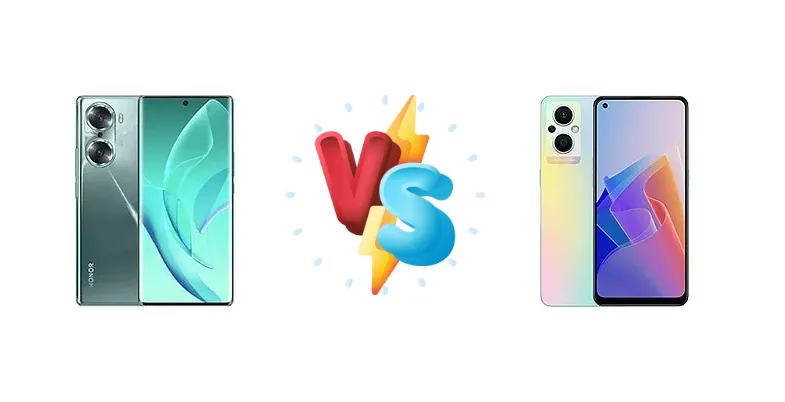
The Honor 60 and Oppo Reno7 Lite both target the competitive mid-range smartphone market, but they take different approaches. The Honor 60 leverages a more powerful Snapdragon 778G 5G chipset, while the Reno7 Lite focuses on a balance of features and affordability. This comparison dissects their key differences to help you determine which device best suits your needs.
🏆 Quick Verdict
For users prioritizing performance and faster charging, the Honor 60 is the clear winner. Its Snapdragon 778G offers a significant performance uplift over the Reno7 Lite’s Snapdragon 695. However, the Oppo Reno7 Lite provides a comparable battery endurance rating and a respectable display at a potentially lower price point.
| Network |
|---|
| 2G bands | GSM 850 / 900 / 1800 / 1900 | GSM 850 / 900 / 1800 / 1900 |
| 3G bands | HSDPA 800 / 850 / 900 / 1700(AWS) / 1900 / 2100 | HSDPA 800 / 850 / 900 / 1900 / 2100 |
| 4G bands | 1, 2, 3, 4, 5, 8, 18, 19, 26, 28, 34, 38, 39, 40, 41 | 1, 3, 5, 7, 8, 28, 34, 38, 39, 40, 41 |
| 5G bands | 1, 5, 8, 28, 41, 77, 78 SA/NSA | 1, 8, 28, 41, 77, 78 SA/NSA |
| Speed | HSPA, LTE, 5G | HSPA, LTE, 5G |
| Technology | GSM / CDMA / HSPA / CDMA2000 / LTE / 5G | GSM / HSPA / LTE / 5G |
| Launch |
|---|
| Announced | 2021, December 01 | 2022, April 14 |
| Status | Available. Released 2021, December 10 | Available. Released 2022, June |
| Body |
|---|
| Build | - | Glass front, plastic frame, glass back |
| Dimensions | 161.4 x 73.3 x 8 mm (6.35 x 2.89 x 0.31 in) | 159.9 x 73.2 x 7.5 mm (6.30 x 2.88 x 0.30 in) |
| SIM | Nano-SIM + Nano-SIM | Nano-SIM + Nano-SIM |
| Weight | 179 g (6.31 oz) | 173 g (6.10 oz) |
| | - | IPX4, dust and water resistant
RGB ring lights around the cameras (notifications, charging progress) |
| Display |
|---|
| Resolution | 1080 x 2400 pixels, 20:9 ratio (~395 ppi density) | 1080 x 2400 pixels, 20:9 ratio (~409 ppi density) |
| Size | 6.67 inches, 107.4 cm2 (~90.8% screen-to-body ratio) | 6.43 inches, 99.8 cm2 (~85.3% screen-to-body ratio) |
| Type | OLED, 1B colors, 120Hz, HDR10 | AMOLED, 430 nits (typ), 600 nits (HBM) |
| Platform |
|---|
| CPU | Octa-core (1x2.4 GHz Cortex-A78 & 3x2.2 GHz Cortex-A78 & 4x1.9 GHz Cortex-A55) | Octa-core (2x2.2 GHz Kryo 660 Gold & 6x1.7 GHz Kryo 660 Silver) |
| Chipset | Qualcomm SM7325 Snapdragon 778G 5G (6 nm) | Qualcomm SM6375 Snapdragon 695 5G (6 nm) |
| GPU | Adreno 642L | Adreno 619 |
| OS | Android 11, Magic UI 5.0 | Android 11, ColorOS 12 |
| Memory |
|---|
| Card slot | No | microSDXC |
| Internal | 128GB 8GB RAM, 256GB 8GB RAM, 256GB 12GB RAM | 128GB 8GB RAM, 256GB 8GB RAM |
| | - | UFS 2.2 |
| Main Camera |
|---|
| Features | Dual-LED flash, HDR, panorama | LED flash, HDR, panorama |
| Single | - | 16 MP, f/2.4, 27mm (wide), 1.0µm |
| Triple | 108 MP, f/1.9, (wide), 1/1.52", 0.7µm, PDAF
8 MP, f/2.2, 112˚ (ultrawide)
2 MP (macro) | 64 MP, f/1.7, 26mm (wide), PDAF
2 MP (macro)
Auxiliary lens |
| Video | 4K@30fps, 1080p@30/60fps, gyro-EIS | 1080p@30fps |
| Selfie camera |
|---|
| Features | - | HDR, panorama |
| Single | 32 MP, f/2.4, (wide) | 16 MP, f/2.4, 27mm (wide), 1.0µm |
| Video | 1080p@30fps, gyro-EIS | 1080p@30fps |
| Sound |
|---|
| 3.5mm jack | - | Yes |
| 35mm jack | No | Yes |
| Loudspeaker | Yes | Yes |
| Comms |
|---|
| Bluetooth | 5.2, A2DP, LE, aptX HD | 5.1, A2DP, LE, aptX HD |
| NFC | Yes | Yes |
| Positioning | GPS, GLONASS, BDS | GPS, GLONASS, BDS, GALILEO, QZSS |
| Radio | No | No |
| USB | USB Type-C 2.0, OTG | USB Type-C 2.0, OTG |
| WLAN | Wi-Fi 802.11 a/b/g/n/ac/6, dual-band, Wi-Fi Direct | Wi-Fi 802.11 a/b/g/n/ac, dual-band, Wi-Fi Direct |
| Features |
|---|
| Sensors | Fingerprint (under display, optical), accelerometer, gyro, proximity, compass | Fingerprint (under display, optical), accelerometer, proximity, gyro, compass |
| Battery |
|---|
| Charging | 66W wired, 50% in 15 min
5W reverse wired | 33W wired, PD, 31% in 15 min, 100% in 63 min
Reverse wired |
| Type | Li-Ion 4800 mAh | Li-Po 4500 mAh |
| Misc |
|---|
| Colors | Black, Green, Blue, Pink | Cosmic Black, Champagne Silver |
| Models | LSA-AN00 | CPH2343 |
| Price | About 500 EUR | About 350 EUR |
| Tests |
|---|
| Battery life | - |
Endurance rating 125h
|
| Camera | - |
Photo / Video |
| Display | - |
Contrast ratio: Infinite (nominal) |
| Loudspeaker | - |
-28.5 LUFS (Average)
|
| Performance | - |
AnTuTu: 315250 (v8), 376819 (v9)
GeekBench: 1996 (v5.1)
GFXBench: 17fps (ES 3.1 onscreen) |
Honor 60
- Significantly faster Snapdragon 778G 5G processor
- 66W fast charging for rapid power-ups
- Potentially superior display quality (depending on panel tech)
- Display specifications are largely unknown
- Camera details are limited
Oppo Reno7 Lite
- Competitive battery endurance rating (125h)
- More affordable price point (likely)
- 33W fast charging with PD support
- Slower Snapdragon 695 5G processor
- Slower charging speed compared to Honor 60
- Limited camera information
Display Comparison
The Oppo Reno7 Lite boasts a measured peak brightness of 657 nits, which is respectable for outdoor visibility. However, the Honor 60’s display specifications are not provided, making a direct brightness comparison difficult. Both devices feature an 'infinite' (nominal) contrast ratio, typical of OLED panels. Without knowing the panel technology used in the Honor 60 (e.g., LTPO), it’s hard to assess potential advantages in refresh rate management and power efficiency. The Reno7 Lite’s brightness suggests it will perform adequately in most lighting conditions, but the Honor 60 *could* offer a superior viewing experience if equipped with a higher-quality panel.
Camera Comparison
Both phones offer photo and video capabilities, but detailed camera specifications are limited. Without information on sensor sizes, aperture values, or optical image stabilization (OIS), a definitive camera comparison is challenging. The absence of details suggests neither phone is positioned as a camera-centric flagship. The Reno7 Lite’s camera system likely prioritizes versatility, while the Honor 60’s performance will depend on its image processing algorithms and sensor quality. We can assume both phones will perform adequately in good lighting conditions, but low-light performance is likely to be a differentiating factor.
Performance
The Honor 60’s Qualcomm SM7325 Snapdragon 778G 5G (6nm) is a substantial step up from the Oppo Reno7 Lite’s Snapdragon 695 5G (6nm). The 778G features a prime Cortex-A78 core clocked at 2.4 GHz, alongside three additional Cortex-A78 cores at 2.2 GHz, and four Cortex-A55 cores at 1.9 GHz. This contrasts with the Reno7 Lite’s dual 2.2 GHz Kryo 660 Gold cores and six 1.7 GHz Kryo 660 Silver cores. The 778G’s more powerful CPU architecture and core configuration translate to significantly faster application loading times, smoother multitasking, and improved gaming performance. While both chips are built on a 6nm process, the architectural differences favor the Honor 60 for demanding tasks.
Battery Life
Both the Honor 60 and Oppo Reno7 Lite achieve an endurance rating of 125 hours, suggesting similar real-world battery life. However, their charging speeds differ significantly. The Honor 60 supports 66W wired charging, achieving 50% charge in just 15 minutes, while the Reno7 Lite’s 33W charging takes 31% in the same timeframe and requires 63 minutes for a full charge. The Honor 60’s faster charging is a major advantage for users who frequently need to top up their battery quickly. The Reno7 Lite also offers reverse wired charging, a feature also present in the Honor 60, albeit at a lower wattage (5W vs unspecified for Reno7 Lite).
Buying Guide
Buy the Honor 60 if you need a phone capable of handling demanding games and applications smoothly, and if rapid 66W charging is a priority. Buy the Oppo Reno7 Lite if you prefer a phone with a focus on all-day battery life and a more budget-friendly price, and your usage is primarily focused on social media, browsing, and casual gaming.
Frequently Asked Questions
❓ Will the Snapdragon 695 in the Oppo Reno7 Lite struggle with graphically intensive games like Genshin Impact?
The Snapdragon 695 is a capable chip, but it's not designed for high-end gaming. While you can run Genshin Impact on the Reno7 Lite, you'll likely need to lower the graphics settings to achieve a playable frame rate. The Honor 60's Snapdragon 778G will provide a significantly smoother gaming experience at higher settings.
❓ How much faster is the 66W charging on the Honor 60 compared to the 33W charging on the Oppo Reno7 Lite in a typical use case?
The Honor 60's 66W charging can add approximately 35% battery life in 15 minutes, while the Reno7 Lite only gains about 16%. This means you can get a substantial boost in battery life during a quick coffee break with the Honor 60, whereas the Reno7 Lite requires a longer charging period to reach a similar level.
❓ Does the lack of detailed camera specs on both phones mean the camera performance will be similar?
Not necessarily. While the specs are missing, image processing plays a huge role. The Honor 60's image processing algorithms could be more advanced, leading to better photos even with a similar sensor. However, without more information, it's difficult to say for sure.