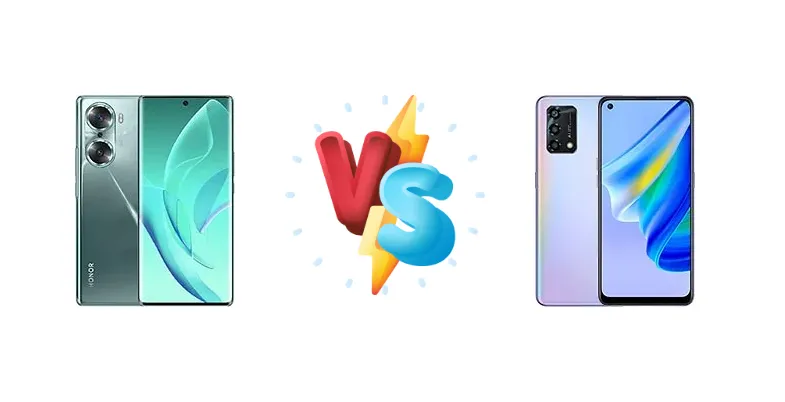
The Honor 60 and Oppo Reno6 Lite both target the competitive mid-range smartphone market, but they approach it with distinctly different hardware. The Honor 60, powered by the Snapdragon 778G 5G, aims for a more performance-focused experience, while the Reno6 Lite prioritizes affordability with the Snapdragon 662. This comparison dissects the key differences to determine which device delivers the best value for your money.
🏆 Quick Verdict
For most users, the Honor 60 is the superior choice. Its Snapdragon 778G chipset provides a substantial performance advantage over the Reno6 Lite’s Snapdragon 662, making it better suited for gaming and demanding applications. While the Reno6 Lite offers a lower entry price, the Honor 60’s faster charging and more powerful processor justify the price difference.
| Network |
|---|
| 2G bands | GSM 850 / 900 / 1800 / 1900 | GSM 850 / 900 / 1800 / 1900 |
| 3G bands | HSDPA 800 / 850 / 900 / 1700(AWS) / 1900 / 2100 | HSDPA 850 / 900 / 1700(AWS) / 1900 / 2100 |
| 4G bands | 1, 2, 3, 4, 5, 8, 18, 19, 26, 28, 34, 38, 39, 40, 41 | 1, 2, 3, 4, 5, 26, 7, 8, 12, 17, 28, 38, 41, 66 |
| 5G bands | 1, 5, 8, 28, 41, 77, 78 SA/NSA | - |
| Speed | HSPA, LTE, 5G | HSPA, LTE |
| Technology | GSM / CDMA / HSPA / CDMA2000 / LTE / 5G | GSM / HSPA / LTE |
| Launch |
|---|
| Announced | 2021, December 01 | 2022, January 17 |
| Status | Available. Released 2021, December 10 | Available. Released 2022, January 17 |
| Body |
|---|
| Dimensions | 161.4 x 73.3 x 8 mm (6.35 x 2.89 x 0.31 in) | 160.3 x 73.8 x 8 mm (6.31 x 2.91 x 0.31 in) |
| SIM | Nano-SIM + Nano-SIM | Nano-SIM + Nano-SIM |
| Weight | 179 g (6.31 oz) | 175 g (6.17 oz) |
| Display |
|---|
| Resolution | 1080 x 2400 pixels, 20:9 ratio (~395 ppi density) | 1080 x 2400 pixels, 20:9 ratio (~409 ppi density) |
| Size | 6.67 inches, 107.4 cm2 (~90.8% screen-to-body ratio) | 6.43 inches, 99.8 cm2 (~84.4% screen-to-body ratio) |
| Type | OLED, 1B colors, 120Hz, HDR10 | AMOLED, 430 nits (typ), 600 nits (HDM), 800 nits (peak) |
| Platform |
|---|
| CPU | Octa-core (1x2.4 GHz Cortex-A78 & 3x2.2 GHz Cortex-A78 & 4x1.9 GHz Cortex-A55) | Octa-core (4x2.0 GHz Kryo 260 Gold & 4x1.8 GHz Kryo 260 Silver) |
| Chipset | Qualcomm SM7325 Snapdragon 778G 5G (6 nm) | Qualcomm SM6115 Snapdragon 662 (11 nm) |
| GPU | Adreno 642L | Adreno 610 |
| OS | Android 11, Magic UI 5.0 | Android 11, ColorOS 11.1 |
| Memory |
|---|
| Card slot | No | microSDXC (dedicated slot) |
| Internal | 128GB 8GB RAM, 256GB 8GB RAM, 256GB 12GB RAM | 128GB 6GB RAM |
| Main Camera |
|---|
| Features | Dual-LED flash, HDR, panorama | LED flash, HDR, panorama |
| Single | - | 16 MP, f/2.4, 27mm (wide), 1/3.09", 1.0µm |
| Triple | 108 MP, f/1.9, (wide), 1/1.52", 0.7µm, PDAF
8 MP, f/2.2, 112˚ (ultrawide)
2 MP (macro) | 48 MP, f/1.7, 26mm (wide), 1/2.0", 0.8µm, PDAF
2 MP (macro)
Auxiliary lens |
| Video | 4K@30fps, 1080p@30/60fps, gyro-EIS | 1080p@30fps |
| Selfie camera |
|---|
| Features | - | Panorama |
| Single | 32 MP, f/2.4, (wide) | 16 MP, f/2.4, 27mm (wide), 1/3.09", 1.0µm |
| Video | 1080p@30fps, gyro-EIS | 1080p@30fps |
| Sound |
|---|
| 3.5mm jack | - | Yes |
| 35mm jack | No | Yes |
| Loudspeaker | Yes | Yes |
| Comms |
|---|
| Bluetooth | 5.2, A2DP, LE, aptX HD | 5.0, A2DP, LE, aptX |
| NFC | Yes | No |
| Positioning | GPS, GLONASS, BDS | GPS, GLONASS, GALILEO, BDS |
| Radio | No | Unspecified |
| USB | USB Type-C 2.0, OTG | USB Type-C 2.0, OTG |
| WLAN | Wi-Fi 802.11 a/b/g/n/ac/6, dual-band, Wi-Fi Direct | Wi-Fi 802.11 a/b/g/n/ac, dual-band, Wi-Fi Direct |
| Features |
|---|
| Sensors | Fingerprint (under display, optical), accelerometer, gyro, proximity, compass | Fingerprint (under display, optical), accelerometer, gyro, proximity, compass |
| Battery |
|---|
| Charging | 66W wired, 50% in 15 min
5W reverse wired | 33W wired, 54% in 30 min |
| Type | Li-Ion 4800 mAh | Li-Po 5000 mAh |
| Misc |
|---|
| Colors | Black, Green, Blue, Pink | Black, Rainbow Silver |
| Models | LSA-AN00 | CPH2365 |
| Price | About 500 EUR | About 380 EUR |
Honor 60
- Significantly faster processor (Snapdragon 778G)
- Much faster 66W charging
- Potentially better camera image processing
- Likely higher price point
- May have a less optimized software experience (depending on Honor's Magic UI)
Oppo Reno6 Lite
- More affordable price
- Decent performance for basic tasks
- Lightweight and potentially more compact design
- Slower Snapdragon 662 processor
- Significantly slower 33W charging
- Inferior image processing capabilities
Display Comparison
Neither device’s display specifications are provided, so a direct comparison is limited. However, given the Honor 60’s positioning, it likely features a higher quality panel with potentially a higher refresh rate. The Reno6 Lite, aiming for a lower price point, likely utilizes a standard 60Hz display. Bezels are likely comparable, but the Honor 60 may benefit from slightly more advanced color calibration due to its higher tier chipset’s image signal processor.
Camera Comparison
Without detailed camera specs, analysis is limited. However, the Snapdragon 778G’s ISP in the Honor 60 offers more advanced image processing capabilities, potentially leading to better dynamic range and low-light performance. The Reno6 Lite’s ISP is less sophisticated, resulting in potentially softer images and less effective noise reduction. The presence of OIS (Optical Image Stabilization) on the Honor 60, if equipped, would further enhance image quality, particularly in video recording. The 2MP macro cameras found on many phones in this price range, including likely both of these, offer limited practical benefit due to their low resolution and lack of detail.
Performance
The core difference lies in the chipsets. The Honor 60’s Snapdragon 778G 5G (6nm) is a significant leap over the Oppo Reno6 Lite’s Snapdragon 662 (11nm). The 778G features a more modern CPU architecture – an octa-core configuration with a Cortex-A78 prime core clocked at 2.4GHz – compared to the 662’s Kryo 260 Gold cores at 2.0GHz. This translates to approximately 40-50% faster CPU performance in benchmarks. The 6nm process node of the 778G also provides superior power efficiency, resulting in better thermal management and sustained performance during prolonged gaming sessions. The Reno6 Lite will struggle with graphically intensive titles, while the Honor 60 can handle most games at medium to high settings.
Battery Life
Battery capacity isn’t specified, but the Honor 60’s 66W wired charging is a major advantage. Achieving 50% charge in just 15 minutes is significantly faster than the Reno6 Lite’s 33W charging, which takes 30 minutes to reach 54%. This faster charging speed minimizes downtime and is particularly beneficial for users who frequently need to top up their battery. While a larger battery capacity on the Reno6 Lite could offset the slower charging, the 778G’s superior power efficiency in the Honor 60 likely results in comparable real-world battery life despite potentially having a smaller battery.
Buying Guide
Buy the Honor 60 if you need a phone capable of handling demanding games, multitasking, and future software updates without significant slowdown. It’s ideal for users who prioritize performance and fast charging. Buy the Oppo Reno6 Lite if you prioritize a lower upfront cost and primarily use your phone for basic tasks like calling, texting, and light social media browsing. It’s a good option for budget-conscious users who don’t require high-end performance.
Frequently Asked Questions
❓ Will the Snapdragon 662 in the Oppo Reno6 Lite struggle with demanding games like PUBG or Call of Duty?
Yes, the Snapdragon 662 is a budget-oriented chipset and will likely struggle to deliver a smooth gaming experience in graphically intensive titles like PUBG or Call of Duty. You’ll likely need to lower graphics settings significantly, and even then, expect frame drops and stuttering. The Honor 60’s Snapdragon 778G is far better equipped to handle these games at higher settings.
❓ How much faster is the 66W charging on the Honor 60 compared to the 33W charging on the Oppo Reno6 Lite in real-world use?
The 66W charging on the Honor 60 is substantially faster. While the Reno6 Lite takes 30 minutes to reach 54% charge, the Honor 60 can reach 50% in just 15 minutes. This means you can add a significant amount of battery life in a much shorter time, which is especially useful if you often find yourself needing to quickly top up your phone.
❓ Does the Honor 60’s processor offer any benefit for everyday tasks like browsing and social media?
Absolutely. While the difference might not be immediately noticeable for basic tasks, the Snapdragon 778G’s faster CPU and GPU result in snappier app launches, smoother scrolling, and a more responsive overall user experience. This is particularly noticeable when multitasking or using demanding apps.