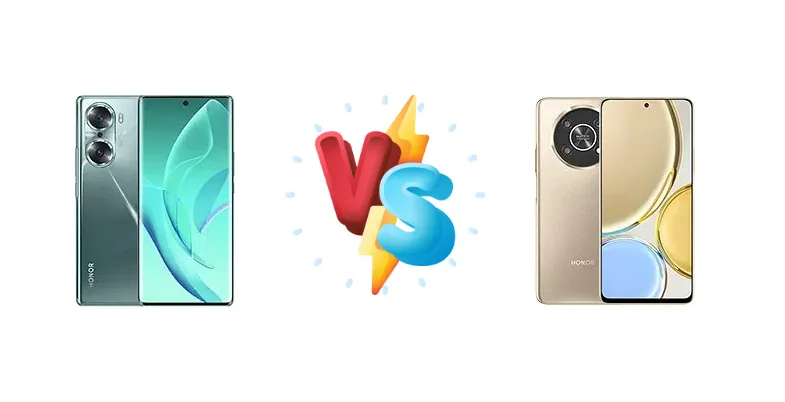
The Honor 60 and X30 represent distinct approaches within Honor’s mid-range lineup. The 60, powered by the Snapdragon 778G, aims for a balance of performance and style, while the X30 prioritizes affordability with the Snapdragon 695. This comparison dissects the key differences to help you determine which device best aligns with your needs and budget.
🏆 Quick Verdict
For users prioritizing consistent performance and smoother multitasking, the Honor 60 is the clear winner. Its Snapdragon 778G offers a significant uplift in CPU and GPU capabilities. However, the Honor X30 provides excellent value for budget-conscious buyers who don't demand the highest level of processing power.
| Network |
|---|
| 2G bands | GSM 850 / 900 / 1800 / 1900 | GSM 850 / 900 / 1800 / 1900 |
| 3G bands | HSDPA 800 / 850 / 900 / 1700(AWS) / 1900 / 2100 | HSDPA 850 / 900 / 1700(AWS) / 1900 / 2100 |
| 4G bands | 1, 2, 3, 4, 5, 8, 18, 19, 26, 28, 34, 38, 39, 40, 41 | LTE |
| 5G bands | 1, 5, 8, 28, 41, 77, 78 SA/NSA | SA/NSA |
| Speed | HSPA, LTE, 5G | HSPA, LTE, 5G |
| Technology | GSM / CDMA / HSPA / CDMA2000 / LTE / 5G | GSM / CDMA / HSPA / CDMA2000 / LTE / 5G |
| | - | CDMA2000 1x |
| Launch |
|---|
| Announced | 2021, December 01 | 2021, December 16 |
| Status | Available. Released 2021, December 10 | Available. Released 2021, December 25 |
| Body |
|---|
| Dimensions | 161.4 x 73.3 x 8 mm (6.35 x 2.89 x 0.31 in) | 166.1 x 75.8 x 8.1 mm (6.54 x 2.98 x 0.32 in) |
| SIM | Nano-SIM + Nano-SIM | Nano-SIM + Nano-SIM |
| Weight | 179 g (6.31 oz) | 189 g (6.67 oz) |
| Display |
|---|
| Resolution | 1080 x 2400 pixels, 20:9 ratio (~395 ppi density) | 1080 x 2388 pixels (~385 ppi density) |
| Size | 6.67 inches, 107.4 cm2 (~90.8% screen-to-body ratio) | 6.81 inches, 112.3 cm2 (~89.2% screen-to-body ratio) |
| Type | OLED, 1B colors, 120Hz, HDR10 | IPS LCD, 120Hz |
| Platform |
|---|
| CPU | Octa-core (1x2.4 GHz Cortex-A78 & 3x2.2 GHz Cortex-A78 & 4x1.9 GHz Cortex-A55) | Octa-core (2x2.2 GHz Kryo 660 Gold & 6x1.7 GHz Kryo 660 Silver) |
| Chipset | Qualcomm SM7325 Snapdragon 778G 5G (6 nm) | Qualcomm SM6375 Snapdragon 695 5G (6 nm) |
| GPU | Adreno 642L | Adreno 619 |
| OS | Android 11, Magic UI 5.0 | Android 11, Magic UI 5.0 |
| Memory |
|---|
| Card slot | No | No |
| Internal | 128GB 8GB RAM, 256GB 8GB RAM, 256GB 12GB RAM | 128GB 6GB RAM, 128GB 8GB RAM, 256GB 8GB RAM, 256GB 12GB RAM |
| Main Camera |
|---|
| Features | Dual-LED flash, HDR, panorama | LED flash, panorama, HDR |
| Single | - | 16 MP, f/2.5 |
| Triple | 108 MP, f/1.9, (wide), 1/1.52", 0.7µm, PDAF
8 MP, f/2.2, 112˚ (ultrawide)
2 MP (macro) | 48 MP, f/1.8, 26mm (wide), PDAF
2 MP (macro)
Auxiliary lens |
| Video | 4K@30fps, 1080p@30/60fps, gyro-EIS | 1080p@30fps |
| Selfie camera |
|---|
| Single | 32 MP, f/2.4, (wide) | 16 MP, f/2.5 |
| Video | 1080p@30fps, gyro-EIS | 1080p@30fps |
| Sound |
|---|
| 3.5mm jack | - | No |
| 35mm jack | No | No |
| Loudspeaker | Yes | Yes |
| Comms |
|---|
| Bluetooth | 5.2, A2DP, LE, aptX HD | 5.1, A2DP, LE |
| NFC | Yes | No |
| Positioning | GPS, GLONASS, BDS | GPS, GLONASS, BDS |
| Radio | No | No |
| USB | USB Type-C 2.0, OTG | USB Type-C 2.0, OTG |
| WLAN | Wi-Fi 802.11 a/b/g/n/ac/6, dual-band, Wi-Fi Direct | Wi-Fi 802.11 a/b/g/n/ac, dual-band, Wi-Fi Direct |
| Features |
|---|
| Sensors | Fingerprint (under display, optical), accelerometer, gyro, proximity, compass | Fingerprint (side-mounted), accelerometer, gyro, proximity, compass |
| Battery |
|---|
| Charging | 66W wired, 50% in 15 min
5W reverse wired | 66W wired, 80% in 30 min |
| Type | Li-Ion 4800 mAh | Li-Po 4800 mAh |
| Misc |
|---|
| Colors | Black, Green, Blue, Pink | Black, Blue, Silver, Gold |
| Models | LSA-AN00 | ANY-AN00 |
| Price | About 500 EUR | About 210 EUR |
Honor 60
- Superior performance with Snapdragon 778G
- Better gaming experience
- Faster app loading and multitasking
- Potentially shorter battery life
- May be more expensive than the X30
Honor X30
- Excellent value for money
- Potentially longer battery life
- Fast 66W charging
- Lower performance compared to the 60
- Less capable GPU for gaming
Display Comparison
Both phones utilize 6nm chipsets, suggesting similar power efficiency considerations for display panel choices. While specific display specs (resolution, refresh rate) aren't provided, the focus here is on the processing power driving the visuals. The Snapdragon 778G in the Honor 60 will deliver a smoother experience with graphically intensive content, ensuring higher and more stable frame rates. The X30’s 695 will be adequate for standard use, but may struggle with demanding games or high-resolution video playback.
Camera Comparison
Without detailed camera specifications, it’s difficult to make a definitive judgment. However, the processing power of the Snapdragon 778G in the Honor 60 will likely contribute to better image processing, particularly in low-light conditions. The ISP (Image Signal Processor) within the 778G is more capable, allowing for faster and more accurate noise reduction and detail enhancement. While both phones likely feature similar sensor configurations given their market positioning, the Honor 60 has the computational advantage.
Performance
The core difference lies in the chipsets. The Honor 60’s Snapdragon 778G 5G (6nm) features a 1x2.4 GHz Cortex-A78 prime core, alongside 3x2.2 GHz Cortex-A78 cores and 4x1.9 GHz Cortex-A55 efficiency cores. This configuration provides a substantial performance advantage over the Honor X30’s Snapdragon 695 5G (6nm) with its 2x2.2 GHz Kryo 660 Gold and 6x1.7 GHz Kryo 660 Silver cores. The 778G’s architecture, with more high-performance cores, translates to faster app loading times, smoother multitasking, and a more responsive overall experience. Gamers will particularly notice the difference, as the 778G’s Adreno 642L GPU significantly outperforms the 695’s Adreno 619.
Battery Life
Both phones feature 66W wired charging, but the X30 claims 80% charge in 30 minutes, while the 60 reaches 50% in 15 minutes. This suggests the X30 may have a slightly larger battery capacity, or a more optimized charging curve. However, the Snapdragon 778G’s greater power consumption could offset this advantage in real-world usage. The X30’s more efficient chipset will likely result in longer battery life during typical use, while the 60 may require more frequent charging, especially with demanding tasks.
Buying Guide
Buy the Honor 60 if you need a phone capable of handling demanding apps, enjoy mobile gaming, and appreciate a more responsive user experience. It’s ideal for content creators and power users. Buy the Honor X30 if you prioritize battery life, are on a tighter budget, and primarily use your phone for everyday tasks like browsing, social media, and light communication. It’s a solid choice for students and casual users.
Frequently Asked Questions
❓ Will the Snapdragon 695 in the Honor X30 struggle with graphically intensive games like Genshin Impact?
Yes, the Snapdragon 695 is not designed for high-end gaming. While it can run Genshin Impact, you'll likely need to lower the graphics settings significantly to achieve playable frame rates. The Honor 60’s Snapdragon 778G offers a much smoother and more enjoyable gaming experience.
❓ How much faster is the Honor 60 in everyday tasks like opening apps and browsing the web compared to the X30?
The Honor 60’s Snapdragon 778G provides a noticeable improvement in responsiveness. App launch times will be quicker, web pages will load faster, and multitasking will feel smoother. The difference is most apparent when switching between multiple apps or running demanding applications.
❓ Does the 66W charging on both phones support Power Delivery (PD) for charging other devices?
The Honor 60 supports 5W reverse wired charging, but it's a slow trickle charge. Neither phone is explicitly advertised as supporting the Power Delivery standard for fast charging external devices. They are optimized for quickly charging themselves.