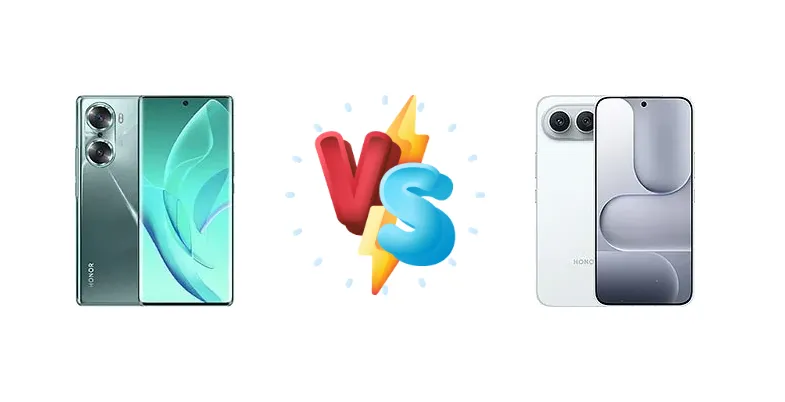
The Honor 60 and Honor 500 represent distinct points in Honor’s strategy. The 60, leveraging the Snapdragon 778G, aims for a balance of features and affordability. The 500, with the newer Snapdragon 8s Gen 4, targets users prioritizing performance without necessarily reaching flagship pricing. This comparison dissects the key differences to determine which device best suits your needs.
🏆 Quick Verdict
For the average user, the Honor 500 emerges as the stronger choice. Its Snapdragon 8s Gen 4 chipset delivers a significant performance uplift over the 778G in the 60, justifying the potential price difference. While the 60 offers respectable performance, the 500 provides a future-proofed experience for demanding tasks and gaming.
| Network |
|---|
| 2G bands | GSM 850 / 900 / 1800 / 1900 | GSM 850 / 900 / 1800 / 1900 |
| 3G bands | HSDPA 800 / 850 / 900 / 1700(AWS) / 1900 / 2100 | HSDPA 800 / 850 / 900 / 1700(AWS) / 1900 / 2100 |
| 4G bands | 1, 2, 3, 4, 5, 8, 18, 19, 26, 28, 34, 38, 39, 40, 41 | LTE |
| 5G bands | 1, 5, 8, 28, 41, 77, 78 SA/NSA | SA/NSA |
| Speed | HSPA, LTE, 5G | HSPA, LTE, 5G |
| Technology | GSM / CDMA / HSPA / CDMA2000 / LTE / 5G | GSM / HSPA / LTE / 5G |
| Launch |
|---|
| Announced | 2021, December 01 | 2025, November 24 |
| Status | Available. Released 2021, December 10 | Available. Released 2025, November 27 |
| Body |
|---|
| Build | - | Glass front, aluminum frame |
| Dimensions | 161.4 x 73.3 x 8 mm (6.35 x 2.89 x 0.31 in) | 155.8 x 74.2 x 7.8 mm (6.13 x 2.92 x 0.31 in) |
| SIM | Nano-SIM + Nano-SIM | Nano-SIM + Nano-SIM |
| Weight | 179 g (6.31 oz) | 198 g (6.98 oz) |
| Display |
|---|
| Protection | - | Aluminosilicate glass |
| Resolution | 1080 x 2400 pixels, 20:9 ratio (~395 ppi density) | 1264 x 2736 pixels, 19.5:9 ratio (~460 ppi density) |
| Size | 6.67 inches, 107.4 cm2 (~90.8% screen-to-body ratio) | 6.55 inches, 105.4 cm2 (~91.2% screen-to-body ratio) |
| Type | OLED, 1B colors, 120Hz, HDR10 | AMOLED, 1B colors, 120Hz, 3840Hz PWM, HDR Vivid, 6000 nits (peak) |
| Platform |
|---|
| CPU | Octa-core (1x2.4 GHz Cortex-A78 & 3x2.2 GHz Cortex-A78 & 4x1.9 GHz Cortex-A55) | Octa-core (1x3.21 GHz Cortex-X4 & 3x3.0 GHz Cortex-A720 & 2x2.8 GHz Cortex-A720 & 2x2.0 GHz Cortex-A720) |
| Chipset | Qualcomm SM7325 Snapdragon 778G 5G (6 nm) | Qualcomm SM8735 Snapdragon 8s Gen 4 (4 nm) |
| GPU | Adreno 642L | Adreno 825 |
| OS | Android 11, Magic UI 5.0 | Android 16, MagicOS 10 |
| Memory |
|---|
| Card slot | No | No |
| Internal | 128GB 8GB RAM, 256GB 8GB RAM, 256GB 12GB RAM | 256GB 12GB RAM, 512GB 12GB RAM, 512GB 16GB RAM |
| Main Camera |
|---|
| Dual | - | 200 MP, f/1.9, (wide), 1/1.4", 0.56µm, PDAF, OIS
12 MP, f/2.2, 117˚ (ultrawide), AF |
| Features | Dual-LED flash, HDR, panorama | LED flash, HDR, panorama |
| Triple | 108 MP, f/1.9, (wide), 1/1.52", 0.7µm, PDAF
8 MP, f/2.2, 112˚ (ultrawide)
2 MP (macro) | - |
| Video | 4K@30fps, 1080p@30/60fps, gyro-EIS | 4K, 1080p, gyro-EIS, OIS |
| Selfie camera |
|---|
| Features | - | HDR |
| Single | 32 MP, f/2.4, (wide) | 50 MP, f/2.0, (wide) |
| Video | 1080p@30fps, gyro-EIS | 4K, 1080p, gyro-EIS |
| Sound |
|---|
| 35mm jack | No | No |
| Loudspeaker | Yes | Yes, with stereo speakers |
| Comms |
|---|
| Bluetooth | 5.2, A2DP, LE, aptX HD | 6.0, A2DP, LE, aptX HD, aptX Adaptive, aptX Lossless, LHDC 5, Auracast, ASHA |
| Infrared port | - | Yes |
| NFC | Yes | Yes |
| Positioning | GPS, GLONASS, BDS | GPS (L1+L5), GLONASS (L1), BDS (B1I+B1c+B2a+B2b), GALILEO (E1+E5a+E5b), QZSS (L1+L5), NavIC (L5) |
| Radio | No | No |
| USB | USB Type-C 2.0, OTG | USB Type-C 2.0, OTG |
| WLAN | Wi-Fi 802.11 a/b/g/n/ac/6, dual-band, Wi-Fi Direct | Wi-Fi 802.11 a/b/g/n/ac/6/7, dual-band, Wi-Fi Direct |
| Features |
|---|
| Sensors | Fingerprint (under display, optical), accelerometer, gyro, proximity, compass | Fingerprint (under display, optical), accelerometer, gyro, proximity, compass (ultrasound) |
| Battery |
|---|
| Charging | 66W wired, 50% in 15 min
5W reverse wired | 80W wired
5W reverse wired |
| Type | Li-Ion 4800 mAh | Si/C Li-Ion 8000 mAh |
| Misc |
|---|
| Colors | Black, Green, Blue, Pink | Black, Silver, Blue, Pink |
| Models | LSA-AN00 | MEY-AN00 |
| Price | About 500 EUR | About 330 EUR |
Honor 60
- More affordable price point
- Efficient Snapdragon 778G chipset
- Fast 66W wired charging
- Less powerful processor compared to the 500
- Potentially less advanced camera system
Honor 500
- Significantly faster Snapdragon 8s Gen 4 processor
- Faster 80W wired charging
- Potentially better camera performance
- Higher price tag
- May generate more heat under sustained load (though 4nm helps)
Display Comparison
While display specifications aren't provided, we can infer differences based on the target market. The Honor 60 likely features a high-quality OLED panel, typical of its price range, with a standard refresh rate. The Honor 500, positioned higher, may incorporate a panel with a higher peak brightness and potentially LTPO technology for adaptive refresh rates, improving battery efficiency. Bezels are likely comparable, but the 500 might benefit from slightly more refined construction. Color accuracy will be good on both, but the 500 could offer wider color gamut support.
Camera Comparison
Without specific camera specs, we can analyze based on the device positioning. Both phones likely feature multi-camera systems. The Honor 500, being the more premium device, is expected to have a larger main sensor with a wider aperture, resulting in better low-light performance and dynamic range. Optical Image Stabilization (OIS) is more likely to be included on the 500. Image processing algorithms will also likely be more advanced on the 500, offering improved detail and color accuracy. The 60 will still deliver good results, but the 500 will offer a more refined and versatile camera experience.
Performance
The core difference lies in the chipsets. The Honor 60’s Snapdragon 778G 5G (6nm) is a proven performer, featuring an octa-core CPU with a Cortex-A78 prime core clocked at 2.4 GHz. However, the Honor 500’s Snapdragon 8s Gen 4 (4nm) represents a substantial leap forward. Its Cortex-X4 prime core at 3.21 GHz, coupled with three Cortex-A720 cores at 3.0 GHz, delivers significantly faster processing speeds. The 4nm process node also provides superior thermal efficiency, reducing throttling during sustained workloads. This translates to smoother gaming, faster app loading times, and improved multitasking on the 500. The 500 will also benefit from a more capable GPU.
Battery Life
Battery capacity isn't specified, but the charging speeds provide a clear advantage to the Honor 500. Its 80W wired charging significantly outperforms the 60’s 66W, allowing for faster top-ups. While both offer 5W reverse wired charging, the 500’s faster charging speed means less time tethered to a wall outlet. The more efficient 4nm process of the Snapdragon 8s Gen 4 in the 500 will also contribute to better battery life, even with similar battery capacities.
Buying Guide
Buy the Honor 60 if you prioritize a smooth, reliable experience for everyday tasks, social media, and light gaming, and are looking for a more budget-friendly option. You’ll appreciate its efficient chipset and fast 66W charging. Buy the Honor 500 if you demand higher performance for gaming, content creation, or multitasking, and are willing to spend a bit more for a more powerful processor and faster 80W charging. The 500 is the better long-term investment for power users.
Frequently Asked Questions
❓ Will the Snapdragon 8s Gen 4 in the Honor 500 get noticeably hotter than the 778G during extended gaming sessions?
While the Snapdragon 8s Gen 4 is more powerful, it also generates more heat. However, the 4nm manufacturing process significantly improves thermal efficiency compared to the 6nm process of the 778G. The Honor 500 is likely to have a more robust cooling system as well, mitigating potential overheating and minimizing throttling during prolonged gaming.
❓ How much of a real-world performance difference can I expect between the two chipsets for everyday tasks like browsing and social media?
For basic tasks, the difference will be minimal. Both chipsets are more than capable of handling everyday usage smoothly. However, you'll notice a difference in app loading times and multitasking. The 8s Gen 4 in the Honor 500 will feel snappier and more responsive when switching between apps or running multiple applications simultaneously.
❓ Is the 80W charging on the Honor 500 significantly faster than the 66W charging on the Honor 60?
Yes, the 80W charging on the Honor 500 is noticeably faster. While both offer fast charging, the 80W can typically charge a phone from 0% to 100% in under 40 minutes, while the 66W will likely take closer to 45-50 minutes. The 500 also gains a more substantial charge in shorter bursts, making it ideal for quick top-ups.