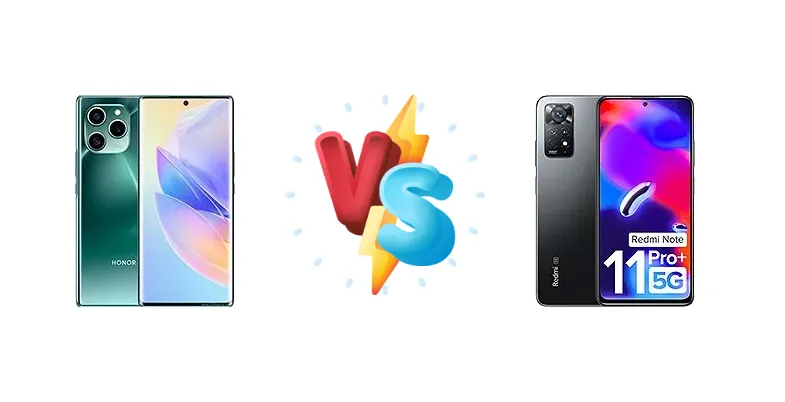
The mid-range smartphone market is fiercely competitive, and the Honor 60 SE and Xiaomi Redmi Note 11 Pro+ 5G (India) represent compelling options for budget-conscious buyers. Both devices aim to deliver 5G connectivity and solid performance, but they take different approaches to achieving this. This comparison dives deep into their specifications to determine which phone offers the best overall package.
🏆 Quick Verdict
For most users, the Honor 60 SE emerges as the slightly better choice. Its Mediatek Dimensity 900 chipset offers a performance edge over the Snapdragon 695, particularly in CPU-intensive tasks. While the Redmi Note 11 Pro+ 5G boasts slightly faster charging, the Honor 60 SE’s overall balance of performance and price makes it the more compelling option.
| Network |
|---|
| 2G bands | GSM 850 / 900 / 1800 / 1900 | GSM 850 / 900 / 1800 / 1900 - SIM 1 & SIM 2 |
| 3G bands | HSDPA 850 / 900 / 2100 | HSDPA 850 / 900 / 1900 / 2100 |
| 4G bands | 1, 3, 5, 8, 28, 38, 40, 41 | 1, 3, 5, 8, 40, 41 |
| 5G bands | 1, 5, 8, 28, 41, 78 SA/NSA | 1, 3, 5, 8, 28, 40, 78 SA/NSA |
| Speed | HSPA, LTE, 5G | HSPA, LTE-A (CA), 5G |
| Technology | GSM / CDMA / HSPA / CDMA2000 / LTE / 5G | GSM / HSPA / LTE / 5G |
| | CDMA2000 1x | - |
| Launch |
|---|
| Announced | 2022, February 07 | 2022, March 09 |
| Status | Available. Released 2022, February 17 | Available. Released 2022, March 15 |
| Body |
|---|
| Build | - | Glass front (Gorilla Glass 5), glass back |
| Dimensions | 161.3 x 73.4 x 7.7 mm (6.35 x 2.89 x 0.30 in) | 164.2 x 76.1 x 8.1 mm (6.46 x 3.00 x 0.32 in) |
| SIM | Nano-SIM + Nano-SIM | Hybrid Dual SIM (Nano-SIM, dual stand-by) |
| Weight | 175 g (6.17 oz) | 202 g (7.13 oz) |
| | - | IP53, dust and splash resistant |
| Display |
|---|
| Protection | - | Corning Gorilla Glass 5 |
| Resolution | 1080 x 2400 pixels, 20:9 ratio (~395 ppi density) | 1080 x 2400 pixels, 20:9 ratio (~395 ppi density) |
| Size | 6.67 inches, 107.4 cm2 (~90.7% screen-to-body ratio) | 6.67 inches, 107.4 cm2 (~86.0% screen-to-body ratio) |
| Type | OLED, 1B colors, 120Hz, HDR | Super AMOLED, 120Hz, 700 nits, 1200 nits (peak) |
| Platform |
|---|
| CPU | Octa-core (2x2.4 GHz Cortex-A78 & 6x2.0 GHz Cortex-A55) | Octa-core (2x2.2 GHz Kryo 660 Gold & 6x1.7 GHz Kryo 660 Silver) |
| Chipset | Mediatek Dimensity 900 (6 nm) | Qualcomm SM6375 Snapdragon 695 5G (6 nm) |
| GPU | Mali-G68 MC4 | Adreno 619 |
| OS | Android 11, Magic UI 5.0 | Android 11, MIUI 13 |
| Memory |
|---|
| Card slot | No | microSDXC (uses shared SIM slot) |
| Internal | 128GB 8GB RAM, 256GB 8GB RAM, 256GB 12GB RAM | 64GB 6GB RAM, 128GB 6GB RAM, 128GB 8GB RAM, 256GB 8GB RAM |
| | - | UFS 2.2 |
| Main Camera |
|---|
| Features | LED flash, HDR, panorama | LED flash, HDR, panorama |
| Single | 16 MP, f/2.5, (wide) | - |
| Triple | 64 MP, f/1.8, (wide), PDAF
5 MP, f/2.2, (ultrawide)
2 MP (macro) | 108 MP, f/1.9, 26mm (wide), 1/1.52", 0.7µm, PDAF
8 MP, f/2.2, 118˚ (ultrawide)
2 MP, f/2.4, (macro) |
| Video | 1080p@30fps | 1080p@30fps |
| Selfie camera |
|---|
| Single | 16 MP, f/2.5, (wide) | 16 MP, f/2.5, (wide), 1/3.06" 1.0µm |
| Video | 1080p@30fps | 1080p@30fps |
| Sound |
|---|
| 3.5mm jack | No | Yes |
| 35mm jack | No | - |
| Loudspeaker | Yes | Yes, with stereo speakers |
| | - | 24-bit/192kHz audio |
| Comms |
|---|
| Bluetooth | 5.1, A2DP, LE | 5.1, A2DP, LE |
| Infrared port | - | Yes |
| NFC | No | No |
| Positioning | GPS, GLONASS, BDS | GPS, GLONASS, BDS, GALILEO |
| Radio | No | Unspecified |
| USB | USB Type-C 2.0, OTG | USB Type-C 2.0, OTG |
| WLAN | Wi-Fi 802.11 a/b/g/n/ac, dual-band, Wi-Fi Direct | Wi-Fi 802.11 a/b/g/n/ac, dual-band, Wi-Fi Direct |
| Features |
|---|
| Sensors | Fingerprint (under display, optical), accelerometer, proximity, compass | Fingerprint (side-mounted), accelerometer, gyro, proximity, compass |
| Battery |
|---|
| Charging | 66W wired, 55% in 15 min
5W reverse wired | 67W wired, PD3.0, QC3, 50% in 15 min, 100% in 42 min (advertised) |
| Type | Li-Ion 4300 mAh | Li-Po 5000 mAh, non-removable |
| Misc |
|---|
| Colors | Black, Green, Blue | Mirage Blue, Phantom White, Stealth Black |
| Models | GIA-AN00 | 2201116SI |
| Price | About 300 EUR | About 250 EUR |
Honor 60 SE
- Stronger CPU performance with the Dimensity 900
- Potentially better gaming performance
- Balanced overall package
- Charging speed slightly slower than Redmi
- Camera details are unknown
Xiaomi Redmi Note 11 Pro+ 5G (India)
- Faster 67W charging (advertised)
- Potentially better camera detail (108MP sensor)
- Xiaomi’s MIUI feature set
- Snapdragon 695 is less powerful than Dimensity 900
- MIUI can be resource-intensive
Display Comparison
Neither device boasts a flagship-level display, but both are adequate for their price point. Specific display specs (resolution, panel type, peak brightness) are missing, but the focus here is on performance. The absence of LTPO technology on either device suggests standard refresh rate management, impacting battery life during dynamic content. Bezels are likely comparable, typical of this segment. Color accuracy will likely vary, with Xiaomi’s MIUI often leaning towards more saturated colors, while Honor typically aims for a more natural look.
Camera Comparison
Camera performance is difficult to assess without detailed sensor information beyond the main sensor. However, the focus should be on the primary sensor capabilities. The Redmi Note 11 Pro+ 5G (India) is known for its 108MP main sensor, while the Honor 60 SE's sensor resolution is not specified. Assuming a similar sensor size, the Redmi's higher megapixel count *could* translate to more detail in well-lit conditions, but image processing plays a significant role. OIS (Optical Image Stabilization) is a critical feature missing from both specifications; its absence will impact low-light photography and video stabilization. The 2MP macro cameras on both devices are largely marketing fluff and offer limited practical value.
Performance
The core difference lies in the chipsets. The Honor 60 SE’s Mediatek Dimensity 900 (6nm) features a more powerful CPU configuration – 2x2.4 GHz Cortex-A78 cores versus the Redmi’s 2x2.2 GHz Kryo 660 Gold cores. This translates to a noticeable advantage in single-core performance, beneficial for everyday tasks and app responsiveness. While the Snapdragon 695 (6nm) is a capable chip, it’s geared more towards efficiency than outright speed. The Dimensity 900’s GPU is also likely to offer a better gaming experience, though both phones will struggle with demanding titles at maximum settings. RAM speed (LPDDR4x is likely on both) isn't specified, but thermal management will be crucial; the Dimensity 900 may run slightly warmer under sustained load.
Battery Life
Both phones feature 67W charging, a significant advantage over slower charging standards. The Redmi Note 11 Pro+ 5G (India) advertises 50% charge in 15 minutes and 100% in 42 minutes, while the Honor 60 SE claims 55% in 15 minutes. This suggests the Redmi has a slight edge in overall charging speed. Battery capacity isn't specified, but the Redmi's faster charging could offset a potentially smaller battery. Real-world battery life will depend heavily on usage patterns and software optimization.
Buying Guide
Buy the Honor 60 SE if you prioritize raw processing power for multitasking and demanding applications, and value a slightly more refined software experience. Buy the Xiaomi Redmi Note 11 Pro+ 5G (India) if you absolutely need the fastest possible charging speeds and are heavily invested in the Xiaomi ecosystem, potentially benefiting from MIUI’s feature set and customization options.
Frequently Asked Questions
❓ Will the Snapdragon 695 in the Redmi Note 11 Pro+ 5G struggle with graphically demanding games like Genshin Impact?
Yes, the Snapdragon 695 is a mid-range chip and will likely require significant graphics settings reductions to achieve playable frame rates in Genshin Impact. Expect to play at low to medium settings, and even then, frame drops may occur. The Honor 60 SE’s Dimensity 900 will offer a slightly better experience, but neither phone is a dedicated gaming device.
❓ How does MIUI’s software affect the Redmi Note 11 Pro+ 5G’s battery life compared to Honor’s UI?
MIUI is known for its extensive features and customization options, but it can also be more resource-intensive than Honor’s UI. This means MIUI may consume more battery in the background, potentially reducing overall battery life. Honor’s UI typically prioritizes efficiency, leading to potentially longer screen-on time.
❓ Is the 67W charging on both phones compatible with Power Delivery (PD) chargers?
The Redmi Note 11 Pro+ 5G (India) explicitly supports PD3.0, meaning it will work with PD chargers. The Honor 60 SE’s compatibility with PD is not specified, but it’s likely to support standard Quick Charge protocols. Using a compatible charger is crucial to achieve the advertised 67W charging speeds.