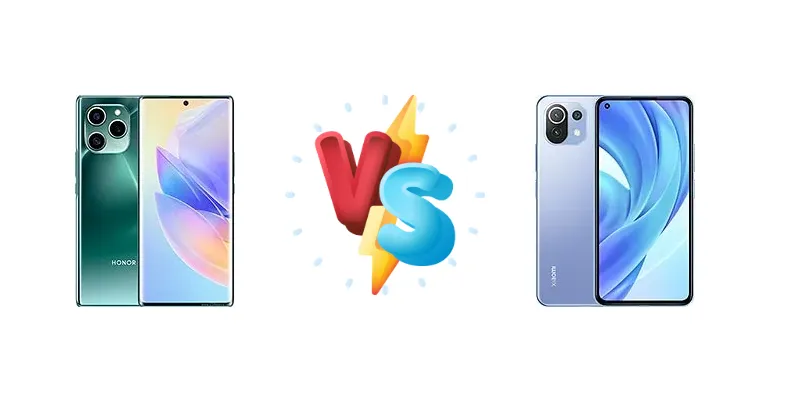
The Honor 60 SE and Xiaomi Mi 11 Lite represent compelling options in the increasingly competitive mid-range smartphone market. While both aim for a balance of features and affordability, they take different approaches to achieving it. The Mi 11 Lite prioritizes a lightweight design and a bright display, while the Honor 60 SE focuses on faster charging and a more modern chipset.
🏆 Quick Verdict
For the average user prioritizing everyday performance and quick top-ups, the Honor 60 SE is the better choice. Its Mediatek Dimensity 900 chipset offers a performance edge, and the 66W charging significantly reduces downtime compared to the Mi 11 Lite’s 33W charging, despite both phones boasting a 100-hour endurance rating.
| Network |
|---|
| 2G bands | GSM 850 / 900 / 1800 / 1900 | GSM 850 / 900 / 1800 / 1900 |
| 3G bands | HSDPA 850 / 900 / 2100 | HSDPA 850 / 900 / 1700(AWS) / 1900 / 2100 |
| 4G bands | 1, 3, 5, 8, 28, 38, 40, 41 | 1, 2, 3, 4, 5, 7, 8, 12, 17, 20, 28, 32, 38, 40, 41, 66 |
| 5G bands | 1, 5, 8, 28, 41, 78 SA/NSA | - |
| Speed | HSPA, LTE, 5G | HSPA, LTE |
| Technology | GSM / CDMA / HSPA / CDMA2000 / LTE / 5G | GSM / HSPA / LTE |
| | CDMA2000 1x | - |
| Launch |
|---|
| Announced | 2022, February 07 | 2021, March 29 |
| Status | Available. Released 2022, February 17 | Available. Released 2021, April 16 |
| Body |
|---|
| Dimensions | 161.3 x 73.4 x 7.7 mm (6.35 x 2.89 x 0.30 in) | 160.5 x 75.7 x 6.8 mm (6.32 x 2.98 x 0.27 in) |
| SIM | Nano-SIM + Nano-SIM | Nano-SIM + Nano-SIM |
| Weight | 175 g (6.17 oz) | 157 g (5.54 oz) |
| | - | IP53, dust and splash resistant |
| Display |
|---|
| Protection | - | Corning Gorilla Glass 5 |
| Resolution | 1080 x 2400 pixels, 20:9 ratio (~395 ppi density) | 1080 x 2400 pixels, 20:9 ratio (~402 ppi density) |
| Size | 6.67 inches, 107.4 cm2 (~90.7% screen-to-body ratio) | 6.55 inches, 103.6 cm2 (~85.3% screen-to-body ratio) |
| Type | OLED, 1B colors, 120Hz, HDR | AMOLED, 1B colors, HDR10, 90Hz, 500 nits (typ), 800 nits |
| Platform |
|---|
| CPU | Octa-core (2x2.4 GHz Cortex-A78 & 6x2.0 GHz Cortex-A55) | Octa-core (2x2.3 GHz Kryo 470 Gold & 6x1.8 GHz Kryo 470 Silver) |
| Chipset | Mediatek Dimensity 900 (6 nm) | Qualcomm SM7150 Snapdragon 732G (8 nm) |
| GPU | Mali-G68 MC4 | Adreno 618 |
| OS | Android 11, Magic UI 5.0 | Android 11, MIUI 12 |
| Memory |
|---|
| Card slot | No | microSDXC (uses shared SIM slot) |
| Internal | 128GB 8GB RAM, 256GB 8GB RAM, 256GB 12GB RAM | 64GB 4GB RAM, 64GB 6GB RAM, 128GB 6GB RAM, 128GB 8GB RAM |
| | - | UFS 2.2 |
| Main Camera |
|---|
| Features | LED flash, HDR, panorama | Dual-LED dual-tone flash, HDR, panorama |
| Single | 16 MP, f/2.5, (wide) | - |
| Triple | 64 MP, f/1.8, (wide), PDAF
5 MP, f/2.2, (ultrawide)
2 MP (macro) | 64 MP, f/1.8, 26mm (wide), 1/1.97", 0.7µm, PDAF
8 MP, f/2.2, 119˚ (ultrawide), 1/4.0", 1.12µm
5 MP (macro), AF |
| Video | 1080p@30fps | 4K@30fps, 1080p@30/60/120fps; gyro-EIS |
| Selfie camera |
|---|
| Features | - | HDR, panorama |
| Single | 16 MP, f/2.5, (wide) | 16 MP, f/2.5, (wide), 1/3.06" 1.0µm |
| Video | 1080p@30fps | 1080p@30fps, 720p@120fps |
| Sound |
|---|
| 3.5mm jack | No | No |
| 35mm jack | No | No |
| Loudspeaker | Yes | Yes, with dual speakers |
| | - | 24-bit/192kHz audio |
| Comms |
|---|
| Bluetooth | 5.1, A2DP, LE | 5.1, A2DP, LE |
| Infrared port | - | Yes |
| NFC | No | Yes (market/region dependent) |
| Positioning | GPS, GLONASS, BDS | GPS, GLONASS, BDS, GALILEO |
| Radio | No | No |
| USB | USB Type-C 2.0, OTG | USB Type-C 2.0, OTG |
| WLAN | Wi-Fi 802.11 a/b/g/n/ac, dual-band, Wi-Fi Direct | Wi-Fi 802.11 a/b/g/n/ac, dual-band, Wi-Fi Direct |
| Features |
|---|
| Sensors | Fingerprint (under display, optical), accelerometer, proximity, compass | Fingerprint (side-mounted), accelerometer, gyro, compass |
| | - | Virtual proximity sensing |
| Battery |
|---|
| Charging | 66W wired, 55% in 15 min
5W reverse wired | 33W wired |
| Type | Li-Ion 4300 mAh | Li-Po 4250 mAh |
| Misc |
|---|
| Colors | Black, Green, Blue | Boba Black (Vinyl Black), Peach Pink (Tuscany Coral), Bubblegum Blue (Jazz Blue) |
| Models | GIA-AN00 | M2101K9AG, M2101K9AI |
| Price | About 300 EUR | £ 221.40 / € 106.34 |
| SAR | - | 1.07 W/kg (head) 0.82 W/kg (body) |
| SAR EU | - | 0.60 W/kg (head) 0.95 W/kg (body) |
| Tests |
|---|
| Battery life | - |
Endurance rating 100h
|
| Camera | - |
Photo / Video |
| Display | - |
Contrast ratio: Infinite (nominal) |
| Loudspeaker | - |
-24.2 LUFS (Very good)
|
| Performance | - |
AnTuTu: 290172 (v8), 294251 (v9)
GeekBench: 1796 (v5.1)
GFXBench: 17fps (ES 3.1 onscreen) |
Honor 60 SE
- Faster 66W charging significantly reduces downtime.
- More powerful Mediatek Dimensity 900 chipset for better performance.
- Potentially better thermal management due to 6nm process.
- Specific display details (resolution, panel type) are unknown.
- Camera specifications are not detailed.
Xiaomi Mi 11 Lite
- Bright 826 nit display for excellent outdoor visibility.
- Lightweight and sleek design for comfortable handling.
- Good battery endurance (100h rating).
- Slower 33W charging.
- Less powerful Snapdragon 732G chipset.
Display Comparison
The Xiaomi Mi 11 Lite boasts a bright display, reaching a measured peak brightness of 826 nits, ensuring excellent visibility even outdoors. While the Honor 60 SE’s display specifications aren’t provided, the Mi 11 Lite’s infinite contrast ratio (nominal) suggests a typical AMOLED panel. The Mi 11 Lite’s focus on a slim bezel design contributes to its overall lightweight feel, a key differentiator. Without specific details on the Honor 60 SE’s panel type or resolution, the Mi 11 Lite holds an advantage in display quality based on available data.
Camera Comparison
Both devices feature photo and video capabilities, but detailed camera specifications are limited. Without information on sensor sizes, aperture values, or image stabilization (OIS), a direct comparison is difficult. However, the market segment suggests both phones likely employ similar mid-range camera setups. The absence of specific details necessitates caution; focusing on image samples and user reviews would be crucial for a definitive camera assessment. We can assume both phones will have a standard set of lenses, but the image processing algorithms will likely differ.
Performance
The Honor 60 SE’s Mediatek Dimensity 900 (6nm) chipset offers a notable advantage over the Xiaomi Mi 11 Lite’s Qualcomm Snapdragon 732G (8nm). The Dimensity 900’s Cortex-A78 cores, clocked at 2.4 GHz, provide a performance boost over the Kryo 470 Gold cores in the Snapdragon 732G, which peak at 2.3 GHz. The 6nm process node of the Dimensity 900 also contributes to improved power efficiency. While both are octa-core CPUs, the architectural differences and process node give the Honor 60 SE an edge in sustained performance and potentially better thermal management during extended use.
Battery Life
Both the Honor 60 SE and Xiaomi Mi 11 Lite achieve an endurance rating of 100 hours, suggesting comparable battery life under similar usage conditions. However, the Honor 60 SE’s 66W wired charging is a significant advantage, capable of charging to 55% in just 15 minutes. The Mi 11 Lite’s 33W charging is considerably slower. This difference in charging speed directly impacts user experience, allowing the Honor 60 SE to quickly recover from low battery situations, even if the overall battery capacity is similar (unspecified for the Honor 60 SE).
Buying Guide
Buy the Honor 60 SE if you need faster charging speeds and a more capable processor for demanding apps and light gaming. This phone suits users who are frequently on the go and need to quickly replenish their battery. Buy the Xiaomi Mi 11 Lite if you prioritize a lightweight and sleek design with a very bright display, and your usage is primarily focused on social media, browsing, and casual content consumption. It’s ideal for those who value portability and a visually vibrant screen.
Frequently Asked Questions
❓ How much faster is the 66W charging on the Honor 60 SE compared to the 33W charging on the Mi 11 Lite in real-world use?
The 66W charging on the Honor 60 SE can take a phone from 0% to 55% in just 15 minutes. The Mi 11 Lite’s 33W charging will take considerably longer to reach the same charge level, potentially over 30-45 minutes. This difference is significant for users who frequently need to quickly top up their battery.
❓ Will the Mediatek Dimensity 900 in the Honor 60 SE handle demanding games like PUBG or Genshin Impact smoothly?
The Dimensity 900 is a capable chipset that should handle PUBG and Genshin Impact at medium to high settings with playable frame rates. While it's not a flagship processor, its Cortex-A78 cores and 6nm process provide sufficient power for a good gaming experience. However, sustained performance may be limited by thermal throttling.
❓ Is the Mi 11 Lite's lightweight design a significant advantage for one-handed use?
Yes, the Mi 11 Lite's lightweight design (around 158g) makes it exceptionally comfortable to hold and use with one hand, especially for extended periods. This is a key benefit for users who prioritize portability and ease of use.