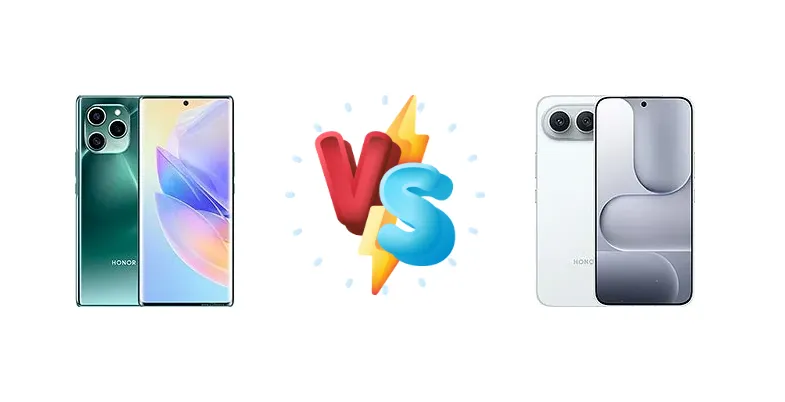
The Honor 60 SE has been a popular mid-range contender, offering a solid experience at an attractive price. Now, Honor introduces the 500, featuring Qualcomm’s newer Snapdragon 8s Gen 4. This comparison dissects the key differences between these two devices, focusing on how the chipset upgrade impacts real-world performance and whether the 500 justifies its likely higher price point.
🏆 Quick Verdict
For most users, the Honor 500 emerges as the superior choice. The Snapdragon 8s Gen 4’s 4nm process and more modern CPU architecture deliver a noticeable performance boost, particularly in demanding tasks and gaming. While the 60 SE remains a capable device, the 500’s efficiency and speed make it the better long-term investment.
| Network |
|---|
| 2G bands | GSM 850 / 900 / 1800 / 1900 | GSM 850 / 900 / 1800 / 1900 |
| 3G bands | HSDPA 850 / 900 / 2100 | HSDPA 800 / 850 / 900 / 1700(AWS) / 1900 / 2100 |
| 4G bands | 1, 3, 5, 8, 28, 38, 40, 41 | LTE |
| 5G bands | 1, 5, 8, 28, 41, 78 SA/NSA | SA/NSA |
| Speed | HSPA, LTE, 5G | HSPA, LTE, 5G |
| Technology | GSM / CDMA / HSPA / CDMA2000 / LTE / 5G | GSM / HSPA / LTE / 5G |
| | CDMA2000 1x | - |
| Launch |
|---|
| Announced | 2022, February 07 | 2025, November 24 |
| Status | Available. Released 2022, February 17 | Available. Released 2025, November 27 |
| Body |
|---|
| Build | - | Glass front, aluminum frame |
| Dimensions | 161.3 x 73.4 x 7.7 mm (6.35 x 2.89 x 0.30 in) | 155.8 x 74.2 x 7.8 mm (6.13 x 2.92 x 0.31 in) |
| SIM | Nano-SIM + Nano-SIM | Nano-SIM + Nano-SIM |
| Weight | 175 g (6.17 oz) | 198 g (6.98 oz) |
| Display |
|---|
| Protection | - | Aluminosilicate glass |
| Resolution | 1080 x 2400 pixels, 20:9 ratio (~395 ppi density) | 1264 x 2736 pixels, 19.5:9 ratio (~460 ppi density) |
| Size | 6.67 inches, 107.4 cm2 (~90.7% screen-to-body ratio) | 6.55 inches, 105.4 cm2 (~91.2% screen-to-body ratio) |
| Type | OLED, 1B colors, 120Hz, HDR | AMOLED, 1B colors, 120Hz, 3840Hz PWM, HDR Vivid, 6000 nits (peak) |
| Platform |
|---|
| CPU | Octa-core (2x2.4 GHz Cortex-A78 & 6x2.0 GHz Cortex-A55) | Octa-core (1x3.21 GHz Cortex-X4 & 3x3.0 GHz Cortex-A720 & 2x2.8 GHz Cortex-A720 & 2x2.0 GHz Cortex-A720) |
| Chipset | Mediatek Dimensity 900 (6 nm) | Qualcomm SM8735 Snapdragon 8s Gen 4 (4 nm) |
| GPU | Mali-G68 MC4 | Adreno 825 |
| OS | Android 11, Magic UI 5.0 | Android 16, MagicOS 10 |
| Memory |
|---|
| Card slot | No | No |
| Internal | 128GB 8GB RAM, 256GB 8GB RAM, 256GB 12GB RAM | 256GB 12GB RAM, 512GB 12GB RAM, 512GB 16GB RAM |
| Main Camera |
|---|
| Dual | - | 200 MP, f/1.9, (wide), 1/1.4", 0.56µm, PDAF, OIS
12 MP, f/2.2, 117˚ (ultrawide), AF |
| Features | LED flash, HDR, panorama | LED flash, HDR, panorama |
| Single | 16 MP, f/2.5, (wide) | - |
| Triple | 64 MP, f/1.8, (wide), PDAF
5 MP, f/2.2, (ultrawide)
2 MP (macro) | - |
| Video | 1080p@30fps | 4K, 1080p, gyro-EIS, OIS |
| Selfie camera |
|---|
| Features | - | HDR |
| Single | 16 MP, f/2.5, (wide) | 50 MP, f/2.0, (wide) |
| Video | 1080p@30fps | 4K, 1080p, gyro-EIS |
| Sound |
|---|
| 3.5mm jack | No | - |
| 35mm jack | No | No |
| Loudspeaker | Yes | Yes, with stereo speakers |
| Comms |
|---|
| Bluetooth | 5.1, A2DP, LE | 6.0, A2DP, LE, aptX HD, aptX Adaptive, aptX Lossless, LHDC 5, Auracast, ASHA |
| Infrared port | - | Yes |
| NFC | No | Yes |
| Positioning | GPS, GLONASS, BDS | GPS (L1+L5), GLONASS (L1), BDS (B1I+B1c+B2a+B2b), GALILEO (E1+E5a+E5b), QZSS (L1+L5), NavIC (L5) |
| Radio | No | No |
| USB | USB Type-C 2.0, OTG | USB Type-C 2.0, OTG |
| WLAN | Wi-Fi 802.11 a/b/g/n/ac, dual-band, Wi-Fi Direct | Wi-Fi 802.11 a/b/g/n/ac/6/7, dual-band, Wi-Fi Direct |
| Features |
|---|
| Sensors | Fingerprint (under display, optical), accelerometer, proximity, compass | Fingerprint (under display, optical), accelerometer, gyro, proximity, compass (ultrasound) |
| Battery |
|---|
| Charging | 66W wired, 55% in 15 min
5W reverse wired | 80W wired
5W reverse wired |
| Type | Li-Ion 4300 mAh | Si/C Li-Ion 8000 mAh |
| Misc |
|---|
| Colors | Black, Green, Blue | Black, Silver, Blue, Pink |
| Models | GIA-AN00 | MEY-AN00 |
| Price | About 300 EUR | About 330 EUR |
Honor 60 SE
- More affordable price point
- Competent performance for everyday tasks
- Fast 66W charging
- Older chipset architecture
- Less efficient than Snapdragon 8s Gen 4
- Potentially limited long-term software support
Honor 500
- Significantly faster Snapdragon 8s Gen 4 processor
- Improved power efficiency and thermal management
- Faster 80W charging
- More future-proofed for demanding apps and games
- Likely higher price tag
- May not represent a massive leap for basic users
Display Comparison
Both devices’ display specifications are not provided, so a direct comparison is limited. However, given the Honor 60 SE’s positioning, it likely features a 120Hz OLED panel. The Honor 500, aiming for a higher tier, may incorporate advancements like LTPO technology for variable refresh rates, improving battery efficiency. Bezels are expected to be minimal on both, but the 500 could benefit from a slightly higher peak brightness due to the newer chipset’s display engine capabilities.
Camera Comparison
Without specific camera specs, analysis is limited. However, the Honor 500’s positioning suggests a more advanced camera system. The Snapdragon 8s Gen 4’s ISP (Image Signal Processor) is significantly more capable than the Dimensity 900’s, enabling faster image processing, improved dynamic range, and better low-light performance. Expect the 500 to offer more sophisticated computational photography features. Both phones likely include a standard suite of lenses, but the 500 is expected to have a larger main sensor and potentially optical image stabilization (OIS).
Performance
The core difference lies in the chipsets. The Honor 60 SE’s Mediatek Dimensity 900 (6nm) is a capable performer, featuring an octa-core configuration with 2x2.4 GHz Cortex-A78 cores and 6x2.0 GHz Cortex-A55 cores. However, the Honor 500’s Qualcomm Snapdragon 8s Gen 4 (4nm) represents a significant leap. Its octa-core setup – 1x3.21 GHz Cortex-X4, 3x3.0 GHz Cortex-A720, 2x2.8 GHz Cortex-A720, and 2x2.0 GHz Cortex-A720 – benefits from a more advanced architecture and a smaller 4nm process. This translates to higher CPU and GPU performance, improved power efficiency, and better thermal management, reducing throttling during sustained workloads. The 8s Gen 4’s Adreno GPU will also provide a substantial gaming advantage.
Battery Life
The Honor 60 SE supports 66W wired charging, claiming a 55% charge in 15 minutes. The Honor 500 steps up to 80W wired charging, promising even faster top-ups. While battery capacity isn’t specified, the Snapdragon 8s Gen 4’s superior efficiency means the 500 is likely to achieve comparable or better battery life despite potentially having a similar or smaller battery size. The 5W reverse wired charging is consistent across both devices, offering a convenient way to top up accessories.
Buying Guide
Buy the Honor 60 SE if you prioritize affordability and a balanced everyday experience. It’s ideal for users who primarily browse, use social media, and engage in light gaming. Buy the Honor 500 if you demand smoother multitasking, faster app loading times, and a more future-proofed gaming experience. This phone is geared towards power users and mobile gamers who want a responsive and capable device.
Frequently Asked Questions
❓ Will the Snapdragon 8s Gen 4 in the Honor 500 handle demanding games like Genshin Impact at high settings?
Yes, the Snapdragon 8s Gen 4 is specifically designed for gaming. Its Adreno GPU and efficient architecture will allow you to play Genshin Impact and other graphically intensive games at high settings with smoother frame rates and less thermal throttling compared to the Dimensity 900 in the Honor 60 SE.
❓ How much faster is the charging on the Honor 500 compared to the 60 SE in real-world use?
The Honor 500’s 80W charging will significantly reduce charging times. While the 60 SE reaches 55% in 15 minutes, the 500 is expected to reach around 70-80% in the same timeframe. A full 0-100% charge will be noticeably quicker on the 500, saving you valuable time.
❓ Is the efficiency gain of the 4nm Snapdragon 8s Gen 4 noticeable in everyday use?
Absolutely. While the difference might not be dramatic for simple tasks, the 4nm process of the Snapdragon 8s Gen 4 results in lower power consumption during sustained use, like video streaming or prolonged gaming sessions. This translates to longer battery life and less heat generation, improving the overall user experience.