
Honor 60 Pro vs. Huawei Mate 50 Pro: A Detailed Showdown
| Phones Images | |||||
|---|---|---|---|---|---|
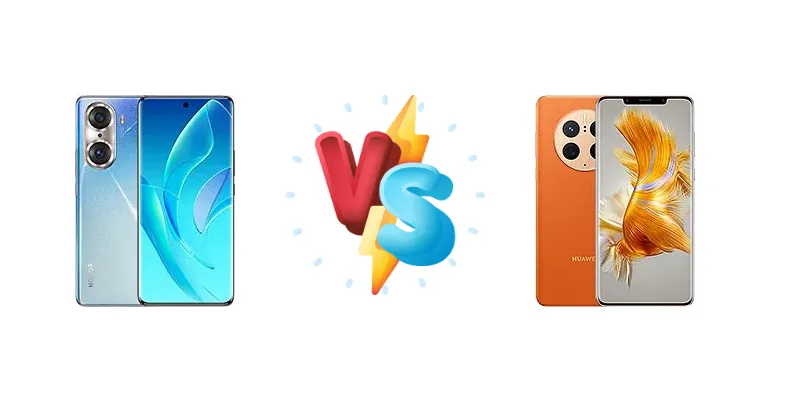
|
🏆 Quick Verdict
The Huawei Mate 50 Pro emerges as the overall winner thanks to its superior Snapdragon 8+ Gen 1 chipset, exceptional camera capabilities, and impressive battery life. While the Honor 60 Pro offers a competitive price and fast charging, the Mate 50 Pro's premium features justify its higher cost.
| PHONES | ||
|---|---|---|
| Phone Names | Honor 60 Pro | Huawei Mate 50 Pro |
| Network | ||
|---|---|---|
| 2G bands | GSM 850 / 900 / 1800 / 1900 | GSM 850 / 900 / 1800 / 1900 |
| 3G bands | HSDPA 800 / 850 / 900 / 1700(AWS) / 1900 / 2100 | HSDPA 800 / 850 / 900 / 1700(AWS) / 1900 / 2100 |
| 4G bands | 1, 2, 3, 4, 5, 8, 18, 19, 26, 28, 34, 38, 39, 40, 41 | 1, 2, 3, 4, 5, 7, 8, 12, 13, 17, 18, 19, 20, 26, 28, 32, 34, 38, 39, 40, 41, 66 - International |
| 5G bands | 1, 5, 8, 28, 41, 77, 78 SA/NSA | - |
| Speed | HSPA, LTE, 5G | HSPA, LTE |
| Technology | GSM / CDMA / HSPA / CDMA2000 / LTE / 5G | GSM / CDMA / HSPA / CDMA2000 / LTE |
| CDMA2000 1x | 1, 2, 3, 4, 5, 7, 8, 12, 17, 18, 19, 20, 26, 28, 34, 38, 39, 40, 41 - China | |
| Launch | ||
|---|---|---|
| Announced | 2021, December 01 | 2022, September 06 |
| Status | Available. Released 2021, December 10 | Available. Released 2022, September 28 |
| Body | ||
|---|---|---|
| Dimensions | 163.9 x 74.8 x 8.2 mm (6.45 x 2.94 x 0.32 in) | 162.1 x 75.5 x 8.5 mm (6.38 x 2.97 x 0.33 in) |
| SIM | Nano-SIM + Nano-SIM | · Nano-SIM· Nano-SIM + Nano-SIM |
| Weight | 192 g (6.77 oz) | 205 g / 209 g (7.23 oz) |
| - | IP68 dust/water resistant (up to 6m for 30 min) | |
| Display | ||
|---|---|---|
| Protection | - | Huawei Kunlun Glass |
| Resolution | 1200 x 2652 pixels (~429 ppi density) | 1212 x 2616 pixels, 19.5:9 ratio (~428 ppi density) |
| Size | 6.78 inches, 111.4 cm2 (~90.9% screen-to-body ratio) | 6.74 inches, 111.8 cm2 (~91.3% screen-to-body ratio) |
| Type | OLED, 1B colors, 120Hz, HDR10+ | OLED, 1B colors, 120Hz |
| Platform | ||
|---|---|---|
| CPU | Octa-core (1x2.5 GHz Cortex-A78 & 3x2.4 GHz Cortex-A78 & 4x1.8 GHz Cortex-A55) | Octa-core (1x3.19 GHz Cortex-X2 & 3x2.75 GHz Cortex-A710 & 4x2.0 GHz Cortex-A510) |
| Chipset | Qualcomm Snapdragon 778G+ 5G | Qualcomm SM8475 Snapdragon 8+ Gen 1 4G (4 nm) |
| GPU | Adreno 642L | Adreno 730 |
| OS | Android 11, Magic UI 5.0 | EMUI 13 (International), HarmonyOS 3.0 (China) |
| Memory | ||
|---|---|---|
| Card slot | No | Nano Memory (uses shared SIM slot) |
| Internal | 256GB 8GB RAM, 256GB 12GB RAM | 256GB 8GB RAM, 512GB 8GB RAM |
| - | UFS 3.1 | |
| Main Camera | ||
|---|---|---|
| Features | Dual-LED flash, HDR, panorama | Laser AF, color spectrum sensor, LED flash, panorama, HDR |
| Single | 50 MP, f/2.4, 18mm (ultrawide) | 13 MP, f/2.4, 18mm (ultrawide) TOF 3D, (depth/biometrics sensor) |
| Triple | 108 MP, f/1.9, (wide), 1/1.52", 0.7µm, PDAF 50 MP, f/2.2, 122˚ (ultrawide) 2 MP (macro) | 50 MP, f/1.4-f/4.0, 24mm (wide), PDAF, OIS 64 MP, f/3.5, 90mm (periscope telephoto), PDAF, OIS, 3.5x optical zoom 13 MP, f/2.2, 13mm, 120˚ (ultrawide), PDAF |
| Video | 4K@30fps, 1080p@30/60fps, gyro-EIS | 4K@30/60fps, 1080p@30/60/120/240/480fps, 720p@960fps, 720p@3840fps, HDR, gyro-EIS |
| Selfie camera | ||
|---|---|---|
| Features | - | HDR, panorama |
| Single | 50 MP, f/2.4, 18mm (ultrawide) | 13 MP, f/2.4, 18mm (ultrawide) TOF 3D, (depth/biometrics sensor) |
| Video | 4K@30fps, 1080p@30fps, gyro-EIS | 4K@30/60fps, 1080p@30/60/240fps |
| Sound | ||
|---|---|---|
| 3.5mm jack | No | No |
| 35mm jack | No | No |
| Loudspeaker | Yes, with stereo speakers | Yes, with stereo speakers |
| - | 32-bit/384kHz audio | |
| Comms | ||
|---|---|---|
| Bluetooth | 5.2, A2DP, LE, aptX HD | 5.2, A2DP, LE |
| Infrared port | - | Yes |
| NFC | Yes | Yes |
| Positioning | GPS, GLONASS, BDS | GPS (L1+L5), GLONASS (L1), BDS (B1I+B1c+B2a), GALILEO (E1+E5a), QZSS (L1+L5), NavIC (L5) |
| Radio | No | No |
| USB | USB Type-C 2.0, OTG | USB Type-C 3.1, OTG, Display Port 1.2 |
| WLAN | Wi-Fi 802.11 a/b/g/n/ac/6, dual-band, Wi-Fi Direct | Wi-Fi 802.11 a/b/g/n/ac/6, dual-band, Wi-Fi Direct |
| Features | ||
|---|---|---|
| Sensors | Fingerprint (under display, optical), accelerometer, gyro, proximity, compass | Face ID, fingerprint (under display, optical), accelerometer, gyro, proximity, barometer, compass |
| - | BDS Satellite Message (sending only) | |
| Battery | ||
|---|---|---|
| Charging | 66W wired, 50% in 15 min 5W reverse wired | 66W wired 50W wireless 5W reverse wireless |
| Type | Li-Po 4800 mAh | Li-Po 4700 mAh |
| Misc | ||
|---|---|---|
| Colors | Black, Green, Blue, Pink | Black, Silver, Purple, Orange |
| Models | TNA-AN00 | DCO-AL00, DCO-LX9 |
| Price | About 390 EUR | About 900 EUR |
| Tests | ||
|---|---|---|
| Battery life | - | Endurance rating 104h |
| Camera | - | Photo / Video |
| Display | - | Contrast ratio: Infinite (nominal) |
| Loudspeaker | - | -24.8 LUFS (Very good) |
| Performance | - | AnTuTu: 979921 (v9) GeekBench: 3839 (v5.1) GFXBench: 68fps (ES 3.1 onscreen) |
Honor 60 Pro
- Fast 66W wired charging
- Stylish design
- Competitive price
- Decent performance for the price
- Less powerful chipset
- Camera not as advanced
- Lower brightness display
- 4G connectivity
Huawei Mate 50 Pro
- Flagship Snapdragon 8+ Gen 1 chipset
- Exceptional camera system
- Long-lasting battery life
- Bright and vibrant display
- 50W wireless charging
- Higher price
- 4G connectivity
- Potential software limitations (due to US sanctions)
Display Comparison
The Huawei Mate 50 Pro boasts a significantly brighter display (946 nits vs Honor 60 Pro's estimated 700-800 nits) and an infinite contrast ratio, resulting in a more vibrant and immersive viewing experience. Both phones likely feature OLED panels with smooth refresh rates, but the Mate 50 Pro's superior brightness gives it a clear edge, especially in outdoor conditions.
Camera Comparison
The Mate 50 Pro's camera system is a major highlight. While specific details are missing, Huawei's reputation for camera excellence suggests a superior image quality, particularly in challenging lighting conditions. The Honor 60 Pro's camera is competent, but likely lacks the advanced features and image processing capabilities of the Mate 50 Pro.
Performance
Here, the Mate 50 Pro dominates. Its Snapdragon 8+ Gen 1 chipset is considerably more powerful than the Honor 60 Pro's Snapdragon 778G+. Expect smoother multitasking, faster app loading times, and better performance in demanding games on the Mate 50 Pro. The Honor 60 Pro is still capable, but it won't match the flagship performance of its rival.
Battery Life
The Mate 50 Pro demonstrates exceptional battery life, with an active use score of 10:36h and an endurance rating of 104h. The Honor 60 Pro's battery life is respectable, but falls short of the Mate 50 Pro's longevity. Both offer 66W wired charging, ensuring relatively quick top-ups.
Buying Guide
The Honor 60 Pro is ideal for budget-conscious users who prioritize fast charging and a stylish design. The Huawei Mate 50 Pro is for those seeking top-tier performance, a flagship camera system, and extended battery life, regardless of price.