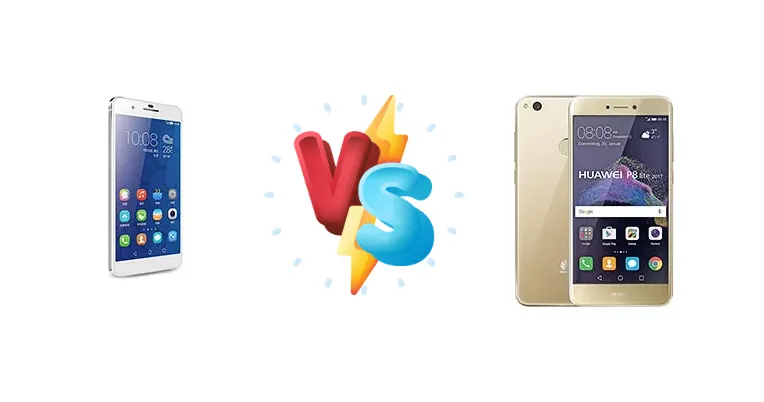
The Honor 6 Plus and Huawei P8 Lite (2017) represent different eras of smartphone technology. Both offered compelling value at their respective launch times, but how do they stack up against each other today? This review dives deep into their specs, performance, and features to help you decide which is the better choice.
🏆 Quick Verdict
The Huawei P8 Lite (2017) generally edges out the Honor 6 Plus. While the Honor 6 Plus boasts a slightly more powerful CPU on paper, the P8 Lite's newer Kirin 655 chipset, improved manufacturing process (16nm vs 28nm), and generally better software support make it the more appealing option for most users.
| Network |
|---|
| 2G bands | GSM 900 / 1800 / 1900 - SIM 1 & SIM 2 | GSM 850 / 900 / 1800 / 1900 - SIM 1 & SIM 2 |
| 3G bands | HSDPA 850 / 900 / 1900 / 2100 - PE-UL00 | HSDPA 850 / 900 / 1900 / 2100 |
| 4G bands | 1, 3, 41 - PE-UL00 | 1, 3, 7, 8, 20 |
| Speed | HSPA 42.2/5.76 Mbps, LTE Cat6 300/50 Mbps | HSPA 42.2/5.76 Mbps, LTE Cat4 150/50 Mbps |
| Technology | GSM / HSPA / LTE | GSM / HSPA / LTE |
| | 1, 3, 7, 38, 39, 40, 41 - PE-TL10 | - |
| Launch |
|---|
| Announced | 2014, December. Released 2014, December | 2017, January. Released 2017, January |
| Status | Discontinued | Discontinued |
| Body |
|---|
| Build | - | Glass front, glass back, aluminum frame |
| Dimensions | 150.5 x 75.7 x 7.5 mm (5.93 x 2.98 x 0.30 in) | 147.2 x 72.9 x 7.6 mm (5.80 x 2.87 x 0.30 in) |
| SIM | · Micro-SIM (PE-TL10)· Nano-SIM + Micro-SIM | Nano-SIM + Nano-SIM |
| Weight | 165 g (5.82 oz) | 147 g (5.19 oz) |
| Display |
|---|
| Protection | Corning Gorilla Glass 3 | - |
| Resolution | 1080 x 1920 pixels, 16:9 ratio (~401 ppi density) | 1080 x 1920 pixels, 16:9 ratio (~424 ppi density) |
| Size | 5.5 inches, 83.4 cm2 (~73.2% screen-to-body ratio) | 5.2 inches, 74.5 cm2 (~69.5% screen-to-body ratio) |
| Type | IPS LCD | IPS LCD |
| Platform |
|---|
| CPU | Octa-core (4x1.8 GHz Cortex-A15 & 4x1.3 GHz Cortex-A7) | Octa-core (4x2.1 GHz Cortex-A53 & 4x1.7 GHz Cortex-A53) |
| Chipset | Kirin 925 (28 nm) | Kirin 655 (16 nm) |
| GPU | Mali-T628 MP4 | Mali-T830MP2 |
| OS | Android 4.4.2 (KitKat), upgradable to 6 (Marshmallow), EMUI 3 | Android 7.0 (Nougat), upgradable to Android 8.0 (Oreo), EMUI 9 |
| Memory |
|---|
| Card slot | microSDXC (uses shared SIM slot) | microSDXC (uses shared SIM slot) |
| Internal | 16GB (3G model); 16/32GB (LTE model), 3GB RAM | 16GB 3GB RAM, 32GB 4GB RAM, 64GB 4GB RAM |
| Main Camera |
|---|
| Features | Dual-LED flash, HDR | LED flash, panorama, HDR |
| Single | 8 MP, f/2.0, AF
Auxiliary lens | 12 MP, AF |
| Video | 1080p@30fps | 1080p@30fps |
| Selfie camera |
|---|
| Single | 8 MP, f/2.4 | 8 MP, f/2.0 |
| Video | 1080p@30fps | 1080p@30fps |
| Sound |
|---|
| 3.5mm jack | Yes | Yes |
| 35mm jack | Yes | Yes |
| Loudspeaker | Yes | Yes |
| Comms |
|---|
| Bluetooth | 4.0, A2DP, EDR, LE | 4.1, A2DP, EDR, LE |
| Infrared port | Yes | - |
| NFC | Yes (LTE model) | Yes (market dependent) |
| Positioning | GPS, GLONASS/ BDS (market dependant) | GPS, GLONASS |
| Radio | FM radio | FM radio |
| USB | microUSB 2.0, OTG | microUSB 2.0, OTG |
| WLAN | Wi-Fi 802.11 a/b/g/n, dual-band, Wi-Fi Direct, hotspot | Wi-Fi 802.11 b/g/n, Wi-Fi Direct |
| Features |
|---|
| Sensors | Accelerometer, gyro, proximity, compass | Fingerprint (rear-mounted), accelerometer, proximity, compass |
| Battery |
|---|
| Type | Li-Po 3600 mAh, non-removable | Li-Ion 3000 mAh, non-removable |
| Misc |
|---|
| Colors | Black, White / Gold (LTE model) | Black, White, Gold, Blue |
| Models | PE-TL10, PE-UL00, PE-TL20 | PRA-TL10, PRA-TL20, PRA-LA1, PRA-LX1, PRA-LX2, TAG-L21, PRA-AL00X, TAG-L32, PRA-LX3, PRA-AL00 |
| Price | About 320 EUR | About 170 EUR |
Honor 6 Plus
- Potentially higher peak CPU performance
- Dual-lens camera for depth effects
- Larger screen (5.5 inches)
- Older chipset and architecture
- Less efficient power consumption
- Outdated software support
- Lower image quality compared to P8 Lite
Huawei P8 Lite (2017)
- More efficient Kirin 655 chipset
- Better battery life
- Improved camera performance
- More modern software and updates
- Slightly lower peak CPU performance than Honor 6 Plus
- Smaller screen (5.46 inches)
Display Comparison
The Honor 6 Plus features a 5.5-inch Full HD display, while the Huawei P8 Lite (2017) has a similar 5.46-inch Full HD display. Both offer decent viewing experiences, but the P8 Lite's slightly newer panel might offer marginally better color accuracy and brightness. Neither phone has particularly impressive display technology by today's standards.
Camera Comparison
The Honor 6 Plus has a dual-lens rear camera setup (13MP + 13MP) offering some unique depth-of-field effects. The Huawei P8 Lite (2017) features a 12MP rear camera. While megapixels aren't everything, the P8 Lite's newer sensor and image processing algorithms typically produce better image quality, especially in low-light conditions. Both phones have decent front-facing cameras for selfies.
Performance
The Honor 6 Plus utilizes a Kirin 925 chipset with a dual-core Cortex-A15 and quad-core Cortex-A7 configuration. The Huawei P8 Lite (2017) employs a Kirin 655 chipset with four Cortex-A53 cores at 2.1 GHz and four at 1.7 GHz. While the Honor 6 Plus has a higher peak clock speed on some cores, the P8 Lite's more efficient 16nm process and unified core architecture generally result in smoother performance and better power efficiency. Expect the P8 Lite to handle multitasking and modern apps more effectively.
Battery Life
The Huawei P8 Lite (2017) generally has better battery life due to its more efficient Kirin 655 chipset and optimized software. The Honor 6 Plus has a 3100mAh battery, while the P8 Lite (2017) has a 3000mAh battery. Despite the smaller capacity, the P8 Lite's efficiency often translates to longer usage times.
Buying Guide
The Honor 6 Plus is a good option for budget-conscious users who prioritize raw CPU power and don't mind an older device. The Huawei P8 Lite (2017) is ideal for those seeking a more modern experience with better battery efficiency and a slightly improved camera, even if it means a small performance trade-off.
Frequently Asked Questions
❓ Is the Honor 6 Plus still worth buying?
Only if you're on a very tight budget and prioritize raw CPU power above all else. Be aware of its age and limited software support.
❓ Which phone has better software support?
The Huawei P8 Lite (2017) received more updates and has a slightly more modern Android version, although both are now quite outdated.