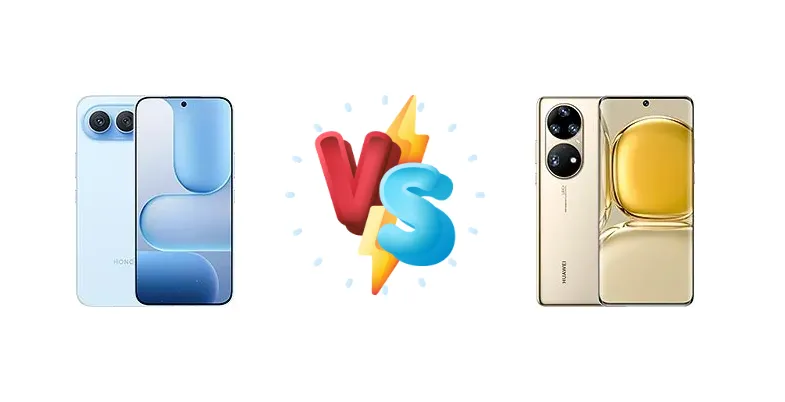
The Honor 500 Pro (China) and Huawei P50 Pro represent two distinct approaches to the high-end smartphone market. The P50 Pro, despite its age, remains a strong contender, while the Honor 500 Pro arrives with the latest Qualcomm Snapdragon 8 Elite chipset, promising a significant leap in performance. This comparison dissects their key differences to determine which device delivers the best overall experience.
🏆 Quick Verdict
For most users, the Honor 500 Pro emerges as the superior choice. Its Snapdragon 8 Elite chipset, built on a 3nm process, offers demonstrably faster performance and improved efficiency compared to the Huawei P50 Pro’s Kirin 9000 or Snapdragon 888 4G. While the P50 Pro boasts a respectable endurance rating, the Honor 500 Pro’s faster charging mitigates any potential battery life concerns.
| Network |
|---|
| 2G bands | GSM 850 / 900 / 1800 / 1900 | GSM 850 / 900 / 1800 / 1900 |
| 3G bands | HSDPA 800 / 850 / 900 / 1700(AWS) / 1900 / 2100 | HSDPA 800 / 850 / 900 / 1700(AWS) / 1900 / 2100 |
| 4G bands | LTE | 1, 2, 3, 4, 5, 6, 7, 8, 9, 12, 17, 18, 19, 20, 26, 28, 34, 38, 39, 40, 41 - China |
| 5G bands | SA/NSA | - |
| Speed | HSPA, LTE, 5G | HSPA, LTE |
| Technology | GSM / HSPA / LTE / 5G | GSM / CDMA / HSPA / CDMA2000 / LTE |
| | - | 1, 2, 3, 4, 5, 7, 8, 12, 17, 18, 19, 20, 26, 28, 32, 34, 38, 39, 40, 41, 66 - International |
| Launch |
|---|
| Announced | 2025, November 24 | 2021, July 29 |
| Status | Available. Released 2025, November 27 | Available. Released 2021, August 12 |
| Body |
|---|
| Build | Glass front, aluminum frame | Glass front, glass back, aluminum frame |
| Dimensions | 155.8 x 74.2 x 7.8 mm (6.13 x 2.92 x 0.31 in) | 158.8 x 72.8 x 8.5 mm (6.25 x 2.87 x 0.33 in) |
| SIM | Nano-SIM + Nano-SIM | · Nano-SIM· Nano-SIM + Nano-SIM |
| Weight | 201 g (7.09 oz) | 195 g (6.88 oz) |
| | - | IP68 dust/water resistant (up to 1.5m for 30 min) |
| Display |
|---|
| Protection | Aluminosilicate glass | - |
| Resolution | 1264 x 2736 pixels, 19.5:9 ratio (~460 ppi density) | 1228 x 2700 pixels (~450 ppi density) |
| Size | 6.55 inches, 105.4 cm2 (~91.2% screen-to-body ratio) | 6.6 inches, 105.4 cm2 (~91.2% screen-to-body ratio) |
| Type | AMOLED, 1B colors, 120Hz, 3840Hz PWM, HDR Vivid, 6000 nits (peak) | OLED, 1B colors, 120Hz |
| Platform |
|---|
| CPU | Octa-core (2x4.32 GHz Oryon V2 Phoenix L + 6x3.53 GHz Oryon V2 Phoenix M) | Octa-core (1x3.13 GHz Cortex-A77 & 3x2.54 GHz Cortex-A77 & 4x2.05 GHz Cortex-A55)Octa-core (1x2.84 GHz Cortex-X1 & 3x2.42 GHz Cortex-A78 & 4x1.80 GHz Cortex-A55) |
| Chipset | Qualcomm SM8750-AB Snapdragon 8 Elite (3 nm) | Kirin 9000 (5 nm)Qualcomm SM8350 Snapdragon 888 4G (5 nm) |
| GPU | Adreno 830 | Mali-G78 MP24Adreno 660 |
| OS | Android 16, MagicOS 10 | HarmonyOS 2.0 (China), EMUI 14.2 (Europe), no Google Play Services |
| Memory |
|---|
| Card slot | No | Nano Memory (uses shared SIM slot) |
| Internal | 256GB 12GB RAM, 512GB 12GB RAM, 512GB 16GB RAM, 1TB 16GB RAM | 128GB 8GB RAM, 256GB 8GB RAM, 512GB 8GB RAM, 512GB 12GB RAM |
| Main Camera |
|---|
| Features | Color spectrum sensor, LED flash, HDR, panorama | Laser AF, color spectrum sensor, Leica optics, dual-LED flash, panorama, HDR |
| Quad | - | 50 MP, f/1.8, 23mm (wide), PDAF, OIS
64 MP, f/3.5, 90mm (periscope telephoto), PDAF, OIS, 3.5x optical zoom, 7x lossless zoom
13 MP, f/2.2, 13mm (ultrawide), AF
40 MP, f/1.6, 23mm (B/W), AF |
| Single | - | 13 MP, f/2.4, (wide), AF |
| Triple | 200 MP, f/1.9, (wide), 1/1.4", 0.56µm, PDAF, OIS
50 MP, f/2.4, 68mm (periscope telephoto), 1/2.51", 0.7µm, PDAF, OIS, 3x optical zoom
12 MP, f/2.2, 117˚ (ultrawide), AF | - |
| Video | 4K, 1080p, gyro-EIS, OIS | 4K@30/60fps, 1080p@30/60fps, 1080p@960fps; gyro-EIS |
| Selfie camera |
|---|
| Features | HDR | Panorama, HDR |
| Single | 50 MP, f/2.0, (wide) | 13 MP, f/2.4, (wide), AF |
| Video | 4K, 1080p, gyro-EIS | 4K@30fps, 1080p@30/60/240fps |
| Sound |
|---|
| 3.5mm jack | - | No |
| 35mm jack | No | No |
| Loudspeaker | Yes, with stereo speakers | Yes, with stereo speakers |
| Comms |
|---|
| Bluetooth | 6.0, A2DP, LE, aptX HD, aptX Adaptive, aptX Lossless, LHDC 5, Auracast, ASHA | 5.2, A2DP, LE |
| Infrared port | Yes | Yes |
| NFC | Yes | Yes |
| Positioning | GPS (L1+L5), BDS (B1I+B1C+B2a+B2b), GALILEO (E1+E5a+E5b), QZSS (L1+L5), NavIC (L1+L5), GLONASS | GPS (L1+L5), GLONASS (L1), BDS (B1I+B1c+B2a+B2b), GALILEO (E1+E5a+E5b), QZSS (L1+L5), NavIC |
| Radio | No | No |
| USB | USB Type-C 2.0, OTG | USB Type-C 3.1, OTG |
| WLAN | Wi-Fi 802.11 a/b/g/n/ac/6/7, dual-band, Wi-Fi Direct | Wi-Fi 802.11 a/b/g/n/ac/6, dual-band, Wi-Fi Direct |
| Features |
|---|
| Sensors | Fingerprint (under display), accelerometer, gyro, compass, proximity (ultrasound) | Fingerprint (under display, optical), accelerometer, gyro, proximity, compass, barometer |
| Battery |
|---|
| Charging | 80W wired
50W wireless, 28% in 15 min
5W reverse wired
Reverse wireless | 66W wired
50W wireless
Reverse wireless charging |
| Type | Si/C Li-Ion 8000 mAh | Li-Po 4360 mAh |
| Misc |
|---|
| Colors | Black, Silver, Blue, Pink | Golden Black, Cocoa Gold, Pearl White, Charm Pink |
| Models | MEP-AN00 | JAD-AL50, JAD-LX9, JAD-AL00 |
| Price | About 440 EUR | $ 196.62 / £ 329.00 / € 473.13 |
| Tests |
|---|
| Battery life | - |
Endurance rating 76h
|
| Camera | - |
Photo / Video |
| Display | - |
Contrast ratio: Infinite (nominal) |
| Loudspeaker | - |
-27.3 LUFS (Good)
|
| Performance | - |
AnTuTu: 793876 (v8), 786215 (v9)
GeekBench: 3145 (v5.1)
GFXBench: 44fps (ES 3.1 onscreen) |
Honor 500 Pro (China)
- Significantly faster processor (Snapdragon 8 Elite 3nm)
- Faster wired and wireless charging
- Potential for improved thermal management
- Reverse wireless charging
- Camera specs currently unknown
- Limited availability (China only)
Huawei P50 Pro
- Proven camera system and image quality
- Solid battery endurance (76h rating)
- Established software ecosystem
- Good display brightness (754 nits)
- Older chipset (Kirin 9000/Snapdragon 888 4G)
- Slower charging speeds compared to Honor 500 Pro
- 4G connectivity limitation (Snapdragon 888 variant)
Display Comparison
The Huawei P50 Pro’s display achieves a measured peak brightness of 754 nits, a respectable figure, but the Honor 500 Pro’s display specifications are currently unknown. Given Honor’s recent focus on high-end displays, it’s likely to match or exceed this brightness. Both devices offer an 'infinite' contrast ratio, typical of OLED panels. Without further details on the Honor 500 Pro’s panel technology (LTPO, PWM dimming rate), it’s difficult to definitively declare a winner, but the P50 Pro’s established brightness is a known quantity.
Camera Comparison
Both the Honor 500 Pro and Huawei P50 Pro are advertised as having strong camera capabilities, focusing on photo and video. However, specific sensor details for the Honor 500 Pro are missing. The P50 Pro is known for its excellent image processing and versatile camera system. Without knowing the sensor sizes, apertures, and OIS implementation on the Honor 500 Pro, it’s difficult to make a direct comparison. The P50 Pro’s established reputation and image quality give it a slight edge until more information on the Honor 500 Pro’s camera system is available. We can assume the Honor 500 Pro will leverage computational photography, but the quality will depend on the hardware.
Performance
The Honor 500 Pro’s Qualcomm Snapdragon 8 Elite chipset, fabricated on a 3nm process, represents a substantial upgrade over the Huawei P50 Pro’s options. The Snapdragon 8 Elite features an octa-core CPU configuration with Oryon V2 Phoenix cores (2x4.32 GHz + 6x3.53 GHz), designed for peak performance and efficiency. This contrasts with the P50 Pro’s Kirin 9000 (Cortex-A77 based) or Snapdragon 888 4G (Cortex-X1/A78 based) which are built on a 5nm node. The 3nm process allows for higher transistor density and lower power consumption, translating to sustained performance and reduced thermal throttling. The Honor 500 Pro will demonstrably outperform the P50 Pro in CPU and GPU-intensive tasks.
Battery Life
The Huawei P50 Pro boasts an endurance rating of 76 hours, indicating solid battery life. However, the Honor 500 Pro compensates with significantly faster charging capabilities: 80W wired, 50W wireless (28% charge in 15 minutes), and 5W reverse wired/wireless. The P50 Pro offers 66W wired and 50W wireless charging. While the P50 Pro may have a slight edge in overall endurance, the Honor 500 Pro’s rapid charging minimizes downtime, making it more convenient for users who frequently need to top up their battery. The faster charging effectively negates any potential disadvantage in battery capacity.
Buying Guide
Buy the Honor 500 Pro (China) if you prioritize raw performance for demanding tasks like gaming and video editing, and want the benefits of a cutting-edge 3nm chipset. Buy the Huawei P50 Pro if you value a proven camera system and a slightly more established software ecosystem, and are less concerned with having the absolute latest processor.
Frequently Asked Questions
❓ Does the Snapdragon 8 Elite in the Honor 500 Pro generate excessive heat during prolonged gaming sessions?
The Snapdragon 8 Elite's 3nm process is designed to improve thermal efficiency compared to the 5nm Kirin 9000 and Snapdragon 888 4G. While any high-performance chipset will generate heat under sustained load, the 3nm node should result in less throttling and more consistent performance during extended gaming sessions. Honor's cooling solution will also play a crucial role.
❓ Is the lack of 5G connectivity on the Snapdragon 888 variant of the Huawei P50 Pro a significant drawback in 2024?
Yes, the 4G limitation of the Snapdragon 888 variant of the P50 Pro is a considerable drawback in 2024, especially for users in areas with widespread 5G coverage. The Honor 500 Pro, with its Snapdragon 8 Elite, will offer significantly faster data speeds and lower latency on 5G networks.
❓ How does the Honor 500 Pro's reverse wireless charging compare to the P50 Pro in terms of speed and usability?
The Honor 500 Pro offers both reverse wired (5W) and wireless charging, while the P50 Pro only lists reverse wireless. While both are convenient for topping up accessories, the Honor 500 Pro's wired option provides a slightly faster and more reliable charging experience for compatible devices.