
Honor 50 vs Samsung Galaxy S21 FE: A Detailed Comparison for Power Users
| Phones Images | |||||
|---|---|---|---|---|---|
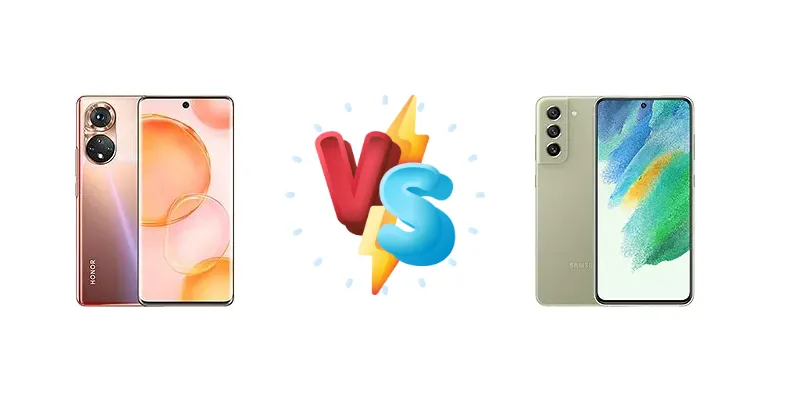
|
🏆 Quick Verdict
For most users, the Samsung Galaxy S21 FE 5G emerges as the stronger choice. While the Honor 50 offers impressive 66W charging, the S21 FE’s Snapdragon 888 (or Exynos 2100) provides a significant performance uplift, making it better suited for demanding tasks and future-proofing. However, the Honor 50 remains a viable option for those prioritizing aesthetics and rapid replenishment.
| PHONES | ||
|---|---|---|
| Phone Names | Honor 50 | Samsung Galaxy S21 FE 5G |
| Network | ||
|---|---|---|
| 2G bands | GSM 850 / 900 / 1800 / 1900 | GSM 850 / 900 / 1800 / 1900 |
| 3G bands | HSDPA 800 / 850 / 900 / 1700(AWS) / 1900 / 2100 | HSDPA 850 / 900 / 1700(AWS) / 1900 / 2100 |
| 4G bands | 1, 2, 3, 4, 5, 7, 8, 12, 17, 18, 19, 20, 26, 28, 34, 38, 39, 40, 41, 66 - International | 1, 2, 3, 4, 5, 7, 8, 12, 17, 20, 26, 28, 32, 38, 40, 41, 66 - International |
| 5G bands | 1, 3, 7, 28, 38, 40, 41, 77, 78 SA/NSA - International | 1, 3, 5, 8, 20, 28, 38, 40, 41, 66, 78 SA/NSA/Sub6 - International |
| Speed | HSPA, LTE, 5G | HSPA 42.2/5.76 Mbps, LTE (5CA) Cat19 1600/200 Mbps, 5G |
| Technology | GSM / CDMA / HSPA / CDMA2000 / LTE / 5G | GSM / CDMA / HSPA / EVDO / LTE / 5G |
| - | 41, 66, 71, 260, 261 SA/NSA/Sub6/mmWave - USA | |
| Launch | ||
|---|---|---|
| Announced | 2021, June 16 | 2022, January 04 |
| Status | Available. Released 2021, June 25 | Available. Released 2022, January 07 |
| Body | ||
|---|---|---|
| Build | Glass front, plastic frame, glass back | Glass front (Gorilla Glass Victus), plastic back, aluminum frame |
| Dimensions | 160 x 73.8 x 7.8 mm (6.30 x 2.91 x 0.31 in) | 155.7 x 74.5 x 7.9 mm (6.13 x 2.93 x 0.31 in) |
| SIM | · Nano-SIM· Nano-SIM + Nano-SIM | · Nano-SIM· Nano-SIM + Nano-SIM |
| Weight | 175 g (6.17 oz) | 177 g (6.24 oz) |
| - | IP68 dust/water resistant (up to 1.5m for 30 min) | |
| Display | ||
|---|---|---|
| Protection | - | Corning Gorilla Glass Victus |
| Resolution | 1080 x 2340 pixels, 19.5:9 ratio (~392 ppi density) | 1080 x 2340 pixels, 19.5:9 ratio (~403 ppi density) |
| Size | 6.57 inches, 106.0 cm2 (~89.7% screen-to-body ratio) | 6.4 inches, 100.5 cm2 (~86.7% screen-to-body ratio) |
| Type | OLED, 1B colors, 120Hz | Dynamic AMOLED 2X, 120Hz, HDR10+ |
| - | Always-on display | |
| Platform | ||
|---|---|---|
| CPU | Octa-core (1x2.4 GHz Cortex-A78 & 3x2.2 GHz Cortex-A78 & 4x1.9 GHz Cortex-A55) | Octa-core (1x2.84 GHz Cortex-X1 & 3x2.42 GHz Cortex-A78 & 4x1.80 GHz Cortex-A55) - Version 1Octa-core (1x2.9 GHz Cortex-X1 & 3x2.80 GHz Cortex-A78 & 4x2.2 GHz Cortex-A55) - Version 2 |
| Chipset | Qualcomm SM7325 Snapdragon 778G 5G (6 nm) | Qualcomm SM8350 Snapdragon 888 5G (5 nm) - Version 1Exynos 2100 (5 nm) - Version 2 |
| GPU | Adreno 642L | Adreno 660 - Version 1Mali-G78 MP14 - Version 2 |
| OS | Android 11, Magic UI 4.2 | Android 12, up to 4 major Android upgrades, One UI 8 |
| Memory | ||
|---|---|---|
| Card slot | No | No |
| Internal | 128GB 6GB RAM, 128GB 8GB RAM, 256GB 8GB RAM, 256GB 12GB RAM | 128GB 6GB RAM, 128GB 8GB RAM, 256GB 6GB RAM, 256GB 8GB RAM |
| Main Camera | ||
|---|---|---|
| Features | LED flash, HDR, panorama | LED flash, auto-HDR, panorama |
| Quad | 108 MP, f/1.9, (wide), 1/1.52", 0.7µm, PDAF 8 MP, f/2.2, 120˚, 17mm (ultrawide) 2 MP (macro) Auxiliary lens | - |
| Single | - | 32 MP, f/2.2, 26mm (wide), 1/2.74", 0.8µm |
| Triple | - | 12 MP, f/1.8, 26mm (wide), 1/1.76", 1.8µm, dual pixel PDAF, OIS 8 MP, f/2.4, 76mm (telephoto), 1/4.5", 1.0µm, PDAF, OIS, 3x optical zoom 12 MP, f/2.2, 13mm, 123˚ (ultrawide), 1/3.0", 1.12µm |
| Video | 4K@30fps, 1080p@30/60fps, gyro-EIS | 4K@30/60fps, 1080p@30/60/120/240fps, HDR10+, gyro-EIS |
| Selfie camera | ||
|---|---|---|
| Features | - | HDR |
| Single | 32 MP, f/2.2, 22mm (wide), 1/3.14" | 32 MP, f/2.2, 26mm (wide), 1/2.74", 0.8µm |
| Video | 1080p@30fps | 4K@30/60fps, 1080p@30/60fps, gyro-EIS |
| Sound | ||
|---|---|---|
| 3.5mm jack | - | No |
| 35mm jack | No | No |
| Loudspeaker | Yes | Yes, with stereo speakers |
| - | 32-bit/384kHz audio | |
| Comms | ||
|---|---|---|
| Bluetooth | 5.2, A2DP, LE, aptX HD | 5.0, A2DP, LE |
| NFC | Yes | Yes |
| Positioning | GPS, GLONASS, GALILEO, BDS, QZSS | GPS, GLONASS, BDS, GALILEO |
| Radio | No | Unspecified |
| USB | USB Type-C 2.0, OTG | USB Type-C, OTG |
| WLAN | Wi-Fi 802.11 a/b/g/n/ac/6, dual-band, Wi-Fi Direct | Wi-Fi 802.11 a/b/g/n/ac/6, dual-band, Wi-Fi Direct |
| Features | ||
|---|---|---|
| Sensors | Fingerprint (under display, optical), accelerometer, gyro, proximity, compass | Fingerprint (under display, optical), accelerometer, gyro, proximity, compass |
| - | Bixby natural language commands and dictation Samsung Pay (Visa, MasterCard certified) Samsung DeX (desktop experience support) | |
| Battery | ||
|---|---|---|
| Charging | 66W wired, 70% in 20 min, 100% in 45 min | 25W wired, PD3.0, 50% in 30 min 15W wireless Reverse wireless |
| Type | Li-Po 4300 mAh | Li-Ion 4500 mAh |
| Misc | ||
|---|---|---|
| Colors | Frost Crystal, Amber Red, Emerald Green, Midnight Black, Honor Code | White, Graphite, Lavender, Olive |
| Models | NTH-AN00, NTH-NX9 | SM-G990B, SM-G990B/DS, SM-G990U, SM-G990U1, SM-G990W, SM-G990E, SM-G9900, SM-G990B2, SM-G990U2, SM-G990W2, SM-G990U3 |
| Price | About 180 EUR | € 199.00 / $ 143.95 / £ 154.99 / ₹ 29,990 |
| SAR | - | 0.77 W/kg (head) 0.90 W/kg (body) |
| SAR EU | - | 0.95 W/kg (head) 1.48 W/kg (body) |
| Tests | ||
|---|---|---|
| Battery life | - | Endurance rating 92h |
| Camera | - | Photo / Video |
| Display | - | Contrast ratio: Infinite (nominal) |
| Loudspeaker | - | -26.9 LUFS (Good) |
| Performance | - | AnTuTu: 566529 (v8), 719696 (v9) GeekBench: 3049 (v5.1) GFXBench: 56fps (ES 3.1 onscreen) |
Honor 50
- Blazing-fast 66W wired charging
- Stylish and eye-catching design
- Competitive price point
- Less powerful processor than the S21 FE
- Limited wireless charging capabilities
Samsung Galaxy S21 FE 5G
- Flagship-level Snapdragon 888 or Exynos 2100 processor
- Brighter and more vibrant display
- Wireless and reverse wireless charging
- Slower wired charging compared to Honor 50
- Potential for thermal throttling with the Exynos variant
Display Comparison
Both phones feature excellent displays, but the Samsung Galaxy S21 FE 5G edges ahead with a measured peak brightness of 792 nits compared to the Honor 50’s 748 nits. This translates to better visibility under direct sunlight. While both offer vibrant colors, the S21 FE’s ‘Infinite’ contrast ratio (nominal) suggests deeper blacks, likely due to its panel technology. The S21 FE’s 120Hz refresh rate, while not explicitly stated for the Honor 50, is a common feature in this class and provides smoother scrolling and animations. The Honor 50’s display is still very good, but the S21 FE offers a slight advantage in overall visual experience.
Camera Comparison
Both devices offer versatile camera systems capable of capturing high-quality photos and videos. However, detailed sensor information is limited. The S21 FE’s advantage likely lies in its image processing algorithms and potentially larger main sensor (typical for Samsung flagships). While both phones can record video, the S21 FE’s processor allows for more advanced video features and potentially better stabilization. The Honor 50’s camera is competent, but the S21 FE’s processing power and potentially superior sensor technology give it an edge in challenging lighting conditions and overall image quality.
Performance
The performance gap is the most significant differentiator. The Samsung Galaxy S21 FE 5G, equipped with either the Qualcomm Snapdragon 888 (5nm) or Exynos 2100 (5nm), boasts a considerably more powerful processor than the Honor 50’s Snapdragon 778G (6nm). The Snapdragon 888’s Cortex-X1 prime core, clocked at up to 2.9 GHz, provides a substantial boost in single-core performance, crucial for responsive app launches and smooth multitasking. The 5nm process node used in the S21 FE’s chipsets also contributes to better thermal efficiency, potentially mitigating throttling during sustained workloads. While the Snapdragon 778G is a capable chip, it’s designed for efficiency rather than outright speed. The S21 FE is the clear winner for gamers and power users.
Battery Life
The Honor 50’s 100-hour endurance rating is slightly better than the S21 FE’s 92-hour rating, but this is a nuanced metric. The S21 FE’s 25W charging, while slower than the Honor 50’s 66W, still offers a respectable 50% charge in 30 minutes. The Honor 50’s ability to reach 70% in 20 minutes and 100% in 45 minutes is a significant advantage for users who frequently need to top up their battery quickly. The S21 FE also supports 15W wireless charging and reverse wireless charging, features absent on the Honor 50. The Honor 50 prioritizes charging speed, while the S21 FE offers more versatile charging options.
Buying Guide
Buy the Honor 50 if you prioritize a stylish design, exceptionally fast charging (66W), and a generally smooth experience for everyday tasks. It’s ideal for users who aren’t heavily invested in mobile gaming or intensive content creation. Buy the Samsung Galaxy S21 FE 5G if you demand raw processing power for gaming, video editing, or multitasking, and appreciate the broader ecosystem and software support offered by Samsung. It’s the better choice for power users and those seeking a longer-lasting device.