
Honor 50 vs OnePlus 9RT 5G: A Detailed Comparison of Mid-Range Powerhouses
| Phones Images | |||||
|---|---|---|---|---|---|
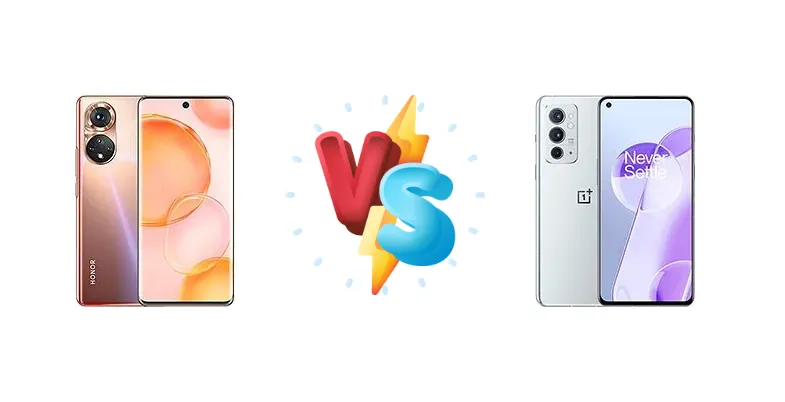
|
🏆 Quick Verdict
For the average user prioritizing everyday tasks and efficient charging, the Honor 50 is the better choice. However, the OnePlus 9RT 5G is the clear winner for gamers and power users who demand the highest possible performance, despite its slightly less optimized battery endurance.
| PHONES | ||
|---|---|---|
| Phone Names | Honor 50 | OnePlus 9RT 5G |
| Network | ||
|---|---|---|
| 2G bands | GSM 850 / 900 / 1800 / 1900 | GSM 850 / 900 / 1800 / 1900 |
| 3G bands | HSDPA 800 / 850 / 900 / 1700(AWS) / 1900 / 2100 | HSDPA 800 / 850 / 900 / 1700(AWS) / 1800 / 1900 / 2100 |
| 4G bands | 1, 2, 3, 4, 5, 7, 8, 12, 17, 18, 19, 20, 26, 28, 34, 38, 39, 40, 41, 66 - International | 1, 2, 3, 4, 5, 7, 8, 12, 17, 18, 19, 20, 26, 28, 34, 38, 39, 40, 41 - Global |
| 5G bands | 1, 3, 7, 28, 38, 40, 41, 77, 78 SA/NSA - International | 1, 3, 5, 8, 28, 40, 41, 78 SA/NSA - Global |
| Speed | HSPA, LTE, 5G | HSPA 42.2/5.76 Mbps, LTE Cat18 1200/200 Mbps, 5G |
| Technology | GSM / CDMA / HSPA / CDMA2000 / LTE / 5G | GSM / CDMA / HSPA / EVDO / LTE / 5G |
| - | CDMA2000 1xEV-DO | |
| Launch | ||
|---|---|---|
| Announced | 2021, June 16 | 2021, October 13 |
| Status | Available. Released 2021, June 25 | Available. Released 2021, October 19 |
| Body | ||
|---|---|---|
| Build | Glass front, plastic frame, glass back | Glass front (Gorilla Glass 5), glass back (Gorilla Glass 5), aluminum frame |
| Dimensions | 160 x 73.8 x 7.8 mm (6.30 x 2.91 x 0.31 in) | 162.2 x 74.6 x 8.3 mm (6.39 x 2.94 x 0.33 in) |
| SIM | · Nano-SIM· Nano-SIM + Nano-SIM | Nano-SIM + Nano-SIM |
| Weight | 175 g (6.17 oz) | 198.5 g (7.02 oz) |
| Display | ||
|---|---|---|
| Protection | - | Corning Gorilla Glass 5 |
| Resolution | 1080 x 2340 pixels, 19.5:9 ratio (~392 ppi density) | 1080 x 2400 pixels, 20:9 ratio (~397 ppi density) |
| Size | 6.57 inches, 106.0 cm2 (~89.7% screen-to-body ratio) | 6.62 inches, 106.3 cm2 (~87.9% screen-to-body ratio) |
| Type | OLED, 1B colors, 120Hz | AMOLED, 120Hz, HDR10+ |
| - | Always-on display | |
| Platform | ||
|---|---|---|
| CPU | Octa-core (1x2.4 GHz Cortex-A78 & 3x2.2 GHz Cortex-A78 & 4x1.9 GHz Cortex-A55) | Octa-core (1x2.84 GHz Cortex-X1 & 3x2.42 GHz Cortex-A78 & 4x1.80 GHz Cortex-A55) |
| Chipset | Qualcomm SM7325 Snapdragon 778G 5G (6 nm) | Qualcomm SM8350 Snapdragon 888 5G (5 nm) |
| GPU | Adreno 642L | Adreno 660 |
| OS | Android 11, Magic UI 4.2 | Android 11, upgradable to Android 13, OxygenOS 13 |
| Memory | ||
|---|---|---|
| Card slot | No | No |
| Internal | 128GB 6GB RAM, 128GB 8GB RAM, 256GB 8GB RAM, 256GB 12GB RAM | 128GB 8GB RAM, 256GB 8GB RAM, 256GB 12GB RAM |
| - | UFS 3.1 | |
| Main Camera | ||
|---|---|---|
| Features | LED flash, HDR, panorama | Dual-LED flash, HDR, panorama |
| Quad | 108 MP, f/1.9, (wide), 1/1.52", 0.7µm, PDAF 8 MP, f/2.2, 120˚, 17mm (ultrawide) 2 MP (macro) Auxiliary lens | 50 MP, f/1.8, 24mm (wide), 1/1.56”, 1.0µm, PDAF, OIS 16 MP, f/2.2, 14mm, 123˚ (ultrawide), 1/3.6", 1.0µm 2 MP (macro) |
| Single | - | 16 MP, f/2.4, (wide), 1/3.06", 1.0µm |
| Video | 4K@30fps, 1080p@30/60fps, gyro-EIS | 4K@30/60fps, 1080p@30/60/240fps, Auto HDR, gyro-EIS |
| Selfie camera | ||
|---|---|---|
| Features | - | HDR |
| Single | 32 MP, f/2.2, 22mm (wide), 1/3.14" | 16 MP, f/2.4, (wide), 1/3.06", 1.0µm |
| Video | 1080p@30fps | 1080p@30fps, gyro-EIS |
| Sound | ||
|---|---|---|
| 3.5mm jack | - | No |
| 35mm jack | No | No |
| Loudspeaker | Yes | Yes, with stereo speakers |
| Comms | ||
|---|---|---|
| Bluetooth | 5.2, A2DP, LE, aptX HD | 5.2, A2DP, LE |
| NFC | Yes | Yes |
| Positioning | GPS, GLONASS, GALILEO, BDS, QZSS | GPS (L1+L5), GLONASS (G1), BDS (B1), GALILEO (E1+E5a) |
| Radio | No | No |
| USB | USB Type-C 2.0, OTG | USB Type-C 2.0, OTG |
| WLAN | Wi-Fi 802.11 a/b/g/n/ac/6, dual-band, Wi-Fi Direct | Wi-Fi 802.11 a/b/g/n/ac/6, dual-band, Wi-Fi Direct |
| Features | ||
|---|---|---|
| Sensors | Fingerprint (under display, optical), accelerometer, gyro, proximity, compass | Fingerprint (under display, optical), accelerometer, gyro, proximity, compass |
| Battery | ||
|---|---|---|
| Charging | 66W wired, 70% in 20 min, 100% in 45 min | 65W wired, 100% in 29 min |
| Type | Li-Po 4300 mAh | Li-Po 4500 mAh |
| Misc | ||
|---|---|---|
| Colors | Frost Crystal, Amber Red, Emerald Green, Midnight Black, Honor Code | Hacker Black, Nano Silver, Blue |
| Models | NTH-AN00, NTH-NX9 | MT2110, MT2111 |
| Price | About 180 EUR | About 590 EUR |
Honor 50
- Faster overall charging time (45 mins vs 29 mins)
- Potentially longer battery life due to efficient chipset
- Stylish design and balanced feature set
- Less powerful processor than the OnePlus 9RT
- Limited camera details available
OnePlus 9RT 5G
- Significantly more powerful Snapdragon 888 processor
- Faster full charge time (29 mins)
- Likely superior gaming performance
- Snapdragon 888 can throttle under heavy load
- Potentially shorter battery life due to power-hungry chipset
Display Comparison
The Honor 50 boasts a 748 nits max brightness, a respectable figure for outdoor visibility. While the OnePlus 9RT’s display specifications aren’t provided, OnePlus typically equips its devices with high-brightness panels. The Honor 50’s display technology isn’t specified, but its brightness suggests it’s likely an OLED panel. The lack of information on the 9RT’s panel type makes a direct comparison difficult, but the 9RT likely targets similar color accuracy and viewing angles. Both phones likely feature high refresh rates, common in this price bracket, but the Honor 50’s brightness gives it a slight edge in direct sunlight.
Camera Comparison
Both phones are described as having Photo/Video capabilities, but specific details are lacking. Without sensor size or aperture information, a direct comparison is challenging. However, the OnePlus 9RT, being positioned as a performance-focused device, likely prioritizes image processing speed and potentially features a larger main sensor. The Honor 50, with its emphasis on overall balance, may focus on color accuracy and a more natural image profile. The absence of details on optical image stabilization (OIS) on either device makes it impossible to assess low-light performance differences.
Performance
The core difference lies in the chipsets: the Honor 50 utilizes the Qualcomm SM7325 Snapdragon 778G 5G (6nm), while the OnePlus 9RT 5G packs the more powerful Qualcomm SM8350 Snapdragon 888 5G (5nm). The Snapdragon 888, built on a 5nm process, offers significantly higher peak performance thanks to its Cortex-X1 prime core clocked at 2.84 GHz, compared to the Honor 50’s 2.4 GHz Cortex-A78. This translates to faster app loading times, smoother multitasking, and superior gaming performance on the 9RT. However, the 5nm node of the 888 also contributes to better thermal efficiency, though the 888 is still known to throttle under sustained load. The Honor 50’s 6nm Snapdragon 778G provides excellent efficiency and is more than capable for most users, but it won’t match the 9RT’s raw horsepower.
Battery Life
The Honor 50 boasts a 100-hour endurance rating, suggesting a relatively large battery capacity. It supports 66W wired charging, achieving 70% charge in 20 minutes and 100% in 45 minutes. The OnePlus 9RT 5G, with 65W wired charging, reaches 100% in 29 minutes. While the wattage is similar, the 9RT’s faster full charge time suggests optimized charging algorithms. The Snapdragon 888’s higher power consumption in the 9RT will likely offset some of the charging speed advantage, resulting in slightly shorter battery life compared to the Honor 50 under similar usage scenarios.
Buying Guide
Buy the Honor 50 if you need a stylish phone with consistently fast charging and a smooth experience for daily use, social media, and casual gaming. It’s ideal for users who value battery longevity and a balanced feature set. Buy the OnePlus 9RT 5G if you prioritize gaming, demanding applications, and future-proofing. It’s the better option for those who frequently edit videos, play graphically intensive games, or simply want the fastest possible performance.