
Google Pixel 6a vs Honor 50: A Detailed Comparison of Mid-Range Powerhouses
| Phones Images | |||||
|---|---|---|---|---|---|
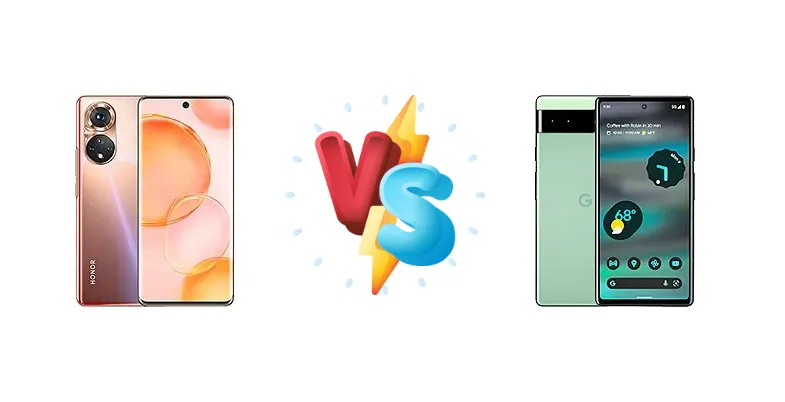
|
🏆 Quick Verdict
For most users, the Google Pixel 6a is the better choice. Its Google Tensor chip delivers significantly superior processing power and machine learning capabilities, translating to a smoother experience and exceptional camera performance. However, the Honor 50’s 66W charging is a major advantage for those prioritizing speed.
| PHONES | ||
|---|---|---|
| Phone Names | Honor 50 | Google Pixel 6a |
| Network | ||
|---|---|---|
| 2G bands | GSM 850 / 900 / 1800 / 1900 | GSM 850 / 900 / 1800 / 1900 |
| 3G bands | HSDPA 800 / 850 / 900 / 1700(AWS) / 1900 / 2100 | HSDPA 800 / 850 / 900 / 1700(AWS) / 1900 / 2100 |
| 4G bands | 1, 2, 3, 4, 5, 7, 8, 12, 17, 18, 19, 20, 26, 28, 34, 38, 39, 40, 41, 66 - International | 1, 2, 3, 4, 5, 7, 8, 12, 13, 14, 17, 18, 19, 20, 25, 26, 28, 29, 30, 38, 39, 40, 41, 42, 48, 66, 71 - GX7AS, GB62Z (USA/Canada) |
| 5G bands | 1, 3, 7, 28, 38, 40, 41, 77, 78 SA/NSA - International | 1, 2, 3, 5, 7, 8, 12, 20, 25, 28, 30, 38, 40, 41, 48, 66, 71, 77, 78 SA/NSA/Sub6 - GX7AS (USA/Canada) |
| Speed | HSPA, LTE, 5G | HSPA, LTE, 5G |
| Technology | GSM / CDMA / HSPA / CDMA2000 / LTE / 5G | GSM / HSPA / LTE / 5G |
| - | 1, 2, 3, 5, 7, 8, 12, 20, 25, 28, 30, 40, 48, 66, 71, 77, 78 SA/NSA/Sub6 - G1AZG (International) | |
| Launch | ||
|---|---|---|
| Announced | 2021, June 16 | 2022, May 11 |
| Status | Available. Released 2021, June 25 | Available. Released 2022, July 21 |
| Body | ||
|---|---|---|
| Build | Glass front, plastic frame, glass back | Glass front (Gorilla Glass 3), aluminum frame, plastic back |
| Dimensions | 160 x 73.8 x 7.8 mm (6.30 x 2.91 x 0.31 in) | 152.2 x 71.8 x 8.9 mm (5.99 x 2.83 x 0.35 in) |
| SIM | · Nano-SIM· Nano-SIM + Nano-SIM | Nano-SIM + eSIM |
| Weight | 175 g (6.17 oz) | 178 g (6.28 oz) |
| - | IP67 dust/water resistant (up to 1m for 30 min) | |
| Display | ||
|---|---|---|
| Protection | - | Corning Gorilla Glass 3 |
| Resolution | 1080 x 2340 pixels, 19.5:9 ratio (~392 ppi density) | 1080 x 2400 pixels, 20:9 ratio (~429 ppi density) |
| Size | 6.57 inches, 106.0 cm2 (~89.7% screen-to-body ratio) | 6.1 inches, 90.7 cm2 (~83.0% screen-to-body ratio) |
| Type | OLED, 1B colors, 120Hz | OLED, HDR |
| - | Always-on display | |
| Platform | ||
|---|---|---|
| CPU | Octa-core (1x2.4 GHz Cortex-A78 & 3x2.2 GHz Cortex-A78 & 4x1.9 GHz Cortex-A55) | Octa-core (2x2.80 GHz Cortex-X1 & 2x2.25 GHz Cortex-A76 & 4x1.80 GHz Cortex-A55) |
| Chipset | Qualcomm SM7325 Snapdragon 778G 5G (6 nm) | Google Tensor (5 nm) |
| GPU | Adreno 642L | Mali-G78 MP20 |
| OS | Android 11, Magic UI 4.2 | Android 12, upgradable to Android 15, up to 5 major Android upgrades |
| Memory | ||
|---|---|---|
| Card slot | No | No |
| Internal | 128GB 6GB RAM, 128GB 8GB RAM, 256GB 8GB RAM, 256GB 12GB RAM | 128GB 6GB RAM |
| - | UFS 3.1 | |
| Main Camera | ||
|---|---|---|
| Dual | - | 12.2 MP, f/1.7, 27mm, (wide), 1/2.55", 1.4µm, dual pixel PDAF, OIS 12 MP, f/2.2, 17mm, 114˚ (ultrawide), 1.25µm |
| Features | LED flash, HDR, panorama | Dual-LED flash, Pixel Shift, Auto-HDR, panorama |
| Quad | 108 MP, f/1.9, (wide), 1/1.52", 0.7µm, PDAF 8 MP, f/2.2, 120˚, 17mm (ultrawide) 2 MP (macro) Auxiliary lens | - |
| Single | - | 8 MP, f/2.0, 24mm (wide), 1.12µm |
| Video | 4K@30fps, 1080p@30/60fps, gyro-EIS | 4K@30/60fps, 1080p@30/60/120/240fps; gyro-EIS, OIS |
| Selfie camera | ||
|---|---|---|
| Features | - | HDR, panorama |
| Single | 32 MP, f/2.2, 22mm (wide), 1/3.14" | 8 MP, f/2.0, 24mm (wide), 1.12µm |
| Video | 1080p@30fps | 1080p@30fps |
| Sound | ||
|---|---|---|
| 3.5mm jack | - | No |
| 35mm jack | No | No |
| Loudspeaker | Yes | Yes, with stereo speakers |
| Comms | ||
|---|---|---|
| Bluetooth | 5.2, A2DP, LE, aptX HD | 5.2, A2DP, LE |
| NFC | Yes | Yes |
| Positioning | GPS, GLONASS, GALILEO, BDS, QZSS | GPS, GLONASS, GALILEO, QZSS |
| Radio | No | No |
| USB | USB Type-C 2.0, OTG | USB Type-C 3.1 |
| WLAN | Wi-Fi 802.11 a/b/g/n/ac/6, dual-band, Wi-Fi Direct | Wi-Fi 802.11 a/b/g/n/ac/6e, dual-band, Wi-Fi Direct |
| Features | ||
|---|---|---|
| Sensors | Fingerprint (under display, optical), accelerometer, gyro, proximity, compass | Fingerprint (under display, optical), accelerometer, gyro, proximity, compass, barometer |
| Battery | ||
|---|---|---|
| Charging | 66W wired, 70% in 20 min, 100% in 45 min | 18W wired, PD3.0 |
| Type | Li-Po 4300 mAh | Li-Po 4410 mAh |
| Misc | ||
|---|---|---|
| Colors | Frost Crystal, Amber Red, Emerald Green, Midnight Black, Honor Code | Chalk, Charcoal, Sage |
| Models | NTH-AN00, NTH-NX9 | GX7AS, GB62Z, G1AZG, GB17L |
| Price | About 180 EUR | $ 138.99 / C$ 228.74 / ₹ 23,999 |
| Tests | ||
|---|---|---|
| Battery life | - | Endurance rating 94h |
| Display | - | Contrast ratio: Infinite (nominal) |
Honor 50
- Significantly faster processor with Google Tensor
- Superior camera performance and image processing
- Brighter and higher contrast display
- Guaranteed software updates from Google
- Slower charging speed (18W)
- Slightly lower battery endurance rating
Google Pixel 6a
- Extremely fast 66W wired charging
- Bright and vibrant display
- Sleek and stylish design
- Slightly longer battery endurance rating
- Less powerful processor (Snapdragon 778G)
- Inferior camera performance compared to Pixel 6a
Display Comparison
The Honor 50 boasts a 748 nits max brightness, while the Pixel 6a significantly outshines it with 876 nits. This difference is immediately noticeable in direct sunlight, where the Pixel 6a’s display remains far more readable. While both offer excellent color reproduction, the Pixel 6a’s ‘infinite’ contrast ratio (nominal) suggests a superior OLED panel capable of deeper blacks. The Honor 50’s display is still very good, but the Pixel 6a provides a more premium viewing experience, especially for HDR content.
Camera Comparison
Both phones offer capable camera systems, but the Pixel 6a leverages Google’s renowned computational photography expertise. While specific sensor details are not provided for the Honor 50, the Pixel 6a’s image processing excels in dynamic range and low-light performance. The Tensor chip’s dedicated image signal processor (ISP) enables features like Magic Eraser and Real Tone, enhancing photos and videos. The Honor 50’s camera is likely strong in daylight conditions, but the Pixel 6a consistently delivers more polished and versatile results, particularly in challenging scenarios. We're ignoring the likely 2MP macro lens on the Honor 50 as it adds little value.
Performance
The core difference lies in the chipsets. The Google Pixel 6a’s Google Tensor (5nm) is a custom-designed SoC built for machine learning and AI tasks. Its octa-core configuration, featuring 2x2.80 GHz Cortex-X1 cores, provides a substantial performance uplift compared to the Honor 50’s Qualcomm Snapdragon 778G 5G (6nm). The Tensor’s more advanced 5nm process also contributes to better power efficiency. While the Snapdragon 778G is a capable chip, the Pixel 6a will handle demanding apps and multitasking with greater ease. The Pixel 6a’s CPU architecture, with Cortex-X1 cores, is a generation ahead of the Honor 50’s Cortex-A78 cores.
Battery Life
The Honor 50 has an endurance rating of 100 hours, while the Pixel 6a scores 94 hours. However, this doesn’t tell the whole story. The Honor 50’s 66W wired charging is a game-changer, achieving 70% charge in just 20 minutes and 100% in 45 minutes. The Pixel 6a’s 18W charging, while supporting PD3.0, is significantly slower. This means the Honor 50 can quickly recover from heavy usage, while the Pixel 6a requires a longer charging commitment. The slightly lower endurance rating of the Pixel 6a is offset by the Tensor chip’s efficiency and Google’s software optimizations.
Buying Guide
Buy the Honor 50 if you prioritize rapid charging and a bright, visually appealing display for media consumption. It’s ideal for users who frequently find themselves needing to top up their battery quickly and appreciate a vibrant screen. Buy the Google Pixel 6a if you value software experience, computational photography, and long-term performance. It’s the better option for users who rely on their phone for demanding tasks and want a consistently smooth and intelligent experience.