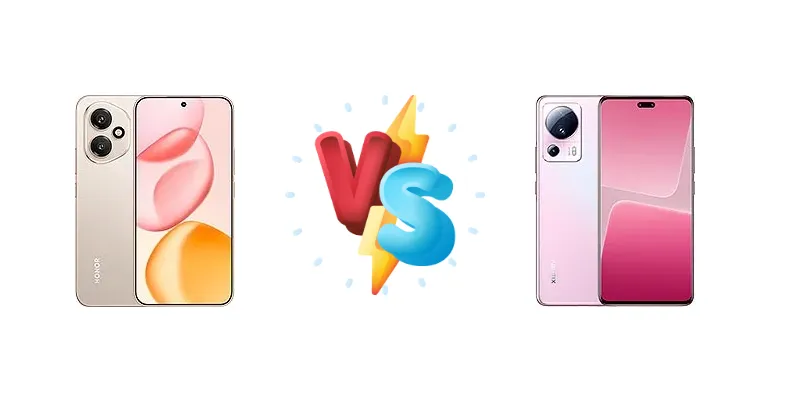
The mid-range smartphone market is fiercely competitive, and the Honor 400 and Xiaomi 13 Lite represent compelling options. The Xiaomi 13 Lite, while an older model, boasts a strong reputation for its balanced feature set. The Honor 400, however, arrives with a newer chipset and a focus on extended battery life, creating a fascinating head-to-head comparison for users prioritizing longevity and performance.
🏆 Quick Verdict
For the average user, the Honor 400 emerges as the stronger choice. Its Snapdragon 7 Gen 3 chipset offers a noticeable performance uplift over the Xiaomi 13 Lite’s Snapdragon 7 Gen 1, and the significantly improved battery endurance – boasting 56:28h versus the Xiaomi’s 93h (older rating) – makes it ideal for power users and those frequently away from a charger.
| Network |
|---|
| 2G bands | GSM 850 / 900 / 1800 / 1900 | GSM 850 / 900 / 1800 / 1900 |
| 3G bands | HSDPA 800 / 850 / 900 / 1700(AWS) / 1900 / 2100 | HSDPA 800 / 850 / 900 / 1700(AWS) / 1900 / 2100 |
| 4G bands | LTE | 1, 2, 3, 4, 5, 7, 8, 12, 13, 17, 18, 19, 20, 26, 28, 32, 38, 40, 41, 42, 66 |
| 5G bands | SA/NSA | 1, 3, 5, 7, 8, 20, 28, 38, 40, 41, 66, 77, 78 SA/NSA |
| Speed | HSPA, LTE, 5G | HSPA, LTE, 5G |
| Technology | GSM / HSPA / LTE / 5G | GSM / HSPA / LTE / 5G |
| Launch |
|---|
| Announced | 2025, May 22 | 2023, February 26 |
| Status | Available. Released 2025, May 23 | Available. Released 2023, March 08 |
| Body |
|---|
| Build | Glass front, plastic frame, plastic back | Glass front (Gorilla Glass 5), glass back, plastic frame |
| Dimensions | 156.5 x 74.6 x 7.3 mm (6.16 x 2.94 x 0.29 in) | 159.2 x 72.7 x 7.2 mm (6.27 x 2.86 x 0.28 in) |
| SIM | · Nano-SIM + Nano-SIM + eSIM (max 2 at a time)· Nano-SIM + eSIM | · Nano-SIM + eSIM· Nano-SIM + Nano-SIM |
| Weight | 184 g (6.49 oz) | 171 g (6.03 oz) |
| | - | IP53, dust and splash resistant |
| Display |
|---|
| Protection | Mohs level 4 | Corning Gorilla Glass 5 |
| Resolution | 1264 x 2736 pixels, 19.5:9 ratio (~460 ppi density) | 1080 x 2400 pixels, 20:9 ratio (~402 ppi density) |
| Size | 6.55 inches, 105.4 cm2 (~90.3% screen-to-body ratio) | 6.55 inches, 103.6 cm2 (~89.5% screen-to-body ratio) |
| Type | AMOLED, 1B colors, 120Hz, 3840Hz PWM, HDR, 5000 nits (peak) | AMOLED, 68B colors, Dolby Vision, HDR10+, 120Hz, 500 nits (typ), 1000 nits (peak) |
| Platform |
|---|
| CPU | Octa-core (1x2.63 GHz Cortex-A715 & 3x2.4 GHz Cortex-A715 & 4x1.8 GHz Cortex-A510) | Octa-core (1x2.4 GHz Cortex-A710 & 3x2.36 GHz Cortex-A710 & 4x1.8 GHz Cortex-A510) |
| Chipset | Qualcomm SM7550-AB Snapdragon 7 Gen 3 (4 nm) | Qualcomm SM7450-AB Snapdragon 7 Gen 1 (4 nm) |
| GPU | Adreno 720 | Adreno 644 |
| OS | Android 15, up to 6 major Android upgrades, MagicOS 9 | Android 12, MIUI 14 |
| Memory |
|---|
| Card slot | No | No |
| Internal | 256GB 8GB RAM, 256GB 12GB RAM, 512GB 8GB RAM, 512GB 12GB RAM | 64GB 8GB RAM, 128GB 8GB RAM, 256GB 8GB RAM |
| | - | UFS 2.2 |
| Main Camera |
|---|
| Dual | 200 MP, f/1.9, (wide), 1/1.4", 0.56µm, PDAF, OIS
12 MP, f/2.2, 112˚ (ultrawide), AF | - |
| Features | LED flash, HDR, panorama | Dual-LED dual-tone flash, HDR, panorama |
| Triple | - | 50 MP, f/1.8, 23mm (wide), 1/1.56", 1.0µm, PDAF
8 MP, f/2.2, 119˚ (ultrawide), 1/4.0", 1.12µm
2 MP (macro) |
| Video | 4K, 1080p, gyro-EIS, OIS | 4K@30fps, 1080p@30/60/120fps, 720p@960fps |
| Selfie camera |
|---|
| Dual | - | 32 MP, f/2.4, 100˚ (ultrawide), 1/2.74", 0.8µm
8 MP, f/2.3, (depth) |
| Features | HDR | Dual-LED flash, HDR |
| Single | 50 MP, f/2.0, (wide), 0.64µm | - |
| Video | 4K, 1080p, gyro-EIS | 1080p@30/60fps |
| Sound |
|---|
| 3.5mm jack | - | No |
| 35mm jack | No | No |
| Loudspeaker | Yes, with stereo speakers | Yes |
| | - | 24-bit/192kHz audio |
| Comms |
|---|
| Bluetooth | 5.4, A2DP, LE, aptX HD | 5.2, A2DP, LE |
| Infrared port | Yes | Yes |
| NFC | Yes | Yes (market/region dependent) |
| Positioning | GPS, GALILEO, GLONASS, QZSS, BDS | GPS (L1), GLONASS (G1), BDS (B1I+B1c), GALILEO (E1), QZSS (L1) |
| Radio | No | No |
| USB | USB Type-C 2.0, OTG | USB Type-C 2.0, OTG |
| WLAN | Wi-Fi 802.11 a/b/g/n/ac/6, dual-band, Wi-Fi Direct | Wi-Fi 802.11 a/b/g/n/ac/6, dual-band |
| Features |
|---|
| Sensors | Fingerprint (under display, optical), accelerometer, compass, proximity (ultrasonic) | Fingerprint (under display, optical), accelerometer, gyro, proximity, compass |
| Battery |
|---|
| Charging | 66W wired (for 5300 mAh), 44% in 15 min, 100% in 46 min
80W wired (for 6000 mAh), 40% in 15 min
5W reverse wired | 67W wired, 100% in 40 min |
| Type | Market-dependent versions:· Si/C Li-Ion 5300 mAh - Europe· Si/C Li-Ion 6000 mAh - ROW | Li-Po 4500 mAh |
| Misc |
|---|
| Colors | Midnight Black, Meteor Silver, Desert Gold, Tidal Blue | Black, Lite Blue, Lite Pink |
| Models | DNY-NX9 | - |
| Price | € 293.99 / $ 338.80 | About 180 EUR |
| Tests |
|---|
| Battery life | - |
Endurance rating 93h
|
| Camera | - |
Photo / Video |
| Display | - |
Contrast ratio: Infinite (nominal) |
| Loudspeaker | - |
-28.5 LUFS (Average)
|
| Performance | - |
AnTuTu: 534143 (v9)
GeekBench: 2936 (v5.1), 2434 (v6)
GFXBench: 33fps (ES 3.1 onscreen) |
| EU LABEL |
|---|
| Battery | 56:28h endurance, 1200 cycles | - |
| Energy | Class A | - |
| Free fall | Class B (180 falls) | - |
| Repairability | Class B | - |
Honor 400
- Significantly longer battery life (56:28h endurance)
- More powerful Snapdragon 7 Gen 3 chipset
- Faster charging options (66W/80W)
- Potentially larger and heavier design (speculation)
- Higher price point (likely)
Xiaomi 13 Lite
- Sleek and lightweight design (assumed)
- Competitive price (likely)
- Good all-around performance for everyday tasks
- Older Snapdragon 7 Gen 1 chipset
- Shorter battery life (93h endurance)
- Slower charging speed
Display Comparison
The Honor 400’s display boasts a measured peak brightness of 1550 nits, a substantial advantage over the Xiaomi 13 Lite’s 938 nits. This translates to significantly better visibility outdoors under direct sunlight. While both phones feature an 'infinite' (nominal) contrast ratio, the Honor 400’s higher brightness is the defining factor for users who frequently consume content on the go. We lack PWM frequency data for both, but the brightness difference alone makes the Honor 400 more versatile.
Camera Comparison
Both devices are listed as having 'Photo / Video' capabilities, but lack specific details. Without sensor size, aperture, or OIS information, a direct comparison is difficult. However, given the Xiaomi 13 Lite’s focus on aesthetics, it likely prioritizes selfie performance. The Honor 400, positioned as a more all-around device, may offer a more versatile camera system, but this remains speculative without further data. We can safely assume the 2MP macro cameras on both devices offer limited practical value.
Performance
The Honor 400’s Qualcomm SM7550-AB Snapdragon 7 Gen 3 (4nm) represents a clear generational leap over the Xiaomi 13 Lite’s Snapdragon 7 Gen 1 (4nm). The 7 Gen 3 features a revised CPU configuration – (1x2.63 GHz Cortex-A715 & 3x2.4 GHz Cortex-A715 & 4x1.8 GHz Cortex-A510) – compared to the 7 Gen 1’s (1x2.4 GHz Cortex-A710 & 3x2.36 GHz Cortex-A710 & 4x1.8 GHz Cortex-A510). The newer architecture and higher clock speeds in the Honor 400 will result in faster app loading times, smoother multitasking, and improved gaming performance. While both are 4nm chips, the architectural improvements in the 7 Gen 3 provide a tangible benefit.
Battery Life
The Honor 400’s battery endurance of 56:28h is a standout feature, dwarfing the Xiaomi 13 Lite’s older 93h rating. This difference is further amplified by the Honor 400’s charging capabilities: 66W (5300 mAh) or 80W (6000 mAh) options, achieving 44% or 40% charge in 15 minutes respectively, and full charges in 46 minutes. The Xiaomi 13 Lite’s 67W charging, while respectable, takes a full 40 minutes. The Honor 400’s larger battery capacity options and faster charging provide a significant advantage for users who demand all-day (and beyond) battery life.
Buying Guide
Buy the Honor 400 if you need exceptional battery life, a more modern chipset for demanding apps and games, and faster charging speeds. It’s the phone for users who prioritize longevity and future-proofing. Buy the Xiaomi 13 Lite if you prefer a slightly more compact form factor (assumed based on market positioning) and are looking for a well-rounded experience at a potentially lower price point, accepting compromises in battery and processing power.
Frequently Asked Questions
❓ Does the Snapdragon 7 Gen 3 in the Honor 400 get hot during extended gaming sessions?
The Snapdragon 7 Gen 3’s 4nm process and improved thermal architecture should mitigate overheating. While sustained gaming will inevitably generate heat, the Honor 400 is likely to experience less throttling than the Xiaomi 13 Lite due to the newer chipset’s efficiency. However, sustained performance will still depend on the phone’s cooling solution, which is not specified.
❓ How does the 80W charging on the 6000 mAh Honor 400 model compare to the 67W charging on the Xiaomi 13 Lite in real-world use?
While both offer fast charging, the Honor 400’s 80W option, paired with a larger 6000 mAh battery, provides a more substantial boost in charging speed. The Honor 400 reaches 40% in 15 minutes, while the Xiaomi 13 Lite takes a similar time to reach 100%. The Honor 400’s larger battery capacity also means it will retain more charge for longer periods.
❓ Is the difference in battery endurance between the Honor 400 and Xiaomi 13 Lite noticeable for typical daily use?
Absolutely. The Honor 400’s 56:28h endurance rating is a significant improvement over the Xiaomi 13 Lite’s 93h. This translates to potentially a full extra day of use for moderate users, and a substantial advantage for power users who frequently stream video, play games, or use GPS navigation.