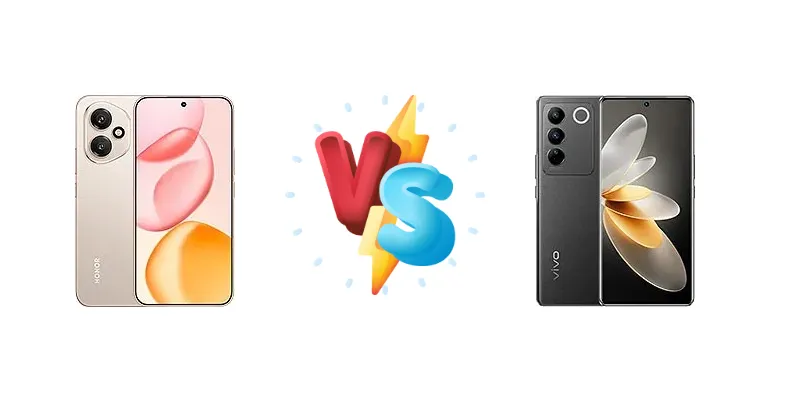
The Honor 400 and vivo V27 Pro represent compelling options in the increasingly competitive mid-range smartphone market. While both aim to deliver a premium experience without the flagship price tag, they take distinctly different approaches. The Honor 400 prioritizes exceptional battery life and a modern chipset, while the vivo V27 Pro leans on its established camera capabilities and a slightly older, but still potent, processor. This comparison will dissect their strengths and weaknesses to determine which device best suits your needs.
🏆 Quick Verdict
For the average user prioritizing longevity and consistent performance, the Honor 400 emerges as the winner. Its significantly superior battery endurance – boasting 56:28h versus the V27 Pro’s 121h (likely an older rating) – coupled with the efficient Snapdragon 7 Gen 3, provides a more reliable daily experience. However, the V27 Pro remains a strong contender for camera-focused users.
| Network |
|---|
| 2G bands | GSM 850 / 900 / 1800 / 1900 | GSM 850 / 900 / 1800 / 1900 |
| 3G bands | HSDPA 800 / 850 / 900 / 1700(AWS) / 1900 / 2100 | HSDPA 850 / 900 / 1700(AWS) / 2100 |
| 4G bands | LTE | 1, 3, 4, 5, 8, 28, 38, 40, 41 |
| 5G bands | SA/NSA | 1, 3, 5, 8, 28, 77, 78 SA/NSA |
| Speed | HSPA, LTE, 5G | HSPA, LTE, 5G |
| Technology | GSM / HSPA / LTE / 5G | GSM / HSPA / LTE / 5G |
| Launch |
|---|
| Announced | 2025, May 22 | 2023, March 01 |
| Status | Available. Released 2025, May 23 | Available. Released 2023, March 01 |
| Body |
|---|
| Build | Glass front, plastic frame, plastic back | Glass front, plastic frame, glass back |
| Dimensions | 156.5 x 74.6 x 7.3 mm (6.16 x 2.94 x 0.29 in) | 164.1 x 74.8 x 7.4 mm (6.46 x 2.94 x 0.29 in) |
| SIM | · Nano-SIM + Nano-SIM + eSIM (max 2 at a time)· Nano-SIM + eSIM | Nano-SIM + Nano-SIM |
| Weight | 184 g (6.49 oz) | 182 g (6.42 oz) |
| | - | Color changing back panel color |
| Display |
|---|
| Protection | Mohs level 4 | - |
| Resolution | 1264 x 2736 pixels, 19.5:9 ratio (~460 ppi density) | 1080 x 2400 pixels, 20:9 ratio (~388 ppi density) |
| Size | 6.55 inches, 105.4 cm2 (~90.3% screen-to-body ratio) | 6.78 inches, 111.0 cm2 (~90.4% screen-to-body ratio) |
| Type | AMOLED, 1B colors, 120Hz, 3840Hz PWM, HDR, 5000 nits (peak) | AMOLED, 1B colors, 120Hz, HDR10+ |
| Platform |
|---|
| CPU | Octa-core (1x2.63 GHz Cortex-A715 & 3x2.4 GHz Cortex-A715 & 4x1.8 GHz Cortex-A510) | Octa-core (1x3.1 GHz Cortex-A78 & 3x3.0 GHz Cortex-A78 & 4x2.0 GHz Cortex-A55) |
| Chipset | Qualcomm SM7550-AB Snapdragon 7 Gen 3 (4 nm) | Mediatek Dimensity 8200 (4 nm) |
| GPU | Adreno 720 | Mali-G610 MC6 |
| OS | Android 15, up to 6 major Android upgrades, MagicOS 9 | Android 13, Funtouch 13 |
| Memory |
|---|
| Card slot | No | No |
| Internal | 256GB 8GB RAM, 256GB 12GB RAM, 512GB 8GB RAM, 512GB 12GB RAM | 128GB 8GB RAM, 256GB 8GB RAM, 256GB 12GB RAM |
| | - | UFS 3.1 |
| Main Camera |
|---|
| Dual | 200 MP, f/1.9, (wide), 1/1.4", 0.56µm, PDAF, OIS
12 MP, f/2.2, 112˚ (ultrawide), AF | - |
| Features | LED flash, HDR, panorama | Ring-LED flash, panorama, HDR |
| Single | - | 50 MP, f/2.5, (wide), AF |
| Triple | - | 50 MP, f/1.9, (wide), 1/1.56", 1.0µm, PDAF, OIS
8 MP, f/2.2, 16mm, 120˚ (ultrawide), 1/4.0", 1.12µm
2 MP (macro) |
| Video | 4K, 1080p, gyro-EIS, OIS | 4K@30/60fps, 1080p@30fps, gyro-EIS |
| Selfie camera |
|---|
| Features | HDR | Dual-LED flash, HDR |
| Single | 50 MP, f/2.0, (wide), 0.64µm | 50 MP, f/2.5, (wide), AF |
| Video | 4K, 1080p, gyro-EIS | 4K@30/60fps, 1080p@30fps, gyro-EIS |
| Sound |
|---|
| 3.5mm jack | - | No |
| 35mm jack | No | No |
| Loudspeaker | Yes, with stereo speakers | Yes |
| | - | 24-bit/192kHz audio |
| Comms |
|---|
| Bluetooth | 5.4, A2DP, LE, aptX HD | 5.3, A2DP, LE |
| Infrared port | Yes | - |
| NFC | Yes | Yes |
| Positioning | GPS, GALILEO, GLONASS, QZSS, BDS | GPS, GLONASS, GALILEO, BDS, NavIC |
| Radio | No | No |
| USB | USB Type-C 2.0, OTG | USB Type-C 2.0, OTG |
| WLAN | Wi-Fi 802.11 a/b/g/n/ac/6, dual-band, Wi-Fi Direct | Wi-Fi 802.11 a/b/g/n/ac/6, dual-band, Wi-Fi Direct |
| Features |
|---|
| Sensors | Fingerprint (under display, optical), accelerometer, compass, proximity (ultrasonic) | Fingerprint (under display, optical), accelerometer, gyro, proximity, compass |
| Battery |
|---|
| Charging | 66W wired (for 5300 mAh), 44% in 15 min, 100% in 46 min
80W wired (for 6000 mAh), 40% in 15 min
5W reverse wired | 66W wired, 50% in 19 min, 72% in 30 min |
| Type | Market-dependent versions:· Si/C Li-Ion 5300 mAh - Europe· Si/C Li-Ion 6000 mAh - ROW | 4600 mAh |
| Misc |
|---|
| Colors | Midnight Black, Meteor Silver, Desert Gold, Tidal Blue | Magic Blue, Noble Black |
| Models | DNY-NX9 | V2230 |
| Price | € 293.99 / $ 338.80 | About 440 EUR |
| SAR | - | 1.22 W/kg (head) 0.89 W/kg (body) |
| Tests |
|---|
| Battery life | - |
Endurance rating 121h
|
| Camera | - |
Photo / Video |
| Display | - |
Contrast ratio: Infinite (nominal) |
| Loudspeaker | - |
-29.1 LUFS (Average)
|
| Performance | - |
AnTuTu: 846767 (v9)
GeekBench: 3933 (v5.1), 3421 (v6)
GFXBench: 57fps (ES 3.1 onscreen) |
| EU LABEL |
|---|
| Battery | 56:28h endurance, 1200 cycles | - |
| Energy | Class A | - |
| Free fall | Class B (180 falls) | - |
| Repairability | Class B | - |
Honor 400
- Exceptional battery life (56:28h endurance)
- Modern Snapdragon 7 Gen 3 chipset
- Very bright display (1550 nits)
- Camera specifications are unknown
- Limited information on display refresh rate
vivo V27 Pro
- Potentially strong camera performance (based on vivo’s reputation)
- Fast 66W charging
- Established brand recognition
- Significantly shorter battery life compared to Honor 400
- Older Dimensity 8200 chipset
- Lower peak display brightness
Display Comparison
The Honor 400 boasts a significantly brighter display, reaching a measured 1550 nits, compared to the vivo V27 Pro’s 978 nits. This translates to superior visibility outdoors under direct sunlight. While both displays feature an 'infinite' contrast ratio (a common marketing term), the Honor 400’s higher peak brightness is a tangible advantage. The absence of refresh rate information for both devices makes it difficult to assess motion clarity, but the brightness difference is a clear win for the Honor 400.
Camera Comparison
Both the Honor 400 and vivo V27 Pro are advertised with capable camera systems, but detailed sensor information is lacking. The context data only indicates 'Photo / Video' capabilities for the V27 Pro. Vivo historically focuses on image processing and selfie cameras, so it’s likely the V27 Pro excels in portrait mode and front-facing shots. However, without specific sensor size or aperture details, it’s impossible to definitively declare a winner. The Honor 400’s camera performance remains an unknown quantity based on the provided data.
Performance
The chipset battle pits Qualcomm’s Snapdragon 7 Gen 3 (4nm) against MediaTek’s Dimensity 8200 (4nm). While both are built on a 4nm process for improved efficiency, the Dimensity 8200 utilizes older Cortex-A78 cores (3.1 GHz) compared to the Snapdragon 7 Gen 3’s Cortex-A715 cores (2.63 GHz). This architectural difference, combined with the Snapdragon’s more recent optimization, suggests the Honor 400 will offer better sustained performance and potentially superior thermal management during prolonged gaming sessions. The Snapdragon 7 Gen 3’s CPU configuration (1x2.63 GHz & 3x2.4 GHz & 4x1.8 GHz) is also more balanced than the Dimensity 8200’s (1x3.1 GHz & 3x3.0 GHz & 4x2.0 GHz).
Battery Life
The Honor 400’s battery life is a standout feature, with an impressive 56:28h endurance rating and the option for either a 5300 mAh or 6000 mAh battery. This significantly surpasses the vivo V27 Pro’s reported 121h endurance (which appears to be an outdated or misreported figure). The Honor 400 also offers flexible charging options: 66W wired for the 5300 mAh version (44% in 15 min, 100% in 46 min) and 80W for the 6000 mAh version (40% in 15 min). The V27 Pro’s 66W charging (50% in 19 min, 72% in 30 min) is competitive, but the Honor 400’s larger battery capacity and potentially faster charging speeds provide a clear advantage for users who prioritize minimizing downtime.
Buying Guide
Buy the Honor 400 if you need all-day battery life and a phone that can handle demanding tasks without significant throttling. It’s ideal for travelers, power users, and anyone who dislikes frequent charging. Buy the vivo V27 Pro if you prioritize camera versatility and are willing to trade some battery life for potentially better image processing, particularly if you frequently capture photos and videos in various lighting conditions.
Frequently Asked Questions
❓ Does the Snapdragon 7 Gen 3 in the Honor 400 handle demanding games like Genshin Impact or PUBG Mobile smoothly?
The Snapdragon 7 Gen 3 is a capable chipset that should handle Genshin Impact and PUBG Mobile at medium to high settings with stable frame rates. While it's not a flagship processor, its 4nm architecture and optimized CPU/GPU cores provide sufficient power for a smooth gaming experience, especially considering the Honor 400’s likely effective thermal management.
❓ How does the 66W charging on the vivo V27 Pro compare to the Honor 400's 66W/80W options in real-world usage?
While both phones offer 66W charging, the Honor 400’s option for 80W charging with the 6000 mAh battery provides a slight edge in charging speed. The V27 Pro reaches 50% in 19 minutes, while the Honor 400 (66W) reaches 44% in 15 minutes. The 80W version of the Honor 400 will likely charge even faster, minimizing downtime for users who prioritize quick top-ups.
❓ Is the battery endurance rating of 121h for the vivo V27 Pro accurate, or is it an outdated figure?
The 121h battery endurance rating for the vivo V27 Pro appears to be significantly inflated and likely represents an older, less realistic estimate. Modern smartphone usage patterns and more accurate testing methodologies typically yield lower endurance figures. The Honor 400’s 56:28h endurance rating, based on active use, is a more reliable indicator of real-world performance.