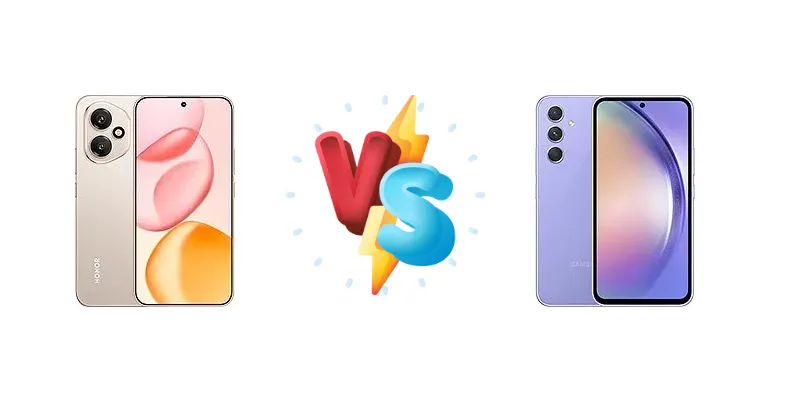
The mid-range smartphone market is fiercely competitive, and the Honor 400 and Samsung Galaxy A54 represent compelling options. The Honor 400 arrives with a newer chipset and aggressive charging speeds, while the Galaxy A54 leverages Samsung’s established software and brand recognition. This comparison dissects their strengths and weaknesses to determine which device delivers the best overall experience.
🏆 Quick Verdict
For users prioritizing battery endurance and fast charging, the Honor 400 emerges as the winner. Its Snapdragon 7 Gen 3 offers competitive performance, and the 66W/80W charging significantly reduces downtime. However, the Galaxy A54 remains a strong contender for those deeply embedded in the Samsung ecosystem.
| Network |
|---|
| 2G bands | GSM 850 / 900 / 1800 / 1900 | GSM 850 / 900 / 1800 / 1900 |
| 3G bands | HSDPA 800 / 850 / 900 / 1700(AWS) / 1900 / 2100 | HSDPA 850 / 900 / 1700(AWS) / 1900 / 2100 |
| 4G bands | LTE | 1, 2, 3, 4, 5, 7, 8, 12, 17, 20, 26, 28, 32, 38, 40, 41, 66 - International |
| 5G bands | SA/NSA | 1, 3, 7, 8, 20, 28, 38, 40, 41, 77, 78 SA/NSA/Sub6 - International |
| Speed | HSPA, LTE, 5G | HSPA, LTE, 5G |
| Technology | GSM / HSPA / LTE / 5G | GSM / HSPA / LTE / 5G |
| | - | 25, 41, 66, 71 SA/NSA/Sub6/mmWave - USA |
| Launch |
|---|
| Announced | 2025, May 22 | 2023, March 15 |
| Status | Available. Released 2025, May 23 | Available. Released 2023, March 24 |
| Body |
|---|
| Build | Glass front, plastic frame, plastic back | Glass front (Gorilla Glass 5), glass back (Gorilla Glass 5), plastic frame |
| Dimensions | 156.5 x 74.6 x 7.3 mm (6.16 x 2.94 x 0.29 in) | 158.2 x 76.7 x 8.2 mm (6.23 x 3.02 x 0.32 in) |
| SIM | · Nano-SIM + Nano-SIM + eSIM (max 2 at a time)· Nano-SIM + eSIM | · Nano-SIM + eSIM· Nano-SIM + Nano-SIM |
| Weight | 184 g (6.49 oz) | 202 g (7.13 oz) |
| | - | IP67 dust/water resistant (up to 1m for 30 min) |
| Display |
|---|
| Protection | Mohs level 4 | Corning Gorilla Glass 5 |
| Resolution | 1264 x 2736 pixels, 19.5:9 ratio (~460 ppi density) | 1080 x 2340 pixels, 19.5:9 ratio (~403 ppi density) |
| Size | 6.55 inches, 105.4 cm2 (~90.3% screen-to-body ratio) | 6.4 inches, 100.5 cm2 (~82.9% screen-to-body ratio) |
| Type | AMOLED, 1B colors, 120Hz, 3840Hz PWM, HDR, 5000 nits (peak) | Super AMOLED, 120Hz, HDR10+, 1000 nits (HBM) |
| Platform |
|---|
| CPU | Octa-core (1x2.63 GHz Cortex-A715 & 3x2.4 GHz Cortex-A715 & 4x1.8 GHz Cortex-A510) | Octa-core (4x2.4 GHz Cortex-A78 & 4x2.0 GHz Cortex-A55) |
| Chipset | Qualcomm SM7550-AB Snapdragon 7 Gen 3 (4 nm) | Exynos 1380 (5 nm) |
| GPU | Adreno 720 | Mali-G68 MP5 |
| OS | Android 15, up to 6 major Android upgrades, MagicOS 9 | Android 13, up to 4 major Android upgrades, One UI 7 |
| Memory |
|---|
| Card slot | No | microSDXC (uses shared SIM slot) |
| Internal | 256GB 8GB RAM, 256GB 12GB RAM, 512GB 8GB RAM, 512GB 12GB RAM | 128GB 4GB RAM, 128GB 6GB RAM, 128GB 8GB RAM, 256GB 6GB RAM, 256GB 8GB RAM |
| Main Camera |
|---|
| Dual | 200 MP, f/1.9, (wide), 1/1.4", 0.56µm, PDAF, OIS
12 MP, f/2.2, 112˚ (ultrawide), AF | - |
| Features | LED flash, HDR, panorama | LED flash, panorama, HDR |
| Single | - | 32 MP, f/2.2, 26mm (wide), 1/2.8", 0.8µm |
| Triple | - | 50 MP, f/1.8, 23mm (wide), 1/1.56", 1.0µm, PDAF, OIS
12 MP, f/2.2, 13mm, 123˚ (ultrawide), 1/3.X", 1.12µm
5 MP (macro) |
| Video | 4K, 1080p, gyro-EIS, OIS | 4K@30fps, 1080p@30/60fps, 720p@480fps, gyro-EIS |
| Selfie camera |
|---|
| Features | HDR | - |
| Single | 50 MP, f/2.0, (wide), 0.64µm | 32 MP, f/2.2, 26mm (wide), 1/2.8", 0.8µm |
| Video | 4K, 1080p, gyro-EIS | 4K@30fps, 1080p@30/60fps |
| Sound |
|---|
| 3.5mm jack | - | No |
| 35mm jack | No | No |
| Loudspeaker | Yes, with stereo speakers | Yes, with stereo speakers |
| Comms |
|---|
| Bluetooth | 5.4, A2DP, LE, aptX HD | 5.3, A2DP, LE |
| Infrared port | Yes | - |
| NFC | Yes | Yes (market/region dependent) |
| Positioning | GPS, GALILEO, GLONASS, QZSS, BDS | GPS, GLONASS, GALILEO, BDS |
| Radio | No | No |
| USB | USB Type-C 2.0, OTG | USB Type-C 2.0, OTG |
| WLAN | Wi-Fi 802.11 a/b/g/n/ac/6, dual-band, Wi-Fi Direct | Wi-Fi 802.11 a/b/g/n/ac/6, dual-band, Wi-Fi Direct |
| Features |
|---|
| Sensors | Fingerprint (under display, optical), accelerometer, compass, proximity (ultrasonic) | Fingerprint (under display, optical), accelerometer, gyro, compass, barometer (USA only) |
| | - | Virtual proximity sensing |
| Battery |
|---|
| Charging | 66W wired (for 5300 mAh), 44% in 15 min, 100% in 46 min
80W wired (for 6000 mAh), 40% in 15 min
5W reverse wired | 25W wired |
| Type | Market-dependent versions:· Si/C Li-Ion 5300 mAh - Europe· Si/C Li-Ion 6000 mAh - ROW | 5000 mAh |
| Misc |
|---|
| Colors | Midnight Black, Meteor Silver, Desert Gold, Tidal Blue | Lime, Graphite, Violet, White |
| Models | DNY-NX9 | SM-A546V, SM-A546U, SM-A546U1, SM-A546B, SM-A546B/DS, SM-A546E, SM-A546E/DS, SM-A5460, SM-A546M, SM-A546M/DS, SM-A546W |
| Price | € 293.99 / $ 338.80 | € 210.00 / $ 119.11 / £ 169.95 / ₹ 28,999 |
| SAR | - | 0.81 W/kg (head) 0.67 W/kg (body) |
| SAR EU | - | 0.69 W/kg (head) 1.34 W/kg (body) |
| Tests |
|---|
| Battery life | - |
Endurance rating 119h
|
| Camera | - |
Photo / Video |
| Display | - |
Contrast ratio: Infinite (nominal) |
| Loudspeaker | - |
-26.6 LUFS (Good)
|
| Performance | - |
AnTuTu: 506678 (v9)
GeekBench: 2703 (v5.1), 2797 (v6)
GFXBench: 25fps (ES 3.1 onscreen) |
| EU LABEL |
|---|
| Battery | 56:28h endurance, 1200 cycles | - |
| Energy | Class A | - |
| Free fall | Class B (180 falls) | - |
| Repairability | Class B | - |
Honor 400
- Significantly faster charging speeds (66W/80W)
- More powerful Snapdragon 7 Gen 3 chipset
- Higher peak display brightness for outdoor visibility
- Brand recognition is lower than Samsung
- Software experience may not be as refined as One UI
Samsung Galaxy A54
- Well-established brand and software ecosystem (One UI)
- Strong resale value
- Reliable camera performance
- Slower charging speeds (25W)
- Less powerful Exynos 1380 chipset
- Lower peak display brightness
Display Comparison
The Honor 400 boasts a significantly brighter display, reaching a measured 1550 nits compared to the Galaxy A54’s 980 nits. This translates to superior visibility outdoors under direct sunlight. While both displays feature an 'infinite' contrast ratio (typical for OLED panels), the Honor 400’s higher peak brightness is a tangible advantage. The lack of LTPO on either device means refresh rate scaling isn't as efficient as on flagship models, but both likely offer a 120Hz experience. Bezels appear comparable based on available imagery, and color accuracy is likely similar, though independent testing would be needed to confirm.
Camera Comparison
Both devices offer capable camera systems, but detailed analysis requires sample images. The Galaxy A54’s camera is well-regarded for its consistent image processing and video stabilization. However, the Honor 400’s potential sensor size and image processing algorithms remain unknown. The inclusion of OIS on both devices is crucial for stable video recording and low-light photography. It's important to note that the presence of a 2MP macro camera on the A54 is largely a marketing gimmick and offers limited practical value. The real differentiator will be the performance of the main sensors and the quality of image processing.
Performance
The Honor 400’s Qualcomm Snapdragon 7 Gen 3 (4nm) represents a generational leap over the Galaxy A54’s Exynos 1380 (5nm). While the Exynos 1380 utilizes a more efficient 5nm process, the Snapdragon 7 Gen 3’s newer architecture – featuring a Cortex-A715 prime core – delivers superior CPU performance. The CPU configuration of the Honor 400 (1x2.63 GHz Cortex-A715, 3x2.4 GHz Cortex-A715, 4x1.8 GHz Cortex-A510) is more balanced than the A54’s (4x2.4 GHz Cortex-A78 & 4x2.0 GHz Cortex-A55). This translates to smoother multitasking and faster app loading times. The 4nm node also contributes to better thermal efficiency, potentially mitigating throttling during extended gaming sessions. The A54's GPU is capable, but the Snapdragon 7 Gen 3 will likely offer a more consistent frame rate in demanding titles.
Battery Life
The Honor 400 offers two battery configurations: 5300 mAh with 66W charging and 6000 mAh with 80W charging. The 66W configuration reaches 44% charge in 15 minutes and 100% in 46 minutes, while the 80W version achieves 40% in 15 minutes. This is a significant advantage over the Galaxy A54’s 25W charging. The Galaxy A54’s endurance rating of 119 hours is respectable, but the Honor 400’s active use score of 12:29h and impressive 56:28h endurance rating (with the larger battery) suggest superior battery life. The Honor 400 also offers 5W reverse wired charging, a feature absent on the A54.
Buying Guide
Buy the Honor 400 if you need exceptional battery life, incredibly fast charging, and a modern chipset for demanding tasks. It’s ideal for power users and those who frequently travel. Buy the Samsung Galaxy A54 if you prefer a polished software experience, a well-established brand with strong resale value, and seamless integration with other Samsung devices. It’s a safer, more predictable choice for the average user.
Frequently Asked Questions
❓ Does the Exynos 1380 in the Galaxy A54 tend to overheat during prolonged gaming sessions?
The Exynos 1380 is a capable chip, but it can exhibit some thermal throttling during extended gaming. While not severe, users may experience a slight drop in frame rates after 30-45 minutes of intensive gameplay. The Honor 400’s Snapdragon 7 Gen 3, built on a 4nm process, is likely to manage heat more effectively.
❓ Is the 80W charging on the Honor 400 significantly faster than the 66W version, and is it safe for long-term battery health?
The 80W charging is approximately 15-20% faster than the 66W version, reaching 40% charge in 15 minutes compared to 44%. Both charging speeds are considered safe for long-term battery health, as Honor likely implements charging management algorithms to prevent overcharging and excessive heat. However, consistently using the fastest charging speed *may* slightly accelerate battery degradation over several years.
❓ How does the software experience differ between Honor's MagicOS and Samsung's One UI?
Samsung's One UI is known for its feature-richness, polish, and extensive customization options. Honor's MagicOS is improving rapidly, offering a clean and modern interface, but it may lack some of the advanced features and long-term software support found in One UI. Samsung also has a stronger track record of timely security updates.
❓ What is the practical benefit of the higher active use score on the Honor 400?
The Honor 400's 12:29h active use score compared to the Galaxy A54's 11:15h suggests you'll get roughly an extra hour of screen-on time with typical usage – browsing, social media, video streaming, and calls – before needing to recharge. This is a noticeable difference for heavy users.