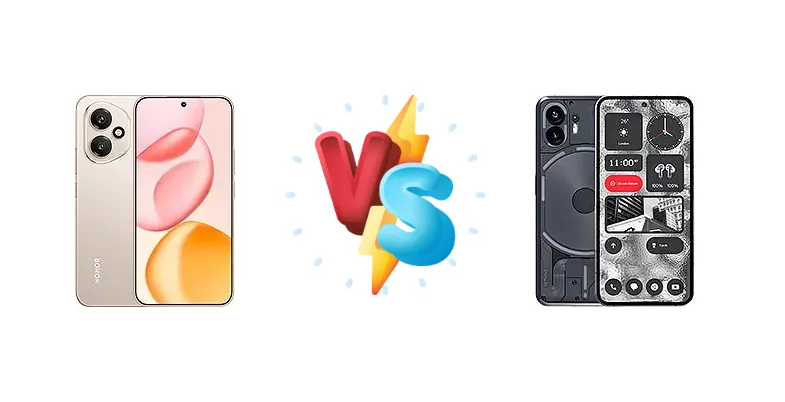
The Honor 400 and Nothing Phone (2) represent compelling options in a crowded mid-range and upper-mid-range smartphone market. The Honor 400 focuses on maximizing battery life and efficient performance, while the Nothing Phone (2) prioritizes a more powerful chipset and a unique design aesthetic. This comparison dissects their key differences to determine which device best suits your needs.
🏆 Quick Verdict
For the average user prioritizing all-day battery life and efficient performance, the Honor 400 emerges as the winner. Its impressive 56:28h endurance rating and fast charging capabilities outweigh the Nothing Phone (2)'s more powerful processor, especially considering the price difference. However, power users will appreciate the Nothing Phone (2)'s Snapdragon 8+ Gen 1.
| Network |
|---|
| 2G bands | GSM 850 / 900 / 1800 / 1900 | GSM 850 / 900 / 1800 / 1900 |
| 3G bands | HSDPA 800 / 850 / 900 / 1700(AWS) / 1900 / 2100 | HSDPA 800 / 850 / 900 / 1700(AWS) / 1900 / 2100 |
| 4G bands | LTE | 1, 2, 3, 4, 5, 7, 8, 12, 17, 18, 19, 20, 25, 26, 28, 30, 32, 34, 38, 39, 40, 41, 42, 48, 66, 71 |
| 5G bands | SA/NSA | 1, 2, 3, 5, 7, 8, 12, 20, 25, 28, 30, 38, 40, 41, 66, 71, 75, 77, 78 SA/NSA |
| Speed | HSPA, LTE, 5G | HSPA, LTE, 5G |
| Technology | GSM / HSPA / LTE / 5G | GSM / HSPA / LTE / 5G |
| Launch |
|---|
| Announced | 2025, May 22 | 2023, July 11 |
| Status | Available. Released 2025, May 23 | Available. Released 2023, July 17 |
| Body |
|---|
| Build | Glass front, plastic frame, plastic back | Glass front (Gorilla Glass 5), glass back (Gorilla Glass 5), aluminum frame |
| Dimensions | 156.5 x 74.6 x 7.3 mm (6.16 x 2.94 x 0.29 in) | 162.1 x 76.4 x 8.6 mm (6.38 x 3.01 x 0.34 in) |
| SIM | · Nano-SIM + Nano-SIM + eSIM (max 2 at a time)· Nano-SIM + eSIM | Nano-SIM + Nano-SIM |
| Weight | 184 g (6.49 oz) | 201.2 g (7.09 oz) |
| Display |
|---|
| Protection | Mohs level 4 | Corning Gorilla Glass 5 |
| Resolution | 1264 x 2736 pixels, 19.5:9 ratio (~460 ppi density) | 1080 x 2412 pixels, 20:9 ratio (~394 ppi density) |
| Size | 6.55 inches, 105.4 cm2 (~90.3% screen-to-body ratio) | 6.7 inches, 108.0 cm2 (~87.2% screen-to-body ratio) |
| Type | AMOLED, 1B colors, 120Hz, 3840Hz PWM, HDR, 5000 nits (peak) | LTPO OLED, 1B colors, 120Hz, 1920Hz PWM, HDR10+, 1600 nits (HBM), 1600 nits (peak) |
| Platform |
|---|
| CPU | Octa-core (1x2.63 GHz Cortex-A715 & 3x2.4 GHz Cortex-A715 & 4x1.8 GHz Cortex-A510) | Octa-core (1x3.0 GHz Cortex-X2 & 3x2.5 GHz Cortex-A710 & 4x1.80 GHz Cortex-A510) |
| Chipset | Qualcomm SM7550-AB Snapdragon 7 Gen 3 (4 nm) | Qualcomm SM8475 Snapdragon 8+ Gen 1 (4 nm) |
| GPU | Adreno 720 | Adreno 730 |
| OS | Android 15, up to 6 major Android upgrades, MagicOS 9 | Android 13, upgradable to Android 15, up to 3 major Android upgrades, Nothing OS 3.0 |
| Memory |
|---|
| Card slot | No | No |
| Internal | 256GB 8GB RAM, 256GB 12GB RAM, 512GB 8GB RAM, 512GB 12GB RAM | 128GB 8GB RAM, 256GB 12GB RAM, 512GB 12GB RAM |
| Main Camera |
|---|
| Dual | 200 MP, f/1.9, (wide), 1/1.4", 0.56µm, PDAF, OIS
12 MP, f/2.2, 112˚ (ultrawide), AF | 50 MP, f/1.9, 24mm (wide), 1/1.56", 1.0µm, PDAF, OIS
50 MP, f/2.2, 114˚ (ultrawide), 1/2.76", 0.64µm, AF |
| Features | LED flash, HDR, panorama | LED flash, panorama, HDR |
| Video | 4K, 1080p, gyro-EIS, OIS | 4K@30/60fps, 1080p@30/60fps, gyro-EIS, live HDR, OIS |
| Selfie camera |
|---|
| Features | HDR | HDR |
| Single | 50 MP, f/2.0, (wide), 0.64µm | 32 MP, f/2.5, (wide), 1/2.74", 0.8µm |
| Video | 4K, 1080p, gyro-EIS | 1080p@30fps |
| Sound |
|---|
| 35mm jack | No | No |
| Loudspeaker | Yes, with stereo speakers | Yes, with stereo speakers |
| Comms |
|---|
| Bluetooth | 5.4, A2DP, LE, aptX HD | 5.3, A2DP, LE, aptX HD, aptX Adaptive |
| Infrared port | Yes | - |
| NFC | Yes | Yes |
| Positioning | GPS, GALILEO, GLONASS, QZSS, BDS | GPS (L1+L5), GLONASS (L1), BDS (B1I+B1c), GALILEO (E1), QZSS (L1), NavIC |
| Radio | No | No |
| USB | USB Type-C 2.0, OTG | USB Type-C 2.0, OTG |
| WLAN | Wi-Fi 802.11 a/b/g/n/ac/6, dual-band, Wi-Fi Direct | Wi-Fi 802.11 a/b/g/n/ac/6, dual-band, Wi-Fi Direct |
| Features |
|---|
| Sensors | Fingerprint (under display, optical), accelerometer, compass, proximity (ultrasonic) | Fingerprint (under display, optical), accelerometer, proximity, gyro, compass |
| Battery |
|---|
| Charging | 66W wired (for 5300 mAh), 44% in 15 min, 100% in 46 min
80W wired (for 6000 mAh), 40% in 15 min
5W reverse wired | 45W wired, PD3.0, PPS, QC4, 100% in 55 min
15W wireless, 100% in 130 min
5W reverse wireless |
| Type | Market-dependent versions:· Si/C Li-Ion 5300 mAh - Europe· Si/C Li-Ion 6000 mAh - ROW | Li-Ion 4700 mAh |
| Misc |
|---|
| Colors | Midnight Black, Meteor Silver, Desert Gold, Tidal Blue | White, Dark Gray |
| Models | DNY-NX9 | A065 |
| Price | € 293.99 / $ 338.80 | $ 379.99 / £ 370.00 |
| EU LABEL |
|---|
| Battery | 56:28h endurance, 1200 cycles | - |
| Energy | Class A | - |
| Free fall | Class B (180 falls) | - |
| Repairability | Class B | - |
Honor 400
- Exceptional battery life (56:28h endurance)
- Ultra-fast 66W/80W charging
- Bright 1550 nits display
- Less powerful processor than the Nothing Phone (2)
- Camera specs are unknown
Nothing Phone (2)
- Powerful Snapdragon 8+ Gen 1 processor
- Established camera system with OIS
- Unique Glyph Interface design
- Shorter battery life compared to Honor 400
- Slower charging speed (45W)
Display Comparison
The Honor 400 boasts a significantly brighter display, reaching a measured 1550 nits, compared to the Nothing Phone (2)'s 998 nits. This translates to superior visibility in direct sunlight. While both utilize OLED panels, the Honor 400's higher peak brightness is a clear advantage for outdoor use. The Nothing Phone (2) doesn't specify PWM dimming frequency, while Honor's display tech is likely optimized for eye comfort, potentially benefiting users sensitive to flicker. Both displays are likely to offer excellent color accuracy, but the Honor 400's brightness gives it an edge.
Camera Comparison
The context data for both phones is limited regarding camera specifics. However, the Nothing Phone (2) is known for its dual 50MP camera system with OIS, focusing on both photo and video quality. The Honor 400's camera specs are not provided, making a direct comparison difficult. Assuming a similar price point, the Nothing Phone (2)'s established camera reputation and OIS likely provide a more consistent and higher-quality imaging experience. Without detailed sensor information for the Honor 400, it's difficult to assess its low-light performance or dynamic range capabilities.
Performance
The Nothing Phone (2) leverages the Snapdragon 8+ Gen 1 (4nm), a previous-generation flagship chipset, offering a substantial performance advantage over the Honor 400's Snapdragon 7 Gen 3 (4nm). The Snapdragon 8+ Gen 1's Cortex-X2 prime core, clocked at 3.0 GHz, provides a noticeable boost in single-core performance, crucial for responsive app launching and smoother multitasking. However, the Snapdragon 7 Gen 3 is no slouch, and its efficient 4nm process helps manage thermals. The Nothing Phone (2)'s LPDDR5x RAM further enhances performance, while the Honor 400's RAM configuration isn't specified, potentially impacting multitasking speeds. The Snapdragon 8+ Gen 1 will excel in graphically intensive tasks, while the 7 Gen 3 prioritizes efficiency.
Battery Life
The Honor 400 truly shines in battery endurance, achieving a remarkable 56:28h rating and an active use score of 12:29h. This significantly surpasses the Nothing Phone (2)'s active use score of 14:21h (endurance rating of 103h is an older metric and less comparable). The Honor 400 offers two battery options: 5300 mAh with 66W charging and 6000 mAh with 80W charging. The 80W option can deliver 40% charge in just 15 minutes. The Nothing Phone (2) offers 45W wired charging, taking 55 minutes for a full charge, and 15W wireless charging. The Honor 400's faster charging and larger battery options provide a clear advantage for users who prioritize minimizing downtime.
Buying Guide
Buy the Honor 400 if you need exceptional battery life, fast charging, and a reliable daily driver that won't leave you scrambling for a charger. It's ideal for users who prioritize longevity and value. Buy the Nothing Phone (2) if you prefer a more powerful processor for demanding tasks like gaming or video editing, and appreciate a distinctive design with the Glyph Interface, even if it means sacrificing some battery endurance.
Frequently Asked Questions
❓ How does the Snapdragon 7 Gen 3 in the Honor 400 handle demanding games like Genshin Impact?
While the Snapdragon 7 Gen 3 isn't a flagship chipset, it's capable of running Genshin Impact at medium settings with stable frame rates. However, users seeking the highest graphical fidelity and consistent 60fps performance may experience some frame drops. The Nothing Phone (2)'s Snapdragon 8+ Gen 1 will provide a smoother and more consistent gaming experience.
❓ Does the Honor 400's fast charging generate excessive heat during prolonged use?
Honor utilizes intelligent charging algorithms to minimize heat generation during the fast charging process. While some warmth is expected, the 66W/80W charging is designed to be safe and efficient. The Snapdragon 7 Gen 3's 4nm process also contributes to better thermal management, preventing overheating during charging and regular use.
❓ What are the real-world benefits of the Nothing Phone (2)'s Glyph Interface?
The Glyph Interface offers customizable light patterns for notifications, calls, and charging progress. It provides a unique visual experience and can help you quickly identify alerts without looking at the screen. However, its functionality is largely aesthetic and may not appeal to all users.
❓ How does the Nothing Phone (2)'s software experience compare to Honor's MagicOS?
The Nothing Phone (2) runs on Nothing OS, a near-stock Android experience with a focus on simplicity and customization. Honor's MagicOS, while based on Android, includes more pre-installed apps and a more heavily customized user interface. Users who prefer a clean and minimalist software experience will likely prefer Nothing OS.