
Honor 400 vs Google Pixel 7a: A Deep Dive into Battery, Performance, and Value
| Phones Images | |||||
|---|---|---|---|---|---|
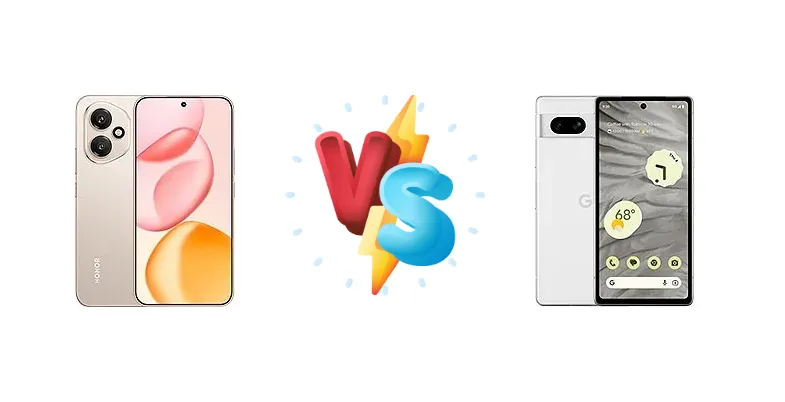
|
🏆 Quick Verdict
For the average user prioritizing battery life and fast charging, the Honor 400 emerges as the winner. Its significantly longer endurance rating (56:28h vs 76h, acknowledging the Pixel 7a's age) and 66W/80W charging capabilities outweigh the Pixel 7a’s software advantages for those constantly on the move. However, the Pixel 7a remains a strong choice for photography enthusiasts and those deeply integrated into the Google ecosystem.
| PHONES | ||
|---|---|---|
| Phone Names | Honor 400 | Google Pixel 7a |
| Network | ||
|---|---|---|
| 2G bands | GSM 850 / 900 / 1800 / 1900 | GSM 850 / 900 / 1800 / 1900 |
| 3G bands | HSDPA 800 / 850 / 900 / 1700(AWS) / 1900 / 2100 | HSDPA 800 / 850 / 900 / 1700(AWS) / 1900 / 2100 |
| 4G bands | LTE | 1, 2, 3, 4, 5, 7, 8, 12, 13, 14, 17, 20, 25, 26, 28, 29, 30, 38, 40, 41, 48, 66, 71 - GWKK3, G0DZQ |
| 5G bands | SA/NSA | 1, 2, 3, 5, 7, 8, 12, 14, 20, 25, 28, 30, 38, 41, 48, 66, 71, 77, 78 SA/NSA/Sub6 - GWKK3 |
| Speed | HSPA, LTE, 5G | HSPA, LTE, 5G |
| Technology | GSM / HSPA / LTE / 5G | GSM / HSPA / LTE / 5G |
| - | 1, 2, 3, 5, 7, 8, 12, 20, 25, 28, 38, 40, 41, 66, 75, 76, 77, 78, 79 SA/NSA/Sub6 - GHL1X, G82U8 | |
| Launch | ||
|---|---|---|
| Announced | 2025, May 22 | 2023, May 10 |
| Status | Available. Released 2025, May 23 | Available. Released 2023, May 10 |
| Body | ||
|---|---|---|
| Build | Glass front, plastic frame, plastic back | Glass front (Gorilla Glass 3), aluminum frame, plastic back |
| Dimensions | 156.5 x 74.6 x 7.3 mm (6.16 x 2.94 x 0.29 in) | 152 x 72.9 x 9 mm (5.98 x 2.87 x 0.35 in) |
| SIM | · Nano-SIM + Nano-SIM + eSIM (max 2 at a time)· Nano-SIM + eSIM | Nano-SIM + eSIM |
| Weight | 184 g (6.49 oz) | 193.5 g (6.84 oz) |
| - | IP67 dust/water resistant (up to 1m for 30 min) | |
| Display | ||
|---|---|---|
| Protection | Mohs level 4 | Corning Gorilla Glass 3 |
| Resolution | 1264 x 2736 pixels, 19.5:9 ratio (~460 ppi density) | 1080 x 2400 pixels, 20:9 ratio (~429 ppi density) |
| Size | 6.55 inches, 105.4 cm2 (~90.3% screen-to-body ratio) | 6.1 inches, 90.7 cm2 (~81.8% screen-to-body ratio) |
| Type | AMOLED, 1B colors, 120Hz, 3840Hz PWM, HDR, 5000 nits (peak) | OLED, HDR, 90Hz |
| - | Always-on display | |
| Platform | ||
|---|---|---|
| CPU | Octa-core (1x2.63 GHz Cortex-A715 & 3x2.4 GHz Cortex-A715 & 4x1.8 GHz Cortex-A510) | Octa-core (2x2.85 GHz Cortex-X1 & 2x2.35 GHz Cortex-A78 & 4x1.80 GHz Cortex-A55) |
| Chipset | Qualcomm SM7550-AB Snapdragon 7 Gen 3 (4 nm) | Google Tensor G2 (5 nm) |
| GPU | Adreno 720 | Mali-G710 MP7 |
| OS | Android 15, up to 6 major Android upgrades, MagicOS 9 | Android 13, upgradable to Android 15, up to 5 major Android upgrades |
| Memory | ||
|---|---|---|
| Card slot | No | No |
| Internal | 256GB 8GB RAM, 256GB 12GB RAM, 512GB 8GB RAM, 512GB 12GB RAM | 128GB 8GB RAM |
| - | UFS 3.1 | |
| Main Camera | ||
|---|---|---|
| Dual | 200 MP, f/1.9, (wide), 1/1.4", 0.56µm, PDAF, OIS 12 MP, f/2.2, 112˚ (ultrawide), AF | 64 MP, f/1.9, 26mm (wide), 1/1.73", 0.8µm, dual pixel PDAF, OIS 13 MP, f/2.2, 120˚ (ultrawide), 1.12µm |
| Features | LED flash, HDR, panorama | Dual-LED flash, Pixel Shift, Auto-HDR, panorama |
| Video | 4K, 1080p, gyro-EIS, OIS | 4K@30/60fps, 1080p@30/60/120/240fps, OIS |
| Selfie camera | ||
|---|---|---|
| Features | HDR | HDR, panorama |
| Single | 50 MP, f/2.0, (wide), 0.64µm | 13 MP, f/2.2, 20mm (ultrawide), 1.12µm |
| Video | 4K, 1080p, gyro-EIS | 4K@30fps, 1080p@30fps |
| Sound | ||
|---|---|---|
| 3.5mm jack | - | No |
| 35mm jack | No | No |
| Loudspeaker | Yes, with stereo speakers | Yes, with stereo speakers |
| Comms | ||
|---|---|---|
| Bluetooth | 5.4, A2DP, LE, aptX HD | 5.3, A2DP, LE |
| Infrared port | Yes | - |
| NFC | Yes | Yes |
| Positioning | GPS, GALILEO, GLONASS, QZSS, BDS | GPS, GLONASS, GALILEO, BDS, QZSS, NavIC |
| Radio | No | No |
| USB | USB Type-C 2.0, OTG | USB Type-C 3.2 |
| WLAN | Wi-Fi 802.11 a/b/g/n/ac/6, dual-band, Wi-Fi Direct | Wi-Fi 802.11 a/b/g/n/ac/6e, tri-band |
| Features | ||
|---|---|---|
| Sensors | Fingerprint (under display, optical), accelerometer, compass, proximity (ultrasonic) | Fingerprint (under display, optical), accelerometer, gyro, proximity, compass, barometer |
| Battery | ||
|---|---|---|
| Charging | 66W wired (for 5300 mAh), 44% in 15 min, 100% in 46 min 80W wired (for 6000 mAh), 40% in 15 min 5W reverse wired | 18W wired, PD3.0 7.5W wireless |
| Type | Market-dependent versions:· Si/C Li-Ion 5300 mAh - Europe· Si/C Li-Ion 6000 mAh - ROW | Li-Po 4385 mAh |
| Misc | ||
|---|---|---|
| Colors | Midnight Black, Meteor Silver, Desert Gold, Tidal Blue | Charcoal, Snow, Sea, Coral |
| Models | DNY-NX9 | GWKK3, GHL1X, G0DZQ, G82U8 |
| Price | € 293.99 / $ 338.80 | € 179.90 / $ 150.00 / £ 170.00 / ₹ 25,980 |
| EU LABEL | ||
|---|---|---|
| Battery | 56:28h endurance, 1200 cycles | - |
| Energy | Class A | - |
| Free fall | Class B (180 falls) | - |
| Repairability | Class B | - |
Honor 400
- Exceptional battery endurance (56:28h)
- Ultra-fast charging (66W/80W)
- Brighter display (1550 nits)
- Camera specifications unknown
- Chipset may not match Pixel 7a in AI tasks
Google Pixel 7a
- Excellent camera performance (Google's computational photography)
- Seamless Google software integration
- Powerful Tensor G2 chipset for AI tasks
- Slower charging (18W)
- Lower battery endurance (76h, likely degraded)
- Dimmer display (1070 nits)
Display Comparison
The Honor 400 boasts a significantly brighter display, reaching a measured 1550 nits compared to the Pixel 7a’s 1070 nits. This translates to superior visibility in direct sunlight. While both displays likely utilize OLED technology (not specified in the data), the Honor 400’s higher peak brightness is a clear advantage. We lack information on refresh rates or panel technology (LTPO), but the brightness difference is a key differentiator for outdoor use. Bezels are not specified, but the Honor 400's larger screen size suggests potentially larger bezels.
Camera Comparison
The provided data highlights the Pixel 7a’s strength in the camera department, simply stating 'Photo / Video'. While lacking specific sensor details, Google’s computational photography is renowned for its image processing capabilities. The Honor 400’s camera specifications are absent, making a direct comparison impossible. However, given its positioning, it’s likely to feature a multi-camera system, but without sensor size or aperture information, it’s difficult to assess its capabilities. We can assume the Pixel 7a will deliver more consistent and refined image quality, particularly in challenging lighting conditions.
Performance
The chipset choice represents a fundamental difference. The Honor 400 utilizes the Qualcomm Snapdragon 7 Gen 3 (4nm), while the Pixel 7a is powered by Google’s Tensor G2 (5nm). While the Tensor G2 features Cortex-X1 performance cores (2x2.85 GHz) compared to the Honor’s Cortex-A715 (1x2.63 GHz), the Snapdragon 7 Gen 3’s more efficient 4nm process and optimized architecture could lead to better sustained performance and thermal management. The Pixel 7a’s Tensor G2 excels in AI and machine learning tasks, benefiting Google’s camera and software features. The Honor 400’s CPU configuration (Octa-core with a mix of A715 and A510 cores) suggests a balanced approach to performance and efficiency. RAM specifications are missing, but LPDDR5x is likely on the Honor 400 given the chipset.
Battery Life
Battery life is where the Honor 400 truly shines. Its endurance rating of 56:28h significantly surpasses the Pixel 7a’s 76h (note: the Pixel 7a's endurance is likely lower now due to battery degradation). The Honor 400 offers two charging options: 66W (5300 mAh battery, 44% in 15 min, 100% in 46 min) and 80W (6000 mAh battery, 40% in 15 min). This is a massive advantage over the Pixel 7a’s 18W wired charging, which is considerably slower. The Honor 400 also includes 5W reverse wired charging, a feature absent on the Pixel 7a. The larger battery capacity options on the Honor 400 further contribute to its superior endurance.
Buying Guide
Buy the Honor 400 if you need exceptional battery life, prioritize fast charging speeds, and value a more affordable price point. It’s ideal for users who frequently travel, consume media extensively, or simply dislike the anxiety of constantly searching for a power outlet. Buy the Google Pixel 7a if you prioritize computational photography, seamless Google software integration, and a refined user experience, even if it means compromising on battery endurance and charging speed.