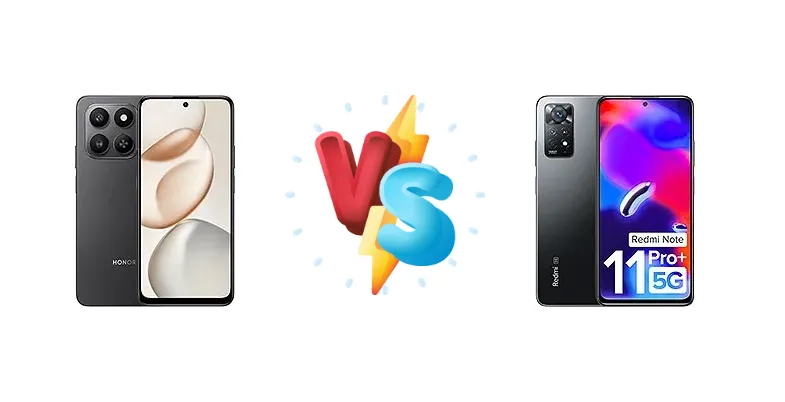
Both the Honor 400 Smart and the Xiaomi Redmi Note 11 Pro+ 5G (India) target the competitive mid-range 5G market, but they approach it with different strengths. The Redmi Note 11 Pro+ boasts significantly faster charging, while the Honor 400 Smart features a newer Snapdragon chipset. This comparison dives deep into the specifics to determine which device offers the best overall experience.
🏆 Quick Verdict
For the average user prioritizing rapid charging and readily available features, the Xiaomi Redmi Note 11 Pro+ 5G (India) is the better choice. Its 67W charging dramatically reduces downtime. However, the Honor 400 Smart’s newer Snapdragon 6s Gen 3 offers a slight edge in efficiency and potential longevity.
| Network |
|---|
| 2G bands | GSM 850 / 900 / 1800 / 1900 | GSM 850 / 900 / 1800 / 1900 - SIM 1 & SIM 2 |
| 3G bands | HSDPA 850 / 900 / 1700(AWS) / 1900 / 2100 | HSDPA 850 / 900 / 1900 / 2100 |
| 4G bands | LTE | 1, 3, 5, 8, 40, 41 |
| 5G bands | SA/NSA | 1, 3, 5, 8, 28, 40, 78 SA/NSA |
| Speed | HSPA, LTE, 5G | HSPA, LTE-A (CA), 5G |
| Technology | GSM / HSPA / LTE / 5G | GSM / HSPA / LTE / 5G |
| Launch |
|---|
| Announced | 2025, August 07 | 2022, March 09 |
| Status | Available. Released 2025, August 09 | Available. Released 2022, March 15 |
| Body |
|---|
| Build | - | Glass front (Gorilla Glass 5), glass back |
| Dimensions | 166.9 x 76.8 x 8.4 mm (6.57 x 3.02 x 0.33 in) | 164.2 x 76.1 x 8.1 mm (6.46 x 3.00 x 0.32 in) |
| SIM | Nano-SIM + Nano-SIM | Hybrid Dual SIM (Nano-SIM, dual stand-by) |
| Weight | 189 g (6.67 oz) | 202 g (7.13 oz) |
| | - | IP53, dust and splash resistant |
| Display |
|---|
| Protection | Scratch-resistant glass, Mohs level 4 | Corning Gorilla Glass 5 |
| Resolution | 720 x 1610 pixels, 20:9 ratio (~261 ppi density) | 1080 x 2400 pixels, 20:9 ratio (~395 ppi density) |
| Size | 6.77 inches, 110.2 cm2 (~86.0% screen-to-body ratio) | 6.67 inches, 107.4 cm2 (~86.0% screen-to-body ratio) |
| Type | TFT LCD, 120Hz, 700 nits (peak) | Super AMOLED, 120Hz, 700 nits, 1200 nits (peak) |
| Platform |
|---|
| CPU | Octa-core (2x2.3 GHz Cortex-A78 & 6x2.0 GHz Cortex-A55) | Octa-core (2x2.2 GHz Kryo 660 Gold & 6x1.7 GHz Kryo 660 Silver) |
| Chipset | Qualcomm SM6375 Snapdragon 6s Gen 3 (6 nm) | Qualcomm SM6375 Snapdragon 695 5G (6 nm) |
| GPU | Adreno 619 | Adreno 619 |
| OS | Android 15, Magic OS 9 | Android 11, MIUI 13 |
| Memory |
|---|
| Card slot | No | microSDXC (uses shared SIM slot) |
| Internal | 128GB 4GB RAM, 256GB 4GB RAM, 256GB 8GB RAM | 64GB 6GB RAM, 128GB 6GB RAM, 128GB 8GB RAM, 256GB 8GB RAM |
| | - | UFS 2.2 |
| Main Camera |
|---|
| Dual | 50 MP, f/1.8, (wide), PDAF
Auxiliary lens | - |
| Features | LED flash, HDR | LED flash, HDR, panorama |
| Triple | - | 108 MP, f/1.9, 26mm (wide), 1/1.52", 0.7µm, PDAF
8 MP, f/2.2, 118˚ (ultrawide)
2 MP, f/2.4, (macro) |
| Video | 1080p@30fps | 1080p@30fps |
| Selfie camera |
|---|
| Single | 5 MP, f/2.2, (wide) | 16 MP, f/2.5, (wide), 1/3.06" 1.0µm |
| Video | 1080p@30fps | 1080p@30fps |
| Sound |
|---|
| 3.5mm jack | - | Yes |
| 35mm jack | Yes | - |
| Loudspeaker | Yes, with stereo speakers | Yes, with stereo speakers |
| | - | 24-bit/192kHz audio |
| Comms |
|---|
| Bluetooth | 5.1, A2DP, LE | 5.1, A2DP, LE |
| Infrared port | - | Yes |
| NFC | Yes | No |
| Positioning | GPS, GLONASS, GALILEO, BDS | GPS, GLONASS, BDS, GALILEO |
| Radio | No | Unspecified |
| USB | USB Type-C 2.0, OTG | USB Type-C 2.0, OTG |
| WLAN | Wi-Fi 802.11 a/b/g/n/ac, dual-band, Wi-Fi Direct | Wi-Fi 802.11 a/b/g/n/ac, dual-band, Wi-Fi Direct |
| Features |
|---|
| Sensors | Fingerprint (side-mounted), accelerometer, proximity, compass | Fingerprint (side-mounted), accelerometer, gyro, proximity, compass |
| Battery |
|---|
| Charging | 35W wired | 67W wired, PD3.0, QC3, 50% in 15 min, 100% in 42 min (advertised) |
| Type | Li-Po 6500 mAh | Li-Po 5000 mAh, non-removable |
| Misc |
|---|
| Colors | Black | Mirage Blue, Phantom White, Stealth Black |
| Models | LGN-NX1 | 2201116SI |
| Price | - | About 250 EUR |
| EU LABEL |
|---|
| Battery | 69:32h endurance, 1600 cycles | - |
| Energy | Class A | - |
| Free fall | Class A (270 falls) | - |
| Repairability | Class B | - |
Honor 400 Smart
- Potentially longer battery lifespan (1600 cycles)
- Newer Snapdragon 6s Gen 3 chipset
- Excellent battery endurance (69:32h)
- Slower 35W charging
- Camera specifications unknown
Xiaomi Redmi Note 11 Pro+ 5G (India)
- Ultra-fast 67W charging (0-100% in 42 mins)
- Likely higher resolution main camera (108MP)
- Established feature set and ecosystem
- Older Snapdragon 695 chipset
- Potentially shorter battery lifespan
Display Comparison
Display specifications are absent from the provided data, but given the market segment, both likely feature 6.67-inch AMOLED displays with FHD+ resolution. The Redmi Note 11 Pro+ historically features a 120Hz refresh rate, a feature we'd expect to see here, while the Honor 400 Smart's refresh rate is unknown. The key differentiator will be peak brightness and color accuracy, which are not specified. However, the Redmi Note 11 Pro+’s established presence suggests a well-tuned display experience.
Camera Comparison
Camera details are missing, but both phones likely feature a multi-camera setup with a primary sensor. The Redmi Note 11 Pro+ 5G (India) is known for its 108MP main sensor, a significant advantage if carried over. The Honor 400 Smart’s primary sensor resolution is unknown. Without further information, it’s difficult to assess image quality, but the Redmi Note 11 Pro+’s higher resolution sensor and potentially better image processing algorithms give it an edge. We can assume both will include standard ultra-wide and depth sensors, but their quality will be secondary to the main sensor.
Performance
The core of the difference lies in the chipsets. The Honor 400 Smart utilizes the Qualcomm SM6375 Snapdragon 6s Gen 3 (6 nm), featuring an octa-core CPU with 2x2.3 GHz Cortex-A78 and 6x2.0 GHz Cortex-A55 cores. The Redmi Note 11 Pro+ 5G (India) employs the Qualcomm SM6375 Snapdragon 695 5G (6 nm) with an octa-core CPU of 2x2.2 GHz Kryo 660 Gold & 6x1.7 GHz Kryo 660 Silver cores. While both are 6nm chips, the Cortex-A78 cores in the 6s Gen 3 represent a newer architecture, potentially offering a slight performance advantage in CPU-intensive tasks. However, the real-world difference will be marginal for everyday use. Both devices likely pair their chipsets with 8GB of RAM, but the type (LPDDR4x vs LPDDR5) is unknown, impacting memory bandwidth.
Battery Life
The Honor 400 Smart boasts impressive battery endurance, rated at 69:32h, and a battery lifespan of 1600 cycles, suggesting excellent long-term battery health. The Redmi Note 11 Pro+ 5G (India) prioritizes speed with its 67W wired charging, capable of reaching 50% in 15 minutes and 100% in 42 minutes (advertised). While the Redmi Note 11 Pro+’s battery capacity is unknown, the Honor 400 Smart’s endurance suggests a substantial battery size. The Redmi Note 11 Pro+’s faster charging significantly offsets any potential capacity difference, making it ideal for users who frequently need to top up their battery.
Buying Guide
Buy the Honor 400 Smart if you prioritize long-term battery health and a slightly more modern chipset, potentially benefiting from future software optimizations. Buy the Xiaomi Redmi Note 11 Pro+ 5G (India) if you value incredibly fast charging – getting you from 0 to 100% in just 42 minutes – and a more established ecosystem of features and accessories.
Frequently Asked Questions
❓ Does the Snapdragon 6s Gen 3 in the Honor 400 Smart offer a noticeable gaming improvement over the Snapdragon 695 in the Redmi Note 11 Pro+ 5G?
While the Snapdragon 6s Gen 3 features newer CPU cores, the difference in gaming performance will be modest. Both chipsets are capable of handling most mobile games at medium settings. The Redmi Note 11 Pro+ may benefit from more optimized game profiles due to its wider user base.
❓ How does the 67W charging on the Redmi Note 11 Pro+ 5G (India) compare to the 35W charging on the Honor 400 Smart in real-world usage?
The 67W charging on the Redmi Note 11 Pro+ is significantly faster. It can add a substantial amount of charge in just a few minutes, making it ideal for users who need a quick top-up. The 35W charging on the Honor 400 Smart will take considerably longer to fully charge the device.
❓ Given the 1600 charge cycles rating of the Honor 400 Smart, does this mean the battery will last significantly longer than the Redmi Note 11 Pro+ 5G?
The 1600 charge cycle rating suggests the Honor 400 Smart's battery is designed for greater longevity. However, battery degradation is also affected by charging habits and usage patterns. While the Honor 400 Smart has a potential advantage, it doesn't guarantee a dramatically longer lifespan in real-world scenarios.