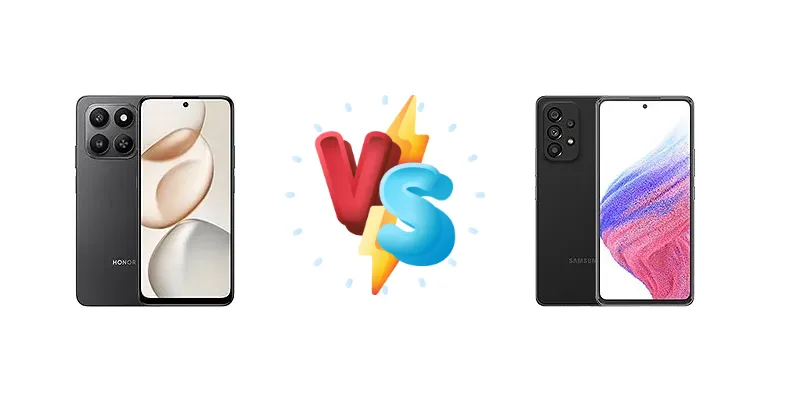
The Honor 400 Smart and Samsung Galaxy A53 5G represent compelling options in the competitive mid-range smartphone market. While the A53 5G has been available for some time, the Honor 400 Smart arrives with a focus on endurance and efficiency. This comparison dissects their key differences, focusing on how their hardware choices translate into real-world user experience.
🏆 Quick Verdict
For the average user prioritizing battery life and overall value, the Honor 400 Smart emerges as the winner. Its significantly longer 69:32h endurance rating and more efficient Snapdragon 6s Gen 3 chipset outweigh the Galaxy A53 5G’s brighter display, especially considering the price difference.
| Network |
|---|
| 2G bands | GSM 850 / 900 / 1800 / 1900 | GSM 850 / 900 / 1800 / 1900 |
| 3G bands | HSDPA 850 / 900 / 1700(AWS) / 1900 / 2100 | HSDPA 850 / 900 / 1700(AWS) / 1900 / 2100 |
| 4G bands | LTE | 1, 2, 3, 4, 5, 7, 12, 14, 20, 29, 30, 38, 39, 40, 41, 46, 48, 66 - SM-A536U |
| 5G bands | SA/NSA | 2, 5, 41, 66, 77, 78 SA/NSA/Sub6/mmWave - SM-A536U |
| Speed | HSPA, LTE, 5G | HSPA, LTE, 5G |
| Technology | GSM / HSPA / LTE / 5G | GSM / HSPA / LTE / 5G |
| | - | 2, 5, 48, 66, 77, 78, 260, 261 SA/NSA/Sub6/mmWave - SM-A536V |
| Launch |
|---|
| Announced | 2025, August 07 | 2022, March 17 |
| Status | Available. Released 2025, August 09 | Available. Released 2022, March 24 |
| Body |
|---|
| Build | - | Glass front (Gorilla Glass 5), plastic frame, plastic back |
| Dimensions | 166.9 x 76.8 x 8.4 mm (6.57 x 3.02 x 0.33 in) | 159.6 x 74.8 x 8.1 mm (6.28 x 2.94 x 0.32 in) |
| SIM | Nano-SIM + Nano-SIM | · Nano-SIM· Nano-SIM + Nano-SIM |
| Weight | 189 g (6.67 oz) | 189 g (6.67 oz) |
| | - | IP67 dust/water resistant (up to 1m for 30 min) |
| Display |
|---|
| Protection | Scratch-resistant glass, Mohs level 4 | Corning Gorilla Glass 5 |
| Resolution | 720 x 1610 pixels, 20:9 ratio (~261 ppi density) | 1080 x 2400 pixels, 20:9 ratio (~405 ppi density) |
| Size | 6.77 inches, 110.2 cm2 (~86.0% screen-to-body ratio) | 6.5 inches, 102.0 cm2 (~85.4% screen-to-body ratio) |
| Type | TFT LCD, 120Hz, 700 nits (peak) | Super AMOLED, 120Hz, 800 nits (HBM) |
| Platform |
|---|
| CPU | Octa-core (2x2.3 GHz Cortex-A78 & 6x2.0 GHz Cortex-A55) | Octa-core (2x2.4 GHz Cortex-A78 & 6x2.0 GHz Cortex-A55) |
| Chipset | Qualcomm SM6375 Snapdragon 6s Gen 3 (6 nm) | Exynos 1280 (5 nm) |
| GPU | Adreno 619 | Mali-G68 |
| OS | Android 15, Magic OS 9 | Android 12, up to 4 major Android upgrades, One UI 8 |
| Memory |
|---|
| Card slot | No | microSDXC (uses shared SIM slot) |
| Internal | 128GB 4GB RAM, 256GB 4GB RAM, 256GB 8GB RAM | 128GB 4GB RAM, 128GB 6GB RAM, 128GB 8GB RAM, 256GB 6GB RAM, 256GB 8GB RAM |
| Main Camera |
|---|
| Dual | 50 MP, f/1.8, (wide), PDAF
Auxiliary lens | - |
| Features | LED flash, HDR | LED flash, panorama, HDR |
| Quad | - | 64 MP, f/1.8, 26mm (wide), 1/1.7X", 0.8µm, PDAF, OIS
12 MP, f/2.2, 123˚ (ultrawide), 1.12µm
5 MP (macro)
Auxiliary lens |
| Single | - | 32 MP, f/2.2, 26mm (wide), 1/2.8", 0.8µm |
| Video | 1080p@30fps | 4K@30fps, 1080p@30/60fps; gyro-EIS |
| Selfie camera |
|---|
| Features | - | HDR |
| Single | 5 MP, f/2.2, (wide) | 32 MP, f/2.2, 26mm (wide), 1/2.8", 0.8µm |
| Video | 1080p@30fps | 4K@30fps, 1080p@30fps |
| Sound |
|---|
| 3.5mm jack | - | No |
| 35mm jack | Yes | No |
| Loudspeaker | Yes, with stereo speakers | Yes, with stereo speakers |
| Comms |
|---|
| Bluetooth | 5.1, A2DP, LE | 5.1, A2DP, LE |
| NFC | Yes | Yes (market/region dependent) |
| Positioning | GPS, GLONASS, GALILEO, BDS | GPS, GLONASS, GALILEO, BDS |
| Radio | No | No |
| USB | USB Type-C 2.0, OTG | USB Type-C 2.0, OTG |
| WLAN | Wi-Fi 802.11 a/b/g/n/ac, dual-band, Wi-Fi Direct | Wi-Fi 802.11 a/b/g/n/ac, dual-band, Wi-Fi Direct |
| Features |
|---|
| Sensors | Fingerprint (side-mounted), accelerometer, proximity, compass | Fingerprint (under display, optical), accelerometer, gyro, compass, barometer (market/region dependent) |
| | - | Virtual proximity sensing |
| Battery |
|---|
| Charging | 35W wired | 25W wired |
| Type | Li-Po 6500 mAh | Li-Po 5000 mAh |
| Misc |
|---|
| Colors | Black | Black, White, Blue, Peach |
| Models | LGN-NX1 | SM-A536B, SM-A536B/DS, SM-A536U, SM-A536U1, SM-A5360, SM-A536E, SM-A536E/DS, SM-A536V, SM-A536W, SM-A536N, SM-S536DL |
| Price | - | $ 151.42 / £ 185.00 / € 169.14 |
| SAR | - | 0.75 W/kg (head) 1.58 W/kg (body) |
| SAR EU | - | 0.89 W/kg (head) 1.60 W/kg (body) |
| Tests |
|---|
| Battery life | - |
Endurance rating 113h
|
| Camera | - |
Photo / Video |
| Display | - |
Contrast ratio: Infinite (nominal) |
| Loudspeaker | - |
-26.5 LUFS (Good)
|
| Performance | - |
AnTuTu: 329802 (v8), 379313 (v9)
GeekBench: 1891 (v5.1)
GFXBench: 19fps (ES 3.1 onscreen) |
| EU LABEL |
|---|
| Battery | 69:32h endurance, 1600 cycles | - |
| Energy | Class A | - |
| Free fall | Class A (270 falls) | - |
| Repairability | Class B | - |
Honor 400 Smart
- Exceptional battery life (69:32h endurance)
- Fast 35W charging
- High battery cycle count (1600 cycles)
- Display specifications are unknown
- Camera details are limited
Samsung Galaxy A53 5G
- Bright 830 nit display
- Established Samsung brand
- 5nm Exynos 1280 chipset
- Significantly shorter battery life (113h endurance)
- Slower 25W charging
- Potential for thermal throttling
Display Comparison
The Samsung Galaxy A53 5G boasts a notably brighter display, reaching a measured peak brightness of 830 nits. This is a significant advantage for users frequently exposed to direct sunlight. While the Honor 400 Smart’s display specs are not provided, the A53’s ‘Infinite’ contrast ratio suggests a Super AMOLED panel, offering vibrant colors and deep blacks. The lack of detailed display information for the Honor 400 Smart suggests a focus on cost optimization, potentially resulting in a less visually striking experience, though likely still adequate for everyday use.
Camera Comparison
Both phones feature photo and video capabilities, but detailed camera specifications are limited. Without sensor size or aperture information, a direct comparison is difficult. The A53 5G likely benefits from Samsung’s established image processing algorithms. The presence of a 2MP macro camera on the A53 5G is a common inclusion in this price segment, but its utility is often limited by its low resolution and fixed focus. The Honor 400 Smart’s camera system remains largely unknown, making it difficult to assess its photographic capabilities.
Performance
Both devices utilize octa-core CPUs with a similar core configuration (2x Cortex-A78 and 6x Cortex-A55). However, the Samsung Galaxy A53 5G’s Exynos 1280, fabricated on a 5nm process, theoretically offers a slight performance edge over the Honor 400 Smart’s Snapdragon 6s Gen 3 (6nm). The 5nm node generally translates to better power efficiency and potentially higher sustained performance. However, the Honor 400 Smart’s chipset is newer, and real-world performance will depend on software optimization. The Snapdragon 6s Gen 3 is designed for efficient multitasking and moderate gaming, while the Exynos 1280 can handle more demanding tasks, but may be prone to thermal throttling under sustained load.
Battery Life
The Honor 400 Smart’s battery life is its standout feature, achieving an impressive 69:32h endurance rating. This is dramatically higher than the Samsung Galaxy A53 5G’s 113h rating. Furthermore, the Honor 400 Smart supports 35W wired charging, faster than the A53 5G’s 25W charging. The Honor 400 Smart also boasts a remarkable 1600 charge cycles, indicating exceptional long-term battery health. This suggests the Honor 400 Smart is designed for users who prioritize longevity and minimal battery degradation over time.
Buying Guide
Buy the Honor 400 Smart if you need exceptional battery life, prioritize long-term device reliability (with 1600 charge cycles), and seek the best value for your money. Buy the Samsung Galaxy A53 5G if you prefer a brighter display for outdoor visibility, are already invested in the Samsung ecosystem, and value a more established brand reputation.
Frequently Asked Questions
❓ Does the Exynos 1280 in the Galaxy A53 5G tend to overheat during prolonged gaming sessions?
The Exynos 1280, while capable, is known to exhibit some thermal throttling under sustained heavy loads like gaming. While not a crippling issue, users may experience frame rate drops after extended play. The Honor 400 Smart’s Snapdragon 6s Gen 3, while less powerful, is designed for efficiency and may maintain more consistent performance over longer periods.
❓ How does the 1600 charge cycle rating of the Honor 400 Smart translate to real-world battery lifespan?
A 1600 charge cycle rating indicates that the Honor 400 Smart’s battery is designed to retain at least 80% of its original capacity after being fully charged and discharged 1600 times. This is significantly higher than the typical 500-800 cycles found in many smartphones, suggesting the Honor 400 Smart will maintain its battery health for a much longer period.
❓ Is the 2MP macro camera on the Samsung Galaxy A53 5G actually useful for taking detailed close-up photos?
Generally, 2MP macro cameras on smartphones offer limited image quality. Due to the low resolution and fixed focus, the resulting images often lack detail and sharpness. While it can be fun to experiment with, don't expect professional-level macro photography from the A53 5G.