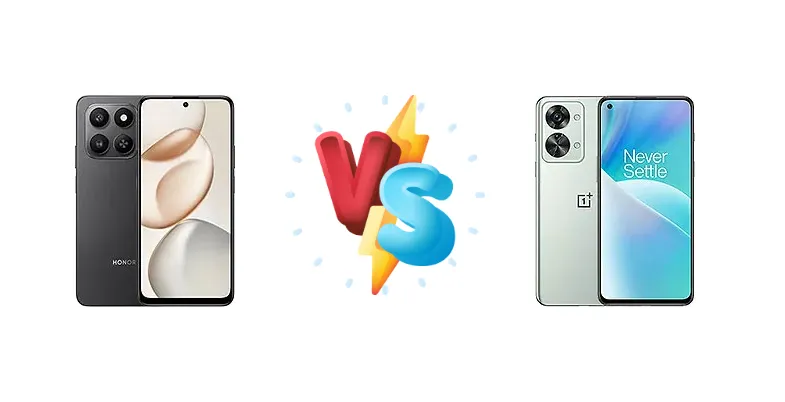
The mid-range smartphone market is fiercely competitive, and the Honor 400 Smart and OnePlus Nord 2T represent compelling options. The Nord 2T, while an older model, boasts significantly faster charging, while the newer Honor 400 Smart promises exceptional battery endurance and a modern chipset. This comparison dissects their key differences to help you choose the right phone for your needs.
🏆 Quick Verdict
For the average user prioritizing long-term battery life and overall efficiency, the Honor 400 Smart emerges as the winner. Its impressive 69:32h endurance rating and 1600 charge cycles significantly outperform the Nord 2T’s 100h rating, despite the Nord 2T’s faster 80W charging.
| Network |
|---|
| 2G bands | GSM 850 / 900 / 1800 / 1900 | GSM 850 / 900 / 1800 / 1900 |
| 3G bands | HSDPA 850 / 900 / 1700(AWS) / 1900 / 2100 | HSDPA 800 / 850 / 900 / 1700(AWS) / 1800 / 1900 / 2100 |
| 4G bands | LTE | 1, 2, 3, 4, 5, 7, 8, 12, 17, 18, 19, 20, 26, 28, 32, 34, 38, 39, 40, 41, 66 |
| 5G bands | SA/NSA | 1, 3, 7, 8, 20, 28, 38, 41, 78 SA/NSA |
| Speed | HSPA, LTE, 5G | HSPA 42.2/5.76 Mbps, LTE Cat18 1200/150 Mbps, 5G |
| Technology | GSM / HSPA / LTE / 5G | GSM / HSPA / LTE / 5G |
| Launch |
|---|
| Announced | 2025, August 07 | 2022, May 19 |
| Status | Available. Released 2025, August 09 | Available. Released 2022, May 21 |
| Body |
|---|
| Build | - | Glass front (Gorilla Glass 5), plastic frame |
| Dimensions | 166.9 x 76.8 x 8.4 mm (6.57 x 3.02 x 0.33 in) | 159.1 x 73.2 x 8.2 mm (6.26 x 2.88 x 0.32 in) |
| SIM | Nano-SIM + Nano-SIM | Nano-SIM + Nano-SIM |
| Weight | 189 g (6.67 oz) | 190 g (6.70 oz) |
| Display |
|---|
| Protection | Scratch-resistant glass, Mohs level 4 | Corning Gorilla Glass 5 |
| Resolution | 720 x 1610 pixels, 20:9 ratio (~261 ppi density) | 1080 x 2400 pixels, 20:9 ratio (~409 ppi density) |
| Size | 6.77 inches, 110.2 cm2 (~86.0% screen-to-body ratio) | 6.43 inches, 99.8 cm2 (~85.7% screen-to-body ratio) |
| Type | TFT LCD, 120Hz, 700 nits (peak) | AMOLED, 90Hz, HDR10+ |
| Platform |
|---|
| CPU | Octa-core (2x2.3 GHz Cortex-A78 & 6x2.0 GHz Cortex-A55) | Octa-core (1x3.0 GHz Cortex-A78 & 3x2.6 GHz Cortex-A78 & 4x2.0 GHz Cortex-A55) |
| Chipset | Qualcomm SM6375 Snapdragon 6s Gen 3 (6 nm) | Mediatek Dimensity 1300 (6 nm) |
| GPU | Adreno 619 | Mali-G77 MC9 |
| OS | Android 15, Magic OS 9 | Android 12, upgradable to Android 14, OxygenOS 14 |
| Memory |
|---|
| Card slot | No | No |
| Internal | 128GB 4GB RAM, 256GB 4GB RAM, 256GB 8GB RAM | 128GB 8GB RAM, 256GB 12GB RAM |
| | - | UFS 3.1 |
| Main Camera |
|---|
| Dual | 50 MP, f/1.8, (wide), PDAF
Auxiliary lens | - |
| Features | LED flash, HDR | Dual-LED flash, HDR, panorama |
| Single | - | 32 MP, f/2.4, (wide), 1/2.8", 0.8µm |
| Triple | - | 50 MP, f/1.9, 24mm (wide), 1/1.56", 1.0µm, PDAF, OIS
8 MP, f/2.2, 120˚ (ultrawide)
Auxiliary lens |
| Video | 1080p@30fps | 4K@30fps, 1080p@30/60/120/480fps, gyro-EIS |
| Selfie camera |
|---|
| Features | - | Auto HDR |
| Single | 5 MP, f/2.2, (wide) | 32 MP, f/2.4, (wide), 1/2.8", 0.8µm |
| Video | 1080p@30fps | 1080p@30fps, gyro-EIS |
| Sound |
|---|
| 3.5mm jack | - | No |
| 35mm jack | Yes | No |
| Loudspeaker | Yes, with stereo speakers | Yes, with stereo speakers |
| Comms |
|---|
| Bluetooth | 5.1, A2DP, LE | 5.2, A2DP, LE, aptX HD |
| NFC | Yes | Yes |
| Positioning | GPS, GLONASS, GALILEO, BDS | GPS, GLONASS, GALILEO, BDS, NavIC |
| Radio | No | No |
| USB | USB Type-C 2.0, OTG | USB Type-C 2.0, OTG |
| WLAN | Wi-Fi 802.11 a/b/g/n/ac, dual-band, Wi-Fi Direct | Wi-Fi 802.11 a/b/g/n/ac/6, dual-band, Wi-Fi Direct |
| Features |
|---|
| Sensors | Fingerprint (side-mounted), accelerometer, proximity, compass | Fingerprint (under display, optical), accelerometer, gyro, proximity, compass |
| Battery |
|---|
| Charging | 35W wired | 80W wired, PD |
| Type | Li-Po 6500 mAh | Li-Po 4500 mAh |
| Misc |
|---|
| Colors | Black | Gray Shadow, Jade Fog |
| Models | LGN-NX1 | CPH2399, CPH2401 |
| Price | - | € 144.39 / $ 169.99 / ₹ 31,490 |
| Tests |
|---|
| Battery life | - |
Endurance rating 100h
|
| Camera | - |
Photo / Video |
| Display | - |
Contrast ratio: Infinite (nominal) |
| Loudspeaker | - |
-25.6 LUFS (Very good)
|
| Performance | - |
AnTuTu: 490545 (v8) | 604467 (v9)
GeekBench: 2790 (v5.1)
GFXBench: 40fps (ES 3.1 onscreen) |
| EU LABEL |
|---|
| Battery | 69:32h endurance, 1600 cycles | - |
| Energy | Class A | - |
| Free fall | Class A (270 falls) | - |
| Repairability | Class B | - |
Honor 400 Smart
- Exceptional battery endurance (69:32h)
- Long-term battery health (1600 charge cycles)
- Efficient Snapdragon 6s Gen 3 chipset (6nm)
- Slower 35W charging
- Display specifications largely unknown
OnePlus Nord 2T
- Faster 80W SuperVOOC charging with PD
- More powerful CPU (Dimensity 1300)
- Bright display (636 nits)
- Significantly lower battery endurance (100h)
- Potentially shorter battery lifespan
Display Comparison
The OnePlus Nord 2T features a display capable of reaching 636 nits of peak brightness, providing good visibility outdoors. However, the Honor 400 Smart’s display specifications are currently unavailable, making a direct brightness comparison impossible. The Nord 2T’s ‘Infinite’ contrast ratio is a marketing term, typical of AMOLED panels, but without knowing the panel type of the Honor 400 Smart, we can’t assess its contrast performance. The absence of refresh rate data for the Honor 400 Smart also leaves a gap in the display comparison.
Camera Comparison
Both devices offer photo and video capabilities, but detailed camera specifications are lacking for both. Without information on sensor size, aperture, or image stabilization (OIS), a meaningful comparison is difficult. The presence of a 2MP macro camera on either device is unlikely to significantly impact image quality, serving primarily as a marketing feature. The image processing style and overall camera performance will likely be the differentiating factors, but require hands-on testing.
Performance
The OnePlus Nord 2T’s MediaTek Dimensity 1300, with its 1x3.0 GHz Cortex-A78 core and 3x2.6 GHz Cortex-A78 cores, offers a performance edge in CPU-intensive tasks compared to the Honor 400 Smart’s Snapdragon 6s Gen 3. The Snapdragon 6s Gen 3 utilizes a 2x2.3 GHz Cortex-A78 and 6x2.0 GHz Cortex-A55 configuration. While the Dimensity 1300’s core clock speeds are higher, the Snapdragon 6s Gen 3 benefits from a more efficient 6nm process, potentially leading to better sustained performance and thermal management. The Nord 2T’s CPU configuration suggests a stronger focus on peak performance, while the Honor 400 Smart aims for a balance of power and efficiency.
Battery Life
The Honor 400 Smart’s standout feature is its exceptional battery endurance, rated at 69:32 hours, coupled with an impressive 1600 charge cycles, indicating long-term battery health. This significantly surpasses the OnePlus Nord 2T’s 100-hour endurance rating. While the Nord 2T compensates with 80W wired charging (and PD support), allowing for rapid top-ups, the Honor 400 Smart’s 35W charging is slower. However, the sheer longevity of the Honor 400 Smart’s battery may negate the need for frequent, fast charging sessions.
Buying Guide
Buy the Honor 400 Smart if you need a phone that will reliably last through a full day – and beyond – of heavy use, and value long-term battery health. It’s ideal for travelers, commuters, or anyone who dislikes frequent charging. Buy the OnePlus Nord 2T if you prioritize quick top-ups and are willing to trade some endurance for the convenience of 80W SuperVOOC charging, and enjoy a slightly more powerful CPU for demanding tasks.
Frequently Asked Questions
❓ How much faster is the OnePlus Nord 2T's 80W charging compared to the Honor 400 Smart's 35W charging in real-world use?
The Nord 2T's 80W charging can potentially take a phone from 0-100% in around 30-40 minutes, while the Honor 400 Smart's 35W charging will likely take closer to 1.5 - 2 hours. However, the Honor 400 Smart's exceptional battery life means you may not need to charge it as frequently, reducing the importance of fast charging.
❓ Will the Snapdragon 6s Gen 3 in the Honor 400 Smart struggle with demanding games like PUBG or Genshin Impact?
While the Dimensity 1300 in the Nord 2T is more powerful, the Snapdragon 6s Gen 3 is still capable of running most popular games. You may need to lower graphics settings to achieve smooth frame rates in more demanding titles, but the 6nm process should help mitigate thermal throttling during extended gaming sessions.
❓ What does '1600 charge cycles' mean for the Honor 400 Smart's battery lifespan?
A charge cycle is completed when you've used 100% of the battery capacity. The Honor 400 Smart's rating of 1600 cycles suggests the battery will retain a significant portion of its original capacity even after being fully charged and discharged 1600 times, offering superior long-term battery health compared to phones with lower cycle ratings.