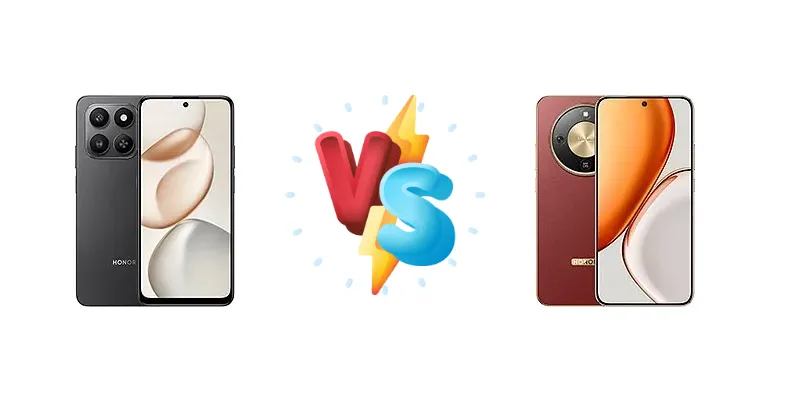
Honor's budget lineup is heating up with the release of the 400 Smart and the X9d. Both aim to deliver a compelling experience without breaking the bank, but they take different approaches. The 400 Smart prioritizes endurance with a focus on optimized efficiency, while the X9d pushes for faster performance and quicker charging with a newer chipset. This comparison will dissect the key differences to help you determine which device best suits your needs.
🏆 Quick Verdict
For the average user prioritizing sustained battery life and a proven, if slightly older, chipset, the Honor 400 Smart emerges as the winner. Its exceptional 69:32h endurance and 1600 charge cycles offer peace of mind. However, users who value faster processing and charging speeds will find the Honor X9d a more appealing choice.
| Network |
|---|
| 2G bands | GSM 850 / 900 / 1800 / 1900 | GSM 850 / 900 / 1800 / 1900 |
| 3G bands | HSDPA 850 / 900 / 1700(AWS) / 1900 / 2100 | HSDPA 850 / 900 / 1700(AWS) / 1900 / 2100 |
| 4G bands | LTE | LTE |
| 5G bands | SA/NSA | SA/NSA |
| Speed | HSPA, LTE, 5G | HSPA, LTE, 5G |
| Technology | GSM / HSPA / LTE / 5G | GSM / HSPA / LTE / 5G |
| Launch |
|---|
| Announced | 2025, August 07 | 2025, September 24 |
| Status | Available. Released 2025, August 09 | Available. Released 2025, October 09 |
| Body |
|---|
| Dimensions | 166.9 x 76.8 x 8.4 mm (6.57 x 3.02 x 0.33 in) | 161.9 x 76.1 x 7.8 mm (6.37 x 3.00 x 0.31 in) |
| SIM | Nano-SIM + Nano-SIM | Nano-SIM + Nano-SIM |
| Weight | 189 g (6.67 oz) | 193 g (6.81 oz) |
| Display |
|---|
| Protection | Scratch-resistant glass, Mohs level 4 | Aluminosilicate glass |
| Resolution | 720 x 1610 pixels, 20:9 ratio (~261 ppi density) | 1200 x 2640 pixels (~427 ppi density) |
| Size | 6.77 inches, 110.2 cm2 (~86.0% screen-to-body ratio) | 6.79 inches, 112.1 cm2 (~90.9% screen-to-body ratio) |
| Type | TFT LCD, 120Hz, 700 nits (peak) | AMOLED, 1B colors, 120Hz, 3840Hz PWM, HDR, 800 nits (typ), 1800 nits (HBM), 6000 nits (peak) |
| Platform |
|---|
| CPU | Octa-core (2x2.3 GHz Cortex-A78 & 6x2.0 GHz Cortex-A55) | Octa-core (1x2.3 GHz Cortex-A720s & 3x2.2 GHz Cortex-A720s & 4x1.8 GHz Cortex-A520s) |
| Chipset | Qualcomm SM6375 Snapdragon 6s Gen 3 (6 nm) | Qualcomm Snapdragon 6 Gen 4 (4 nm) |
| GPU | Adreno 619 | Adreno 810 |
| OS | Android 15, Magic OS 9 | Android 15, Magic OS 9 |
| Memory |
|---|
| Card slot | No | No |
| Internal | 128GB 4GB RAM, 256GB 4GB RAM, 256GB 8GB RAM | 256GB 8GB RAM, 256GB 12GB RAM, 512GB 12GB RAM |
| Main Camera |
|---|
| Dual | 50 MP, f/1.8, (wide), PDAF
Auxiliary lens | 108 MP, f/1.8, (wide), PDAF, OIS
5 MP, f/2.2, (ultrawide) |
| Features | LED flash, HDR | LED flash, panorama, HDR |
| Video | 1080p@30fps | 4K@30fps, 1080p@30fps, gyro-EIS |
| Selfie camera |
|---|
| Single | 5 MP, f/2.2, (wide) | 16 MP, f/2.5, (wide) |
| Video | 1080p@30fps | 1080p@30fps |
| Sound |
|---|
| 35mm jack | Yes | No |
| Loudspeaker | Yes, with stereo speakers | Yes, with stereo speakers |
| Comms |
|---|
| Bluetooth | 5.1, A2DP, LE | 5.2, A2DP, LE, aptX HD, aptX Adaptive |
| NFC | Yes | Yes |
| Positioning | GPS, GLONASS, GALILEO, BDS | GPS, GALILEO, GLONASS, BDS |
| Radio | No | No |
| USB | USB Type-C 2.0, OTG | USB Type-C 2.0, OTG |
| WLAN | Wi-Fi 802.11 a/b/g/n/ac, dual-band, Wi-Fi Direct | Wi-Fi 802.11 a/b/g/n/ac/6, dual-band, Wi-Fi Direct |
| Features |
|---|
| Sensors | Fingerprint (side-mounted), accelerometer, proximity, compass | Fingerprint (under display, optical), accelerometer, compass, gyro, proximity |
| Battery |
|---|
| Charging | 35W wired | 66W wired
7.5W reverse wired |
| Type | Li-Po 6500 mAh | Si/C Li-Ion 8300 mAh |
| Misc |
|---|
| Colors | Black | Reddish Brown, Midnight Black, Sunrise Gold, Forest Green |
| Models | LGN-NX1 | MTN-NX1 |
| Price | - | About 300 EUR |
| EU LABEL |
|---|
| Battery | 69:32h endurance, 1600 cycles | - |
| Energy | Class A | - |
| Free fall | Class A (270 falls) | - |
| Repairability | Class B | - |
Honor 400 Smart
- Exceptional battery endurance (69:32h)
- High charge cycle count (1600)
- Efficient Snapdragon 6s Gen 3 chipset
- Slower charging speed (35W)
- Older chipset architecture
Honor X9d
- Faster Snapdragon 6 Gen 4 chipset
- 66W fast charging
- 7.5W reverse wired charging
- Likely shorter battery lifespan compared to 400 Smart
- Endurance rating not provided
Display Comparison
Display specifications are not provided in the context data. However, given the price points, both devices likely feature LCD panels. The X9d, being a slightly newer model, *may* benefit from improved color calibration or a higher peak brightness. The absence of LTPO technology on either device suggests standard refresh rates, likely 60Hz or 90Hz. Bezels are expected to be moderate on both, typical for this segment.
Camera Comparison
Camera details are absent, making a direct comparison difficult. However, it's reasonable to assume both phones will feature multi-camera setups geared towards everyday photography. The absence of any mention of OIS suggests neither phone will excel in low-light conditions. Image processing will likely be the differentiating factor, with the X9d potentially benefiting from newer algorithms enabled by its more powerful chipset. We can expect both to include standard modes like portrait and night mode, but don't anticipate flagship-level image quality.
Performance
The core difference lies in the chipsets. The Honor X9d’s Snapdragon 6 Gen 4 (4nm) represents a significant architectural leap over the 400 Smart’s Snapdragon 6s Gen 3 (6nm). The 4nm process inherently offers better power efficiency and transistor density, translating to improved performance and thermal management. While both utilize octa-core configurations, the X9d’s CPU features newer Cortex-A720s cores, offering a performance advantage over the 400 Smart’s Cortex-A78 cores. This means faster app launches, smoother multitasking, and a more responsive overall experience on the X9d. The X9d's CPU configuration (1x2.3 GHz Cortex-A720s & 3x2.2 GHz Cortex-A720s & 4x1.8 GHz Cortex-A520s) also suggests a more balanced approach to performance cores versus efficiency cores.
Battery Life
The Honor 400 Smart boasts an impressive 69:32h endurance rating and a remarkable 1600 charge cycles, indicating exceptional battery longevity. While the 400 Smart's battery capacity is unknown, the endurance figure suggests a highly optimized power management system. The X9d, while offering faster 66W wired charging (compared to the 400 Smart’s 35W), doesn’t have an endurance rating. The 66W charging will significantly reduce charging times – likely achieving a full charge in under an hour – while the 7.5W reverse wired charging is a convenient feature for topping up accessories. The 400 Smart's slower charging is a trade-off for its superior long-term battery health and overall endurance.
Buying Guide
Buy the Honor 400 Smart if you need a phone that will reliably last through a full day (and then some) of moderate use, and you aren't a demanding mobile gamer. Its focus on battery optimization makes it ideal for travelers or those who dislike frequent charging. Buy the Honor X9d if you prefer a snappier user experience, faster app loading times, and the convenience of 66W fast charging, even if it means slightly reduced battery longevity.
Frequently Asked Questions
❓ Will the Snapdragon 6 Gen 4 in the X9d handle demanding games like PUBG Mobile smoothly?
The Snapdragon 6 Gen 4 is a capable chipset, but demanding games like PUBG Mobile will likely require reduced graphics settings for a consistently smooth experience. While it's a step up from the 6s Gen 3, it's not a gaming-focused processor.
❓ How long will it take to fully charge the Honor X9d from 0% to 100%?
With 66W fast charging, the Honor X9d should fully charge from 0% to 100% in approximately 45-60 minutes, depending on usage during charging. This is a significant time saving compared to the 400 Smart's 35W charging.
❓ Is the 1600 charge cycle claim for the Honor 400 Smart realistic?
While 1600 cycles is a high number, Honor's claim is based on their internal testing and optimized battery management. It suggests the battery will retain a significant portion of its capacity even after years of regular use, offering long-term reliability.
❓ Does the Honor X9d support 5G connectivity?
The context data does not specify 5G support. However, given the Snapdragon 6 Gen 4's capabilities, it is *likely* that the X9d supports 5G, but this should be verified with official specifications.