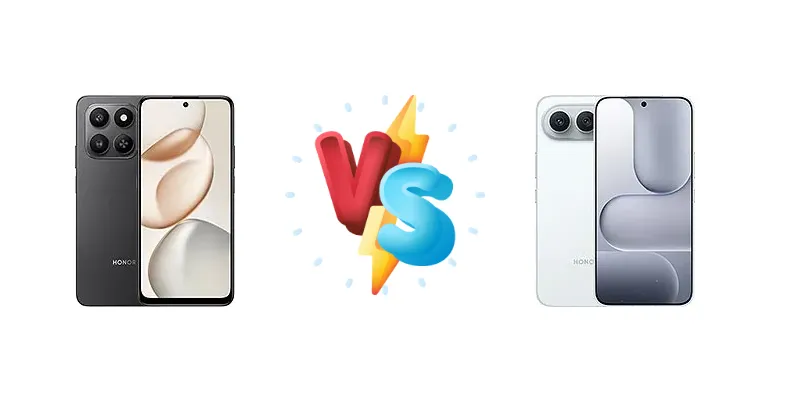
Honor's latest offerings, the 500 and 400 Smart, represent distinct approaches to the mid-range smartphone market. The 500 aims for near-flagship performance with the Snapdragon 8s Gen 4, while the 400 Smart prioritizes longevity and value with the Snapdragon 6s Gen 3. This comparison dissects the key differences to help you determine which device best suits your needs.
🏆 Quick Verdict
For users prioritizing raw power and fast charging, the Honor 500 is the clear winner. Its Snapdragon 8s Gen 4 chipset delivers a significant performance boost, and 80W charging is a game-changer. However, the Honor 400 Smart remains a compelling option for those seeking exceptional battery life and a more budget-friendly price point.
| Network |
|---|
| 2G bands | GSM 850 / 900 / 1800 / 1900 | GSM 850 / 900 / 1800 / 1900 |
| 3G bands | HSDPA 850 / 900 / 1700(AWS) / 1900 / 2100 | HSDPA 800 / 850 / 900 / 1700(AWS) / 1900 / 2100 |
| 4G bands | LTE | LTE |
| 5G bands | SA/NSA | SA/NSA |
| Speed | HSPA, LTE, 5G | HSPA, LTE, 5G |
| Technology | GSM / HSPA / LTE / 5G | GSM / HSPA / LTE / 5G |
| Launch |
|---|
| Announced | 2025, August 07 | 2025, November 24 |
| Status | Available. Released 2025, August 09 | Available. Released 2025, November 27 |
| Body |
|---|
| Build | - | Glass front, aluminum frame |
| Dimensions | 166.9 x 76.8 x 8.4 mm (6.57 x 3.02 x 0.33 in) | 155.8 x 74.2 x 7.8 mm (6.13 x 2.92 x 0.31 in) |
| SIM | Nano-SIM + Nano-SIM | Nano-SIM + Nano-SIM |
| Weight | 189 g (6.67 oz) | 198 g (6.98 oz) |
| Display |
|---|
| Protection | Scratch-resistant glass, Mohs level 4 | Aluminosilicate glass |
| Resolution | 720 x 1610 pixels, 20:9 ratio (~261 ppi density) | 1264 x 2736 pixels, 19.5:9 ratio (~460 ppi density) |
| Size | 6.77 inches, 110.2 cm2 (~86.0% screen-to-body ratio) | 6.55 inches, 105.4 cm2 (~91.2% screen-to-body ratio) |
| Type | TFT LCD, 120Hz, 700 nits (peak) | AMOLED, 1B colors, 120Hz, 3840Hz PWM, HDR Vivid, 6000 nits (peak) |
| Platform |
|---|
| CPU | Octa-core (2x2.3 GHz Cortex-A78 & 6x2.0 GHz Cortex-A55) | Octa-core (1x3.21 GHz Cortex-X4 & 3x3.0 GHz Cortex-A720 & 2x2.8 GHz Cortex-A720 & 2x2.0 GHz Cortex-A720) |
| Chipset | Qualcomm SM6375 Snapdragon 6s Gen 3 (6 nm) | Qualcomm SM8735 Snapdragon 8s Gen 4 (4 nm) |
| GPU | Adreno 619 | Adreno 825 |
| OS | Android 15, Magic OS 9 | Android 16, MagicOS 10 |
| Memory |
|---|
| Card slot | No | No |
| Internal | 128GB 4GB RAM, 256GB 4GB RAM, 256GB 8GB RAM | 256GB 12GB RAM, 512GB 12GB RAM, 512GB 16GB RAM |
| Main Camera |
|---|
| Dual | 50 MP, f/1.8, (wide), PDAF
Auxiliary lens | 200 MP, f/1.9, (wide), 1/1.4", 0.56µm, PDAF, OIS
12 MP, f/2.2, 117˚ (ultrawide), AF |
| Features | LED flash, HDR | LED flash, HDR, panorama |
| Video | 1080p@30fps | 4K, 1080p, gyro-EIS, OIS |
| Selfie camera |
|---|
| Features | - | HDR |
| Single | 5 MP, f/2.2, (wide) | 50 MP, f/2.0, (wide) |
| Video | 1080p@30fps | 4K, 1080p, gyro-EIS |
| Sound |
|---|
| 35mm jack | Yes | No |
| Loudspeaker | Yes, with stereo speakers | Yes, with stereo speakers |
| Comms |
|---|
| Bluetooth | 5.1, A2DP, LE | 6.0, A2DP, LE, aptX HD, aptX Adaptive, aptX Lossless, LHDC 5, Auracast, ASHA |
| Infrared port | - | Yes |
| NFC | Yes | Yes |
| Positioning | GPS, GLONASS, GALILEO, BDS | GPS (L1+L5), GLONASS (L1), BDS (B1I+B1c+B2a+B2b), GALILEO (E1+E5a+E5b), QZSS (L1+L5), NavIC (L5) |
| Radio | No | No |
| USB | USB Type-C 2.0, OTG | USB Type-C 2.0, OTG |
| WLAN | Wi-Fi 802.11 a/b/g/n/ac, dual-band, Wi-Fi Direct | Wi-Fi 802.11 a/b/g/n/ac/6/7, dual-band, Wi-Fi Direct |
| Features |
|---|
| Sensors | Fingerprint (side-mounted), accelerometer, proximity, compass | Fingerprint (under display, optical), accelerometer, gyro, proximity, compass (ultrasound) |
| Battery |
|---|
| Charging | 35W wired | 80W wired
5W reverse wired |
| Type | Li-Po 6500 mAh | Si/C Li-Ion 8000 mAh |
| Misc |
|---|
| Colors | Black | Black, Silver, Blue, Pink |
| Models | LGN-NX1 | MEY-AN00 |
| Price | - | About 330 EUR |
| EU LABEL |
|---|
| Battery | 69:32h endurance, 1600 cycles | - |
| Energy | Class A | - |
| Free fall | Class A (270 falls) | - |
| Repairability | Class B | - |
Honor 400 Smart
- Exceptional battery endurance (69:32h)
- Long-lasting battery health (1600 cycles)
- More affordable price point
- Less powerful processor for demanding tasks
- Slower charging speed (35W)
Honor 500
- Significantly faster performance with Snapdragon 8s Gen 4
- Ultra-fast 80W wired charging
- 5W reverse wired charging for accessories
- Potentially shorter battery life compared to the 400 Smart
- Higher price tag
Display Comparison
While display specifications are absent, the Honor 500's positioning suggests a higher-quality panel. The Snapdragon 8s Gen 4 typically pairs with displays featuring higher refresh rates and potentially LTPO technology for adaptive refresh rate control, improving efficiency. The 400 Smart likely utilizes a standard 60Hz or 90Hz panel. Bezels are expected to be comparable, but color accuracy and peak brightness will likely favor the 500.
Camera Comparison
Camera details are missing, but the chipset difference hints at superior image processing capabilities in the Honor 500. The 8s Gen 4’s ISP (Image Signal Processor) is significantly more advanced, enabling better noise reduction, dynamic range, and faster autofocus. While both phones likely feature multi-camera systems, the 500 will likely excel in low-light photography and video recording. We anticipate the 500 will have a larger main sensor, offering better detail and clarity.
Performance
The core difference lies in the chipsets. The Honor 500’s Qualcomm SM8735 Snapdragon 8s Gen 4 (4nm) boasts a 1x3.21 GHz Cortex-X4 prime core, alongside three Cortex-A720 cores at 3.0 GHz and two more at 2.8 GHz, plus efficiency cores. This configuration represents a substantial leap over the Honor 400 Smart’s Snapdragon 6s Gen 3 (6nm) with its 2x2.3 GHz Cortex-A78 and 6x2.0 GHz Cortex-A55 cores. The 4nm process node of the 8s Gen 4 provides superior thermal efficiency, reducing throttling during sustained workloads. Gamers and power users will see a dramatic difference in performance, while everyday tasks will feel snappier on the 500.
Battery Life
The Honor 400 Smart claims 69:32h of endurance and 1600 charge cycles, indicating a focus on long-term battery health and longevity. However, the Honor 500 compensates for potentially lower endurance with its 80W wired charging, a massive upgrade over the 400 Smart’s 35W. This translates to significantly faster 0-100% charge times. The 5W reverse wired charging on the 500 adds convenience for topping up accessories.
Buying Guide
Buy the Honor 400 Smart if you need a phone that reliably lasts through a full day and beyond, and you don't demand the absolute highest performance for demanding games or applications. Buy the Honor 500 if you prefer a smoother, faster experience for gaming, multitasking, and content creation, and you value the convenience of incredibly rapid charging, even if it means slightly less battery endurance.
Frequently Asked Questions
❓ Will the Snapdragon 6s Gen 3 in the Honor 400 Smart struggle with graphically intensive games like Genshin Impact?
The Snapdragon 6s Gen 3 is a capable chip, but it will likely require significant graphics settings reductions to achieve playable frame rates in demanding titles like Genshin Impact. Expect lower detail levels and potentially some stuttering. The Honor 500’s Snapdragon 8s Gen 4 will provide a much smoother and more consistent gaming experience.
❓ How much faster is the 80W charging on the Honor 500 compared to the 35W charging on the Honor 400 Smart?
The 80W charging on the Honor 500 will dramatically reduce charging times. While exact figures depend on battery capacity, expect a 0-100% charge in approximately 30-40 minutes, compared to potentially 60-90 minutes on the 400 Smart. This is a significant convenience factor for users who frequently need to top up their battery quickly.
❓ Does the Honor 500's more powerful processor translate to noticeably faster app loading times and multitasking?
Yes, the Snapdragon 8s Gen 4’s superior CPU and GPU will result in noticeably faster app loading times and smoother multitasking. Switching between apps will be quicker and more responsive, and demanding applications will run more efficiently.