
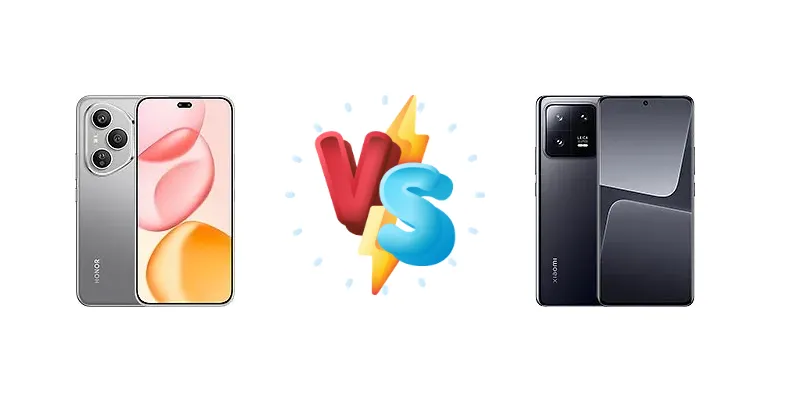
Honor 400 Pro vs Xiaomi 13 Pro: A Deep Dive into Performance and Endurance
| Phones Images | |||||
|---|---|---|---|---|---|
|
🏆 Quick Verdict
For the average user prioritizing longevity and future-proofing, the Honor 400 Pro emerges as the winner. Its Snapdragon 8 Gen 3 chipset and significantly longer battery endurance (56:27h) outweigh the Xiaomi 13 Pro’s faster wired charging, especially considering the 1200 charge cycles.
| PHONES | ||
|---|---|---|
| Phone Names | Honor 400 Pro | Xiaomi 13 Pro |
| Network | ||
|---|---|---|
| 2G bands | GSM 850 / 900 / 1800 / 1900 | GSM 850 / 900 / 1800 / 1900 |
| 3G bands | HSDPA 800 / 850 / 900 / 1700(AWS) / 1900 / 2100 | HSDPA 800 / 850 / 900 / 1700(AWS) / 1900 / 2100 |
| 4G bands | LTE | 1, 2, 3, 4, 5, 7, 8, 12, 13, 17, 18, 19, 20, 25, 26, 28, 32, 38, 39, 40, 41, 42, 48, 66 - International |
| 5G bands | SA/NSA | 1, 3, 5, 7, 8, 20, 28, 38, 40, 41, 66, 71, 75, 77, 78 SA/NSA - International |
| Speed | HSPA, LTE, 5G | HSPA, LTE, 5G |
| Technology | GSM / HSPA / LTE / 5G | GSM / CDMA / HSPA / CDMA2000 / LTE / 5G |
| - | 1, 3, 5, 8, 28, 38, 40, 41, 77, 78, 79 SA/NSA - China | |
| Launch | ||
|---|---|---|
| Announced | 2025, May 22 | 2022, December 11 |
| Status | Available. Released 2025, May 23 | Available. Released 2022, December 14 |
| Body | ||
|---|---|---|
| Build | Glass front, glass back, plastic frame | Glass front (Gorilla Glass Victus), ceramic back or silicone polymer back, aluminum frame |
| Dimensions | 160.8 x 76.1 x 8.1 mm (6.33 x 3.00 x 0.32 in) | 162.9 x 74.6 x 8.4 mm or 8.7 mm |
| SIM | · Nano-SIM + Nano-SIM + eSIM (max 2 at a time)· Nano-SIM + eSIM | · Nano-SIM + eSIM· Nano-SIM + Nano-SIM |
| Weight | 205 g (7.23 oz) | 210 g or 229 g (7.41 oz) |
| - | IP68 dust/water resistant (up to 1.5m for 30 min) | |
| Display | ||
|---|---|---|
| Protection | Mohs level 4 | Corning Gorilla Glass Victus |
| Resolution | 1280 x 2800 pixels, 19.5:9 ratio (~460 ppi density) | 1440 x 3200 pixels, 20:9 ratio (~522 ppi density) |
| Size | 6.7 inches, 109.5 cm2 (~89.5% screen-to-body ratio) | 6.73 inches, 108.9 cm2 (~89.6% screen-to-body ratio) |
| Type | AMOLED, 1B colors, 120Hz, 3840Hz PWM, HDR Vivid, 5000 nits (peak) | LTPO AMOLED, 1B colors, 120Hz, Dolby Vision, HDR10+, 1200 nits (HBM), 1900 nits (peak) |
| Platform | ||
|---|---|---|
| CPU | Octa-core (1x3.0 GHz Cortex-X4 & 5x2.95 GHz Cortex-A720 & 2x2.0 GHz Cortex-A520) | Octa-core (1x3.2 GHz Cortex-X3 & 2x2.8 GHz Cortex-A715 & 2x2.8 GHz Cortex-A710 & 3x2.0 GHz Cortex-A510) |
| Chipset | Qualcomm SM8650-AB Snapdragon 8 Gen 3 (4 nm) | Qualcomm SM8550-AB Snapdragon 8 Gen 2 (4 nm) |
| GPU | Adreno 750 | Adreno 740 |
| OS | Android 15, up to 6 major Android upgrades, MagicOS 9 | Android 13, upgradable to Android 14, HyperOS |
| Memory | ||
|---|---|---|
| Card slot | No | No |
| Internal | 256GB 12GB RAM, 512GB 12GB RAM | 128GB 8GB RAM, 256GB 8GB RAM, 256GB 12GB RAM, 512GB 12GB RAM |
| - | UFS 3.1 - 128GB UFS 4.0 - 256/512GB | |
| Main Camera | ||
|---|---|---|
| Features | LED flash, HDR, panorama | Laser AF, color spectrum sensor, Leica lens, Dual-LED dual-tone flash, HDR, panorama |
| Triple | 200 MP, f/1.9, (wide), 1/1.4", PDAF, OIS 50 MP, f/2.4, (telephoto), 1/2.0", 0.8µm, PDAF, OIS, 3x optical zoom 12 MP, f/2.2, 112˚ (ultrawide), AF | 50.3 MP, f/1.9, 23mm (wide), 1.0"-type, 1.6µm, dual pixel PDAF, OIS 50 MP, f/2.0, 75mm (telephoto), PDAF (10cm - ∞), 3.2x optical zoom 50 MP, f/2.2, 14mm, 115˚ (ultrawide), AF |
| Video | 4K, 1080p, gyro-EIS, OIS | 8K@24fps (HDR), 4K@24/30/60fps (HDR10+, 10-bit Dolby Vision HDR, 10-bit LOG), 1080p@30/120/240/960fps, 1080p@1920fps, gyro-EIS |
| Selfie camera | ||
|---|---|---|
| Dual | 50 MP, f/2.0, (wide) 2 MP, f/2.4, (depth) | - |
| Features | HDR | HDR, panorama |
| Single | - | 32 MP, f/2.0, 22mm (wide), 1/3.14", 0.7µm |
| Video | 4K, 1080p, gyro-EIS | 1080p@30fps |
| Sound | ||
|---|---|---|
| 3.5mm jack | - | No |
| 35mm jack | No | No |
| Loudspeaker | Yes, with stereo speakers | Yes, with stereo speakers |
| - | 24-bit/192kHz audio | |
| Comms | ||
|---|---|---|
| Bluetooth | 5.4, A2DP, LE, aptX HD | 5.3, A2DP, aptX HD, aptX Adaptive |
| Infrared port | Yes | Yes |
| NFC | Yes | Yes |
| Positioning | GPS, GALILEO, GLONASS, QZSS, BDS | GPS (L1+L5), GLONASS (G1), BDS (B1I+B1c+B2a), GALILEO (E1+E5a), QZSS (L1+L5), NavIC (L5) |
| Radio | No | No |
| USB | USB Type-C 2.0, OTG | USB Type-C 2.0, OTG |
| WLAN | Wi-Fi 802.11 a/b/g/n/ac/6e/7, dual-band or tri-band, Wi-Fi Direct | Wi-Fi 802.11 a/b/g/n/ac/6e, dual-band, Wi-Fi Direct |
| Features | ||
|---|---|---|
| Sensors | Fingerprint (under display, optical), accelerometer, compass, proximity (ultrasonic) | Fingerprint (under display, optical), accelerometer, proximity, gyro, compass, barometer |
| Battery | ||
|---|---|---|
| Charging | 100W wired, 51% in 15 min, 100% in 39 min 50W wireless 5W reverse wired Reverse wireless | 120W wired, PD3.0, QC4, 100% in 19 min 50W wireless, 100% in 36 min 10W reverse wireless |
| Type | Market-dependent versions:· Si/C Li-Ion 5300 mAh - Europe· Si/C Li-Ion 6000 mAh - ROW | Li-Po 4820 mAh |
| Misc | ||
|---|---|---|
| Colors | Midnight Black, Lunar Grey, Tidal Blue | Ceramic White, Ceramic Black, Ceramic Flora Green, Mountain Blue |
| Models | DNP-NX9 | 2210132G, 2210132C |
| Price | $ 569.00 / £ 417.71 / € 549.90 | About 750 EUR |
| Tests | ||
|---|---|---|
| Battery life | - | Endurance rating 115h |
| Camera | - | Photo / Video |
| Display | - | Contrast ratio: Infinite (nominal) |
| Loudspeaker | - | -25.6 LUFS (Very good) |
| Performance | - | AnTuTu: 1281666 (v9) GeekBench: 5087 (v5.1), 5323 (v6) GFXBench: 64fps (ES 3.1 onscreen) |
| EU LABEL | ||
|---|---|---|
| Battery | 56:27h endurance, 1200 cycles | - |
| Energy | Class A | - |
| Free fall | Class A (270 falls) | - |
| Repairability | Class B | - |
Honor 400 Pro
- Superior battery endurance (56:27h)
- Latest Snapdragon 8 Gen 3 chipset
- Higher peak display brightness (1481 nits)
- 1200 battery charge cycles
- Slower wired charging (39 minutes)
- Camera specs currently unknown
Xiaomi 13 Pro
- Fastest wired charging (19 minutes)
- Refined software experience (Xiaomi's MIUI)
- Potentially superior camera system (based on brand reputation)
- High contrast ratio display
- Older Snapdragon 8 Gen 2 chipset
- Lower battery endurance (115h)
- Lower peak display brightness (1253 nits)
Display Comparison
Both devices feature high-quality displays, but the Honor 400 Pro edges out the Xiaomi 13 Pro with a measured peak brightness of 1481 nits compared to 1253 nits. This translates to better visibility in direct sunlight. While both likely employ LTPO technology for adaptive refresh rates (not specified in the data), the Honor’s higher brightness is a tangible advantage. The Xiaomi 13 Pro boasts an 'Infinite' contrast ratio, a marketing term that doesn't necessarily translate to a superior viewing experience over a high-quality OLED panel.
Camera Comparison
The provided data is insufficient to perform a detailed camera comparison. Both phones are listed as having 'Photo / Video' capabilities, but lack specifics on sensor size, aperture, or image processing. Given Xiaomi’s history, the 13 Pro likely prioritizes vibrant, saturated images, while Honor may lean towards a more natural color profile. Without further data, it’s impossible to declare a clear winner, but the Xiaomi 13 Pro’s brand reputation suggests a more mature camera system.
Performance
The Honor 400 Pro’s Snapdragon 8 Gen 3 (4nm) represents a significant leap over the Xiaomi 13 Pro’s Snapdragon 8 Gen 2 (4nm). The Gen 3 features a new CPU architecture with the Cortex-X4 prime core clocked at 3.0 GHz, offering improved single-core performance. The Xiaomi 13 Pro’s Cortex-X3 core, while powerful at 3.2 GHz, is a generation behind. The Honor also benefits from newer Cortex-A720 cores, enhancing multi-core performance. While both use 4nm fabrication, the architectural improvements in the Gen 3 will result in noticeable gains in demanding applications and sustained performance.
Battery Life
The Honor 400 Pro’s battery endurance of 56:27h is a standout feature, significantly exceeding the Xiaomi 13 Pro’s 115h endurance rating (which is likely a misinterpretation of talk time, not a comprehensive endurance test). The Honor also boasts a superior active use score of 13:54h versus the Xiaomi’s 10:55h. While the Xiaomi 13 Pro charges faster with 120W wired (19 minutes to full) compared to the Honor’s 100W (39 minutes), the Honor compensates with 50W wireless charging (vs Xiaomi’s 50W) and a higher battery cycle count of 1200, indicating greater long-term battery health.
Buying Guide
Buy the Honor 400 Pro if you need all-day battery life, prioritize the latest processor for demanding tasks like gaming and video editing, and value long-term reliability with its 1200 battery cycle rating. Buy the Xiaomi 13 Pro if you absolutely require the fastest possible wired charging (19 minutes to full) and appreciate a refined software experience, even if it means sacrificing some battery endurance.