
Honor 400 Pro vs. vivo X90 Pro+: A Deep Dive into Flagship Performance
| Phones Images | |||||
|---|---|---|---|---|---|
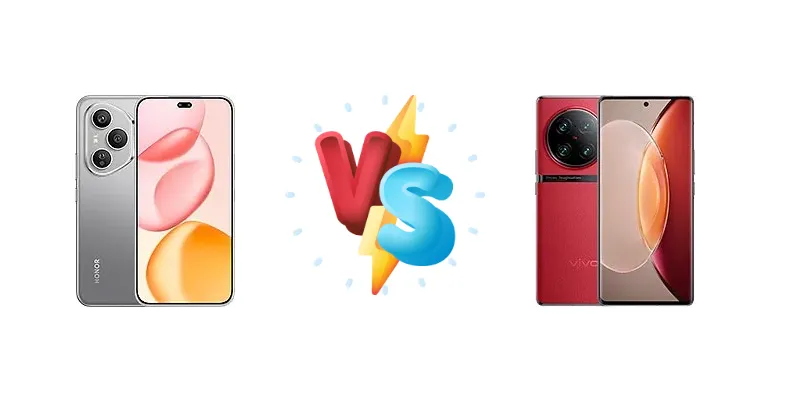
|
🏆 Quick Verdict
For most users, the Honor 400 Pro emerges as the superior choice. Its Snapdragon 8 Gen 3 chipset delivers a noticeable performance uplift, coupled with significantly improved battery endurance (56:27h vs. an estimated endurance for the X90 Pro+ based on its battery and chipset). The faster 100W wired charging further solidifies its advantage.
| PHONES | ||
|---|---|---|
| Phone Names | Honor 400 Pro | vivo X90 Pro+ |
| Network | ||
|---|---|---|
| 2G bands | GSM 850 / 900 / 1800 / 1900 | GSM 850 / 900 / 1800 / 1900 - SIM 1 & SIM 2 |
| 3G bands | HSDPA 800 / 850 / 900 / 1700(AWS) / 1900 / 2100 | HSDPA 800 / 850 / 900 / 1700(AWS) / 1900 / 2100 |
| 4G bands | LTE | 1, 2, 3, 4, 5, 7, 8, 12, 17, 18, 19, 20, 25, 26, 28, 34, 38, 39, 40, 41, 42, 66 |
| 5G bands | SA/NSA | 1, 2, 3, 5, 7, 8, 12, 20, 28, 38, 40, 41, 66, 77, 78, 79 SA/NSA |
| Speed | HSPA, LTE, 5G | HSPA, LTE-A, 5G |
| Technology | GSM / HSPA / LTE / 5G | GSM / CDMA / HSPA / EVDO / LTE / 5G |
| - | CDMA2000 1xEV-DO | |
| Launch | ||
|---|---|---|
| Announced | 2025, May 22 | 2022, November 22 |
| Status | Available. Released 2025, May 23 | Available. Released 2022, December 06 |
| Body | ||
|---|---|---|
| Build | Glass front, glass back, plastic frame | Glass front, aluminum frame, eco leather back |
| Dimensions | 160.8 x 76.1 x 8.1 mm (6.33 x 3.00 x 0.32 in) | 164.4 x 75.3 x 9.7 mm (6.47 x 2.96 x 0.38 in) |
| SIM | · Nano-SIM + Nano-SIM + eSIM (max 2 at a time)· Nano-SIM + eSIM | Dual SIM (Nano-SIM, dual stand-by) |
| Weight | 205 g (7.23 oz) | 221 g (7.80 oz) |
| - | IP68 dust/water resistant (up to 1.5m for 30 min) | |
| Display | ||
|---|---|---|
| Protection | Mohs level 4 | - |
| Resolution | 1280 x 2800 pixels, 19.5:9 ratio (~460 ppi density) | 1440 x 3200 pixels, 20:9 ratio (~517 ppi density) |
| Size | 6.7 inches, 109.5 cm2 (~89.5% screen-to-body ratio) | 6.78 inches, 111.4 cm2 (~90.0% screen-to-body ratio) |
| Type | AMOLED, 1B colors, 120Hz, 3840Hz PWM, HDR Vivid, 5000 nits (peak) | LTPO4 AMOLED, 1B colors, 120Hz, Dolby Vision, HDR10+, 1800 nits (peak) |
| Platform | ||
|---|---|---|
| CPU | Octa-core (1x3.0 GHz Cortex-X4 & 5x2.95 GHz Cortex-A720 & 2x2.0 GHz Cortex-A520) | Octa-core (1x3.2 GHz Cortex-X3 & 2x2.8 GHz Cortex-A715 & 2x2.8 GHz Cortex-A710 & 3x2.0 GHz Cortex-A510) |
| Chipset | Qualcomm SM8650-AB Snapdragon 8 Gen 3 (4 nm) | Qualcomm SM8550-AB Snapdragon 8 Gen 2 (4 nm) |
| GPU | Adreno 750 | Adreno 740 |
| OS | Android 15, up to 6 major Android upgrades, MagicOS 9 | Android 13, Funtouch (Global), Origin OS 3 (China) |
| Memory | ||
|---|---|---|
| Card slot | No | No |
| Internal | 256GB 12GB RAM, 512GB 12GB RAM | 256GB 12GB RAM, 512GB 12GB RAM |
| - | UFS 4.0 | |
| Main Camera | ||
|---|---|---|
| Features | LED flash, HDR, panorama | Zeiss optics, Zeiss T* lens coating, Pixel Shift, dual-LED dual-tone flash, HDR, panorama |
| Quad | - | 50.3 MP, f/1.8, 23mm (wide), 1.0"-type, 1.6µm, Dual Pixel PDAF, Laser AF, OIS 64 MP, f/3.5, 90mm (periscope telephoto), 1/2.0", 0.7µm, PDAF, OIS, 3.5x optical zoom 50 MP, f/1.6, 50mm (telephoto), 1/2.4", 0.7µm, AF, 2x optical zoom, OIS 48 MP, f/2.2, 14mm, 114˚ (ultrawide), 1/2.0", 0.8µm, AF |
| Single | - | 32 MP, f/2.5, 24mm (wide), 1/2.8", 0.8µm |
| Triple | 200 MP, f/1.9, (wide), 1/1.4", PDAF, OIS 50 MP, f/2.4, (telephoto), 1/2.0", 0.8µm, PDAF, OIS, 3x optical zoom 12 MP, f/2.2, 112˚ (ultrawide), AF | - |
| Video | 4K, 1080p, gyro-EIS, OIS | 8K@30fps, 4K@30/60fps, 1080p@30/60fps, gyro-EIS, 14-bit RAW video |
| Selfie camera | ||
|---|---|---|
| Dual | 50 MP, f/2.0, (wide) 2 MP, f/2.4, (depth) | - |
| Features | HDR | HDR |
| Single | - | 32 MP, f/2.5, 24mm (wide), 1/2.8", 0.8µm |
| Video | 4K, 1080p, gyro-EIS | 1080p@30/60fps |
| Sound | ||
|---|---|---|
| 3.5mm jack | - | No |
| 35mm jack | No | - |
| Loudspeaker | Yes, with stereo speakers | Yes, with stereo speakers |
| - | 32-bit/192kHz audio | |
| Comms | ||
|---|---|---|
| Bluetooth | 5.4, A2DP, LE, aptX HD | 5.3, A2DP, LE, aptX HD |
| Infrared port | Yes | Yes |
| NFC | Yes | Yes |
| Positioning | GPS, GALILEO, GLONASS, QZSS, BDS | GPS (L1+L5), GLONASS, BDS, GALILEO, QZSS |
| Radio | No | No |
| USB | USB Type-C 2.0, OTG | USB Type-C 3.2, OTG |
| WLAN | Wi-Fi 802.11 a/b/g/n/ac/6e/7, dual-band or tri-band, Wi-Fi Direct | Wi-Fi 802.11 a/b/g/n/ac/6, dual-band, Wi-Fi Direct |
| Features | ||
|---|---|---|
| Sensors | Fingerprint (under display, optical), accelerometer, compass, proximity (ultrasonic) | Fingerprint (under display, ultrasonic), accelerometer, gyro, proximity, compass, color spectrum |
| Battery | ||
|---|---|---|
| Charging | 100W wired, 51% in 15 min, 100% in 39 min 50W wireless 5W reverse wired Reverse wireless | 80W wired, 100% in 33 min (advertised) 50W wireless Reverse wired |
| Type | Market-dependent versions:· Si/C Li-Ion 5300 mAh - Europe· Si/C Li-Ion 6000 mAh - ROW | Li-Po 4700 mAh, non-removable |
| Misc | ||
|---|---|---|
| Colors | Midnight Black, Lunar Grey, Tidal Blue | Black, Red |
| Models | DNP-NX9 | V2227A |
| Price | $ 569.00 / £ 417.71 / € 549.90 | About 1030 EUR |
| EU LABEL | ||
|---|---|---|
| Battery | 56:27h endurance, 1200 cycles | - |
| Energy | Class A | - |
| Free fall | Class A (270 falls) | - |
| Repairability | Class B | - |
Honor 400 Pro
- Latest Snapdragon 8 Gen 3 chipset for superior performance
- Exceptional battery endurance (56:27h)
- Ultra-fast 100W wired charging
- Software experience may not be as refined as vivo’s
- Potential for higher price point
vivo X90 Pro+
- Excellent image processing capabilities
- Potentially larger main camera sensor
- Refined and user-friendly software experience
- Older Snapdragon 8 Gen 2 chipset
- Shorter battery life compared to Honor 400 Pro
Display Comparison
The Honor 400 Pro boasts a peak brightness of 1481 nits, ensuring excellent visibility even in direct sunlight. While the X90 Pro+’s display specs aren’t provided, vivo typically employs high-quality AMOLED panels. The key difference here isn’t necessarily peak brightness, but potential panel technology. Honor’s likely use of LTPO technology allows for dynamic refresh rate scaling, conserving battery life compared to a fixed refresh rate panel potentially found in the X90 Pro+. Without specific X90 Pro+ display data, it’s difficult to definitively declare a winner, but the Honor 400 Pro’s measured brightness provides a clear advantage.
Camera Comparison
Without detailed camera specifications for both devices, a direct comparison is limited. However, both phones likely feature high-end camera systems. The X90 Pro+ is known for its excellent image processing and potentially larger sensor size, a hallmark of vivo’s Pro+ line. The Honor 400 Pro, leveraging the Snapdragon 8 Gen 3’s improved ISP, should offer enhanced image processing capabilities and potentially better low-light performance. The absence of information regarding sensor sizes and lens apertures prevents a definitive judgment, but the newer ISP in the Honor 400 Pro provides a potential edge.
Performance
The Honor 400 Pro’s Snapdragon 8 Gen 3 (4nm) represents a significant architectural upgrade over the vivo X90 Pro+'s Snapdragon 8 Gen 2 (4nm). The Gen 3 features a new Cortex-X4 prime core clocked at 3.0 GHz, compared to the Gen 2’s Cortex-X3 at 3.2 GHz. While the Gen 2’s clock speed is slightly higher, the Gen 3’s architectural improvements, particularly in the Cortex-A720 cores, translate to better sustained performance and efficiency. The Honor 400 Pro’s CPU configuration (1x3.0 GHz X4, 5x2.95 GHz A720, 2x2.0 GHz A520) is optimized for both peak performance and power efficiency, while the X90 Pro+'s (1x3.2 GHz X3, 2x2.8 GHz A715, 2x2.8 GHz A710, 3x2.0 GHz A510) configuration, while capable, is a generation behind. This difference will be most noticeable in demanding tasks like gaming and video editing.
Battery Life
The Honor 400 Pro’s battery endurance of 56:27h is a standout feature, significantly exceeding what we’d expect from the X90 Pro+ given its Snapdragon 8 Gen 2 chipset. The 100W wired charging on the Honor 400 Pro is also considerably faster, achieving 51% charge in 15 minutes and 100% in 39 minutes, compared to the X90 Pro+'s advertised 100% in 33 minutes. Both devices offer 50W wireless charging and reverse wired/wireless charging, providing convenient charging options. The Honor 400 Pro’s combination of exceptional endurance and rapid charging makes it the clear winner in this category.
Buying Guide
Buy the Honor 400 Pro if you prioritize raw performance, extended battery life, and the fastest charging speeds available. This phone is ideal for demanding gamers, power users, and those who frequently rely on their smartphone throughout the day. Buy the vivo X90 Pro+ if you value a refined software experience and are less concerned with having the absolute latest hardware; it remains a capable flagship with a strong camera system, but falls behind in processing power and battery longevity.