
Honor 400 Pro vs. Samsung Galaxy S23 FE: A Deep Dive into Performance and Value
| Phones Images | |||||
|---|---|---|---|---|---|
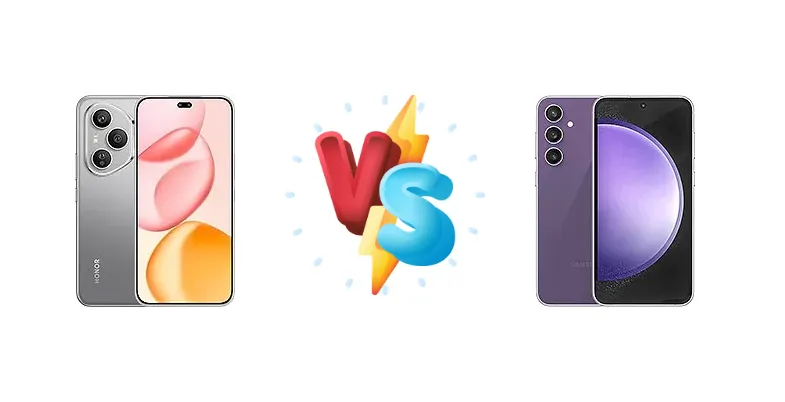
|
🏆 Quick Verdict
For users prioritizing raw performance and charging speed, the Honor 400 Pro is the clear winner. Its Snapdragon 8 Gen 3 offers a significant leap over both the Snapdragon 8 Gen 1 and Exynos 2200 variants of the S23 FE, coupled with blazing-fast 100W charging. However, the S23 FE remains a compelling option for those deeply embedded in the Samsung ecosystem.
| PHONES | ||
|---|---|---|
| Phone Names | Honor 400 Pro | Samsung Galaxy S23 FE |
| Network | ||
|---|---|---|
| 2G bands | GSM 850 / 900 / 1800 / 1900 | GSM 850 / 900 / 1800 / 1900 |
| 3G bands | HSDPA 800 / 850 / 900 / 1700(AWS) / 1900 / 2100 | HSDPA 850 / 900 / 1700(AWS) / 1900 / 2100 |
| 4G bands | LTE | 1, 2, 3, 4, 5, 7, 8, 12, 13, 17, 20, 26, 28, 38, 40, 41, 66 - International |
| 5G bands | SA/NSA | 1, 2, 3, 5, 7, 8, 20, 28, 38, 40, 41, 66, 77, 78 SA/NSA/Sub6 - International |
| Speed | HSPA, LTE, 5G | HSPA, LTE, 5G |
| Technology | GSM / HSPA / LTE / 5G | GSM / HSPA / LTE / 5G |
| Launch | ||
|---|---|---|
| Announced | 2025, May 22 | 2023, October 04 |
| Status | Available. Released 2025, May 23 | Available. Released 2023, October 05 |
| Body | ||
|---|---|---|
| Build | Glass front, glass back, plastic frame | Glass front (Gorilla Glass 5), glass back (Gorilla Glass 5), aluminum frame |
| Dimensions | 160.8 x 76.1 x 8.1 mm (6.33 x 3.00 x 0.32 in) | 158 x 76.5 x 8.2 mm (6.22 x 3.01 x 0.32 in) |
| SIM | · Nano-SIM + Nano-SIM + eSIM (max 2 at a time)· Nano-SIM + eSIM | · Nano-SIM· Nano-SIM + Nano-SIM· Nano-SIM + Nano-SIM + eSIM (max 2 at a time) |
| Weight | 205 g (7.23 oz) | 209 g (7.37 oz) |
| Display | ||
|---|---|---|
| Protection | Mohs level 4 | Corning Gorilla Glass 5 |
| Resolution | 1280 x 2800 pixels, 19.5:9 ratio (~460 ppi density) | 1080 x 2340 pixels, 19.5:9 ratio (~403 ppi density) |
| Size | 6.7 inches, 109.5 cm2 (~89.5% screen-to-body ratio) | 6.4 inches, 100.5 cm2 (~83.2% screen-to-body ratio) |
| Type | AMOLED, 1B colors, 120Hz, 3840Hz PWM, HDR Vivid, 5000 nits (peak) | Dynamic AMOLED 2X, 120Hz, HDR10+, 1450 nits (peak) |
| Platform | ||
|---|---|---|
| CPU | Octa-core (1x3.0 GHz Cortex-X4 & 5x2.95 GHz Cortex-A720 & 2x2.0 GHz Cortex-A520) | Octa-core (1x2.8 GHz Cortex-X2 & 3x2.50 GHz Cortex-A710 & 4x1.8 GHz Cortex-A510) - InternationalOcta-core (1x3.00 GHz Cortex-X2 & 3x2.50 GHz Cortex-A710 & 4x1.80 GHz Cortex-A510) - USA |
| Chipset | Qualcomm SM8650-AB Snapdragon 8 Gen 3 (4 nm) | Exynos 2200 (4 nm) - InternationalQualcomm SM8450 Snapdragon 8 Gen 1 (4 nm) - USA |
| GPU | Adreno 750 | Xclipse 920 - InternationalAdreno 730 - USA |
| OS | Android 15, up to 6 major Android upgrades, MagicOS 9 | Android 13, up to 4 major Android upgrades, One UI 8 |
| Memory | ||
|---|---|---|
| Card slot | No | No |
| Internal | 256GB 12GB RAM, 512GB 12GB RAM | 128GB 8GB RAM, 256GB 8GB RAM |
| Main Camera | ||
|---|---|---|
| Features | LED flash, HDR, panorama | LED flash, HDR, panorama |
| Triple | 200 MP, f/1.9, (wide), 1/1.4", PDAF, OIS 50 MP, f/2.4, (telephoto), 1/2.0", 0.8µm, PDAF, OIS, 3x optical zoom 12 MP, f/2.2, 112˚ (ultrawide), AF | 50 MP, f/1.8, 23mm (wide), 1/1.57", 1.0µm, dual pixel PDAF, OIS 8 MP, f/2.4, 76mm (telephoto), 1/4.5", 1.0µm, PDAF, OIS, 3x optical zoom 12 MP, f/2.2, 13mm, 123˚ (ultrawide), 1/3.0", 1.12µm |
| Video | 4K, 1080p, gyro-EIS, OIS | 8K@24fps, 4K@30/60fps, 1080p@30/60/120/240fps |
| Selfie camera | ||
|---|---|---|
| Dual | 50 MP, f/2.0, (wide) 2 MP, f/2.4, (depth) | - |
| Features | HDR | - |
| Single | - | 10 MP, f/2.4, 25mm (wide), 1/3.0", 1.22µm |
| Video | 4K, 1080p, gyro-EIS | 4K@30/60fps, 1080p@30/60fps; gyro-EIS |
| Sound | ||
|---|---|---|
| 35mm jack | No | No |
| Loudspeaker | Yes, with stereo speakers | Yes, with stereo speakers |
| Comms | ||
|---|---|---|
| Bluetooth | 5.4, A2DP, LE, aptX HD | 5.3, A2DP, LE |
| Infrared port | Yes | - |
| NFC | Yes | Yes |
| Positioning | GPS, GALILEO, GLONASS, QZSS, BDS | GPS, GLONASS, GALILEO, BDS |
| Radio | No | Unspecified |
| USB | USB Type-C 2.0, OTG | USB Type-C, OTG |
| WLAN | Wi-Fi 802.11 a/b/g/n/ac/6e/7, dual-band or tri-band, Wi-Fi Direct | Wi-Fi 802.11 a/b/g/n/ac/6e, dual-band, Wi-Fi Direct |
| Features | ||
|---|---|---|
| Sensors | Fingerprint (under display, optical), accelerometer, compass, proximity (ultrasonic) | Fingerprint (under display, optical), accelerometer, gyro, compass |
| Battery | ||
|---|---|---|
| Charging | 100W wired, 51% in 15 min, 100% in 39 min 50W wireless 5W reverse wired Reverse wireless | 25W wired, PD3.0, 50% in 30 min 15W wireless Reverse wireless |
| Type | Market-dependent versions:· Si/C Li-Ion 5300 mAh - Europe· Si/C Li-Ion 6000 mAh - ROW | Li-Ion 4500 mAh |
| Misc | ||
|---|---|---|
| Colors | Midnight Black, Lunar Grey, Tidal Blue | Mint, Cream, Graphite, Purple, Indigo, Tangerine |
| Models | DNP-NX9 | SM-S711B, SM-S711B/DS, SM-S711U1, SM-S711U, SM-S711W, SM-S7110, SM-S711N |
| Price | $ 569.00 / £ 417.71 / € 549.90 | $ 219.95 / C$ 327.90 / £ 248.99 / € 272.00 / ₹ 34,999 |
| SAR | - | 0.80 W/kg (head) 0.72 W/kg (body) |
| SAR EU | - | 0.76 W/kg (head) 1.04 W/kg (body) |
| EU LABEL | ||
|---|---|---|
| Battery | 56:27h endurance, 1200 cycles | - |
| Energy | Class A | - |
| Free fall | Class A (270 falls) | - |
| Repairability | Class B | - |
Honor 400 Pro
- Significantly faster processor (Snapdragon 8 Gen 3)
- Much faster charging (100W wired, 50W wireless)
- Superior battery endurance (56:27h)
- Less established brand recognition
- Camera performance unknown without further testing
Samsung Galaxy S23 FE
- Established Samsung ecosystem and One UI
- Potentially lower price point
- Refined camera software
- Slower processor (Exynos 2200 or Snapdragon 8 Gen 1)
- Slower charging (25W wired)
- Inferior battery life (8:28h active use)
Display Comparison
The Honor 400 Pro’s display achieves a measured peak brightness of 1481 nits, significantly outshining the Samsung Galaxy S23 FE’s 985 nits. This translates to superior visibility in direct sunlight. While both utilize OLED panels, the Honor’s higher brightness and potentially higher PWM dimming rate (data unavailable, but likely given Honor’s recent displays) could make it a better choice for users sensitive to flicker. The S23 FE’s display is still excellent, but the Honor pulls ahead in raw brightness and potential eye comfort.
Camera Comparison
While both phones likely offer versatile camera systems, the context data focuses on the chipset and display. Given the S23 FE’s reputation, it likely benefits from Samsung’s mature image processing algorithms. However, without specific sensor details for the Honor 400 Pro, a direct comparison is difficult. We can assume the S23 FE’s camera will be more refined out of the box, but the Honor 400 Pro could potentially offer competitive image quality with software updates. The absence of detailed camera specs for the Honor necessitates caution in this comparison.
Performance
The Honor 400 Pro’s Snapdragon 8 Gen 3 (4nm) represents a substantial upgrade over the Exynos 2200 (4nm) and Snapdragon 8 Gen 1 (4nm) found in the S23 FE. The Snapdragon 8 Gen 3’s Cortex-X4 prime core, clocked at 3.0 GHz, offers a performance advantage over the Cortex-X2 in the S23 FE’s chips. The more efficient 4nm process of the Snapdragon 8 Gen 3 also suggests better thermal management, reducing the likelihood of performance throttling during extended gaming sessions. The S23 FE’s performance is still respectable, but the Honor 400 Pro delivers a noticeably smoother and more responsive experience.
Battery Life
The Honor 400 Pro boasts impressive battery endurance, achieving 56:27h in testing and an active use score of 13:54h, significantly exceeding the Galaxy S23 FE’s 8:28h active use score. This difference is partially attributable to the more efficient Snapdragon 8 Gen 3. Furthermore, the Honor 400 Pro’s 100W wired charging is a game-changer, reaching 51% charge in just 15 minutes and a full charge in 39 minutes, compared to the S23 FE’s 25W charging which takes 30 minutes for 50%. The Honor also offers 50W wireless and reverse charging, features not fully matched by the S23 FE.
Buying Guide
Buy the Honor 400 Pro if you need uncompromising performance for gaming and demanding applications, and value incredibly fast charging. The 56:27h battery endurance and 100W charging are ideal for power users. Buy the Samsung Galaxy S23 FE if you prefer Samsung’s One UI, a more established camera ecosystem, and a potentially lower price point, accepting compromises in processing power and charging speed.