
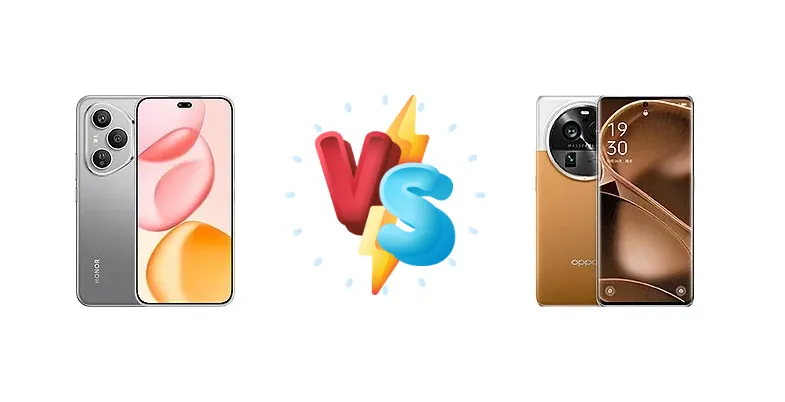
Honor 400 Pro vs Oppo Find X6 Pro: A Deep Dive into Battery, Performance, and Value
| Phones Images | |||||
|---|---|---|---|---|---|
|
🏆 Quick Verdict
For the average user prioritizing longevity and future-proofing, the Honor 400 Pro emerges as the winner. Its Snapdragon 8 Gen 3 chipset and exceptional 56:27h battery endurance significantly outperform the Find X6 Pro, despite the Oppo’s competitive charging speeds and established camera prowess.
| PHONES | ||
|---|---|---|
| Phone Names | Honor 400 Pro | Oppo Find X6 Pro |
| Network | ||
|---|---|---|
| 2G bands | GSM 850 / 900 / 1800 / 1900 | GSM 850 / 900 / 1800 / 1900 |
| 3G bands | HSDPA 800 / 850 / 900 / 1700(AWS) / 1900 / 2100 | HSDPA 800 / 850 / 900 / 1700(AWS) / 1900 / 2100 |
| 4G bands | LTE | 1, 2, 3, 4, 5, 7, 8, 12, 17, 18, 19, 20, 26, 28, 34, 38, 39, 40, 41, 66 |
| 5G bands | SA/NSA | 1, 3, 5, 7, 8, 20, 28, 38, 40, 41, 66, 77, 78, 79 SA/NSA |
| Speed | HSPA, LTE, 5G | HSPA, LTE, 5G |
| Technology | GSM / HSPA / LTE / 5G | GSM / CDMA / HSPA / CDMA2000 / LTE / 5G |
| - | CDMA2000 1x | |
| Launch | ||
|---|---|---|
| Announced | 2025, May 22 | 2023, March 21 |
| Status | Available. Released 2025, May 23 | Available. Released 2023, March 24 |
| Body | ||
|---|---|---|
| Build | Glass front, glass back, plastic frame | Glass front (Gorilla Glass Victus 2), glass back (Gorilla Glass 5) or eco leather back, aluminum frame |
| Dimensions | 160.8 x 76.1 x 8.1 mm (6.33 x 3.00 x 0.32 in) | 164.8 x 76.2 x 9.1 mm or 9.5 mm |
| SIM | · Nano-SIM + Nano-SIM + eSIM (max 2 at a time)· Nano-SIM + eSIM | Nano-SIM + Nano-SIM |
| Weight | 205 g (7.23 oz) | 216 g or 218 g (7.62 oz) |
| - | IP68 dust/water resistant (up to 1.5m for 30 min) | |
| Display | ||
|---|---|---|
| Protection | Mohs level 4 | Corning Gorilla Glass Victus 2 |
| Resolution | 1280 x 2800 pixels, 19.5:9 ratio (~460 ppi density) | 1440 x 3168 pixels (~510 ppi density) |
| Size | 6.7 inches, 109.5 cm2 (~89.5% screen-to-body ratio) | 6.82 inches, 113.0 cm2 (~90.0% screen-to-body ratio) |
| Type | AMOLED, 1B colors, 120Hz, 3840Hz PWM, HDR Vivid, 5000 nits (peak) | LTPO3 AMOLED, 1B colors, 120Hz, Dolby Vision, HDR10+, 800 nits (typ), 1500 nits (HBM), 2500 nits (peak) |
| Platform | ||
|---|---|---|
| CPU | Octa-core (1x3.0 GHz Cortex-X4 & 5x2.95 GHz Cortex-A720 & 2x2.0 GHz Cortex-A520) | Octa-core (1x3.2 GHz Cortex-X3 & 2x2.8 GHz Cortex-A715 & 2x2.8 GHz Cortex-A710 & 3x2.0 GHz Cortex-A510) |
| Chipset | Qualcomm SM8650-AB Snapdragon 8 Gen 3 (4 nm) | Qualcomm SM8550-AB Snapdragon 8 Gen 2 (4 nm) |
| GPU | Adreno 750 | Adreno 740 |
| OS | Android 15, up to 6 major Android upgrades, MagicOS 9 | Android 13, up to 4 major Android upgrades, ColorOS 14 |
| Memory | ||
|---|---|---|
| Card slot | No | No |
| Internal | 256GB 12GB RAM, 512GB 12GB RAM | 256GB 12GB RAM, 256GB 16GB RAM, 512GB 16GB RAM |
| - | UFS 4.0 | |
| Main Camera | ||
|---|---|---|
| Features | LED flash, HDR, panorama | Laser AF, color spectrum sensor, Hasselblad Color Calibration, LED flash, HDR, panorama |
| Triple | 200 MP, f/1.9, (wide), 1/1.4", PDAF, OIS 50 MP, f/2.4, (telephoto), 1/2.0", 0.8µm, PDAF, OIS, 3x optical zoom 12 MP, f/2.2, 112˚ (ultrawide), AF | 50 MP, f/1.8, 23mm (wide), 1.0"-type, 1.6µm, dual pixel PDAF, OIS 50 MP, f/2.6, 65mm (periscope telephoto), 1/1.56", 1.0µm, 2.8x optical zoom, multi-directional PDAF, OIS 50 MP, f/2.2, 15mm, 110˚ (ultrawide), 1/1.56", 1.0µm, multi-directional PDAF |
| Video | 4K, 1080p, gyro-EIS, OIS | 4K@30/60fps, 1080p@30/60/240fps; gyro-EIS; HDR, 10‑bit video, Dolby Vision |
| Selfie camera | ||
|---|---|---|
| Dual | 50 MP, f/2.0, (wide) 2 MP, f/2.4, (depth) | - |
| Features | HDR | Panorama |
| Single | - | 32 MP, f/2.4, 21mm (wide), 1/2.74", 0.8µm, PDAF |
| Video | 4K, 1080p, gyro-EIS | 4K@30fps, gyro-EIS |
| Sound | ||
|---|---|---|
| 3.5mm jack | - | No |
| 35mm jack | No | No |
| Loudspeaker | Yes, with stereo speakers | Yes, with stereo speakers |
| Comms | ||
|---|---|---|
| Bluetooth | 5.4, A2DP, LE, aptX HD | 5.3, A2DP, LE, aptX HD |
| Infrared port | Yes | Yes |
| NFC | Yes | Yes |
| Positioning | GPS, GALILEO, GLONASS, QZSS, BDS | GPS (L1+L5), GLONASS (G1), BDS (B1I+B1c+B2a), GALILEO (E1+E5a), QZSS (L1+L5) |
| Radio | No | No |
| USB | USB Type-C 2.0, OTG | USB Type-C 3.1, OTG |
| WLAN | Wi-Fi 802.11 a/b/g/n/ac/6e/7, dual-band or tri-band, Wi-Fi Direct | Wi-Fi 802.11 a/b/g/n/ac/6e/7, tri-band, Wi-Fi Direct |
| Features | ||
|---|---|---|
| Sensors | Fingerprint (under display, optical), accelerometer, compass, proximity (ultrasonic) | Fingerprint (under display, optical), accelerometer, gyro, proximity, compass |
| Battery | ||
|---|---|---|
| Charging | 100W wired, 51% in 15 min, 100% in 39 min 50W wireless 5W reverse wired Reverse wireless | 100W wired, PD, 45% in 10 min, 100% in 30 min 50W wireless, 50% in 22 min, 100% in 51 min 10W reverse wireless |
| Type | Market-dependent versions:· Si/C Li-Ion 5300 mAh - Europe· Si/C Li-Ion 6000 mAh - ROW | Li-Po 5000 mAh |
| Misc | ||
|---|---|---|
| Colors | Midnight Black, Lunar Grey, Tidal Blue | Black, Green, Brown |
| Models | DNP-NX9 | PGEM110, PGEM10 |
| Price | $ 569.00 / £ 417.71 / € 549.90 | About 820 EUR |
| Tests | ||
|---|---|---|
| Battery life | - | Endurance rating 114h |
| Camera | - | Photo / Video |
| Display | - | Contrast ratio: Infinite (nominal) |
| Loudspeaker | - | -25.1 LUFS (Very good) |
| Performance | - | AnTuTu: 1294797 (v9) GeekBench: 4791 (v5.1), 5226 (v6) GFXBench: 60fps (ES 3.1 onscreen) |
| EU LABEL | ||
|---|---|---|
| Battery | 56:27h endurance, 1200 cycles | - |
| Energy | Class A | - |
| Free fall | Class A (270 falls) | - |
| Repairability | Class B | - |
Honor 400 Pro
- Significantly longer battery life (56:27h endurance)
- Latest Snapdragon 8 Gen 3 chipset for superior performance
- 1200 charge cycles for extended battery health
- Higher peak display brightness (1481 nits)
- Camera specifications are currently unknown
- Slightly slower wired charging (39 minutes vs 30 minutes)
Oppo Find X6 Pro
- Proven camera system (Oppo’s expertise)
- Faster wired charging (30 minutes to 100%)
- 50W wireless charging with competitive speeds (51 minutes to 100%)
- Established brand reputation for image quality
- Significantly shorter battery life (114h endurance)
- Older Snapdragon 8 Gen 2 chipset
- Battery cycle life is unknown
Display Comparison
Both devices feature high-quality displays, but the Honor 400 Pro edges out the Oppo Find X6 Pro with a measured peak brightness of 1481 nits compared to the Oppo’s 1318 nits. This translates to better visibility in direct sunlight. While both likely employ LTPO technology for adaptive refresh rates (not specified in the data), the Honor’s higher brightness provides a tangible advantage for outdoor use. The Oppo’s ‘Infinite’ contrast ratio is a marketing term; both displays will offer excellent contrast, but the Honor’s brightness is a measurable differentiator.
Camera Comparison
The provided data highlights the Oppo Find X6 Pro’s focus on camera capabilities with a simple 'Photo / Video' designation. While specific sensor details are missing, Oppo is known for its excellent image processing and high-quality camera hardware. The Honor 400 Pro lacks any camera specifics in the provided data, making a direct comparison impossible. However, given the competitive landscape, it’s reasonable to assume the Honor 400 Pro will also feature a multi-camera system, but its performance relative to the Oppo remains unknown without further details. We can infer that the Oppo likely prioritizes camera features more heavily than the Honor, based on brand positioning.
Performance
The Honor 400 Pro’s Snapdragon 8 Gen 3 (4nm) represents a significant leap over the Oppo Find X6 Pro’s Snapdragon 8 Gen 2 (4nm). The Gen 3 features a new CPU architecture – Cortex-X4 prime core clocked at 3.0 GHz versus the X3 in the Gen 2 at 3.2 GHz – and improved GPU performance. While the Gen 2 is still incredibly capable, the Gen 3 offers a noticeable performance uplift in demanding applications and games. The Honor’s CPU configuration (1x3.0 GHz X4, 5x2.95 GHz A720, 2x2.0 GHz A520) is optimized for both peak performance and efficiency, while the Oppo’s (1x3.2 GHz X3, 2x2.8 GHz A715, 2x2.8 GHz A710, 3x2.0 GHz A510) is slightly older. The 4nm process node in both chips ensures good thermal efficiency, but the Gen 3’s architectural improvements should result in less throttling under sustained load.
Battery Life
The Honor 400 Pro dominates in battery endurance, achieving a remarkable 56:27h rating and 13:54h of active use. This is a substantial improvement over the Oppo Find X6 Pro’s 114h endurance rating. While the Oppo offers competitive 100W wired charging (100% in 30 minutes), the Honor 400 Pro’s 100W charging (100% in 39 minutes) is only slightly slower. The Honor also adds 50W wireless and reverse charging options, providing greater versatility. The Honor’s 1200 charge cycles suggest superior long-term battery health compared to the Oppo, which lacks cycle data. The Honor’s longer endurance means fewer trips to the charger, making it ideal for heavy users.
Buying Guide
Buy the Honor 400 Pro if you need all-day battery life and want the latest processing power for demanding tasks like gaming and video editing. Its 1200 charge cycles also promise long-term battery health. Buy the Oppo Find X6 Pro if you prioritize a refined camera experience and faster initial charging, and are willing to trade some battery endurance for those features. The Find X6 Pro is a strong choice for content creators and photography enthusiasts.