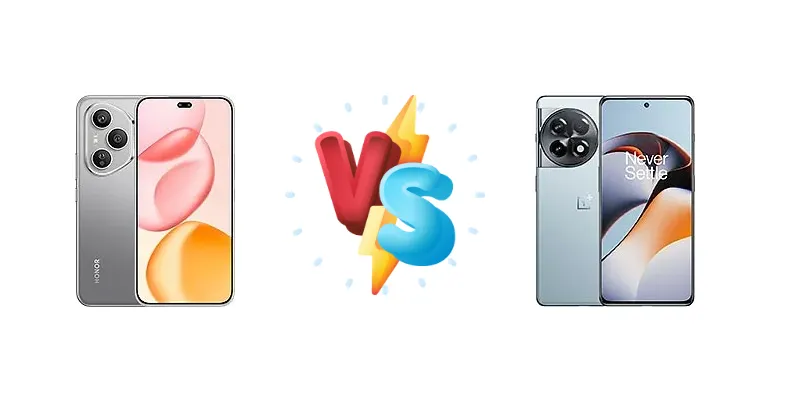
The Honor 400 Pro arrives with Qualcomm’s latest Snapdragon 8 Gen 3, promising a significant leap in performance. But does that justify the price premium over the well-established OnePlus 11R, which leverages the still-potent Snapdragon 8+ Gen 1? This comparison dissects both phones, focusing on where each excels and who will benefit most from their respective strengths.
🏆 Quick Verdict
For users prioritizing raw performance and future-proofing, the Honor 400 Pro is the clear winner, thanks to the Snapdragon 8 Gen 3. However, the OnePlus 11R delivers exceptional value, offering a very similar user experience for a potentially lower price, making it ideal for budget-conscious gamers and everyday users.
| Network |
|---|
| 2G bands | GSM 850 / 900 / 1800 / 1900 | GSM 850 / 900 / 1800 / 1900 |
| 3G bands | HSDPA 800 / 850 / 900 / 1700(AWS) / 1900 / 2100 | HSDPA 850 / 900 / 1700(AWS) / 2100 |
| 4G bands | LTE | 1, 3, 4, 5, 8, 28, 34, 38, 39, 40, 41 |
| 5G bands | SA/NSA | 1, 3, 5, 8, 28, 40, 41, 77, 78 SA/NSA |
| Speed | HSPA, LTE, 5G | HSPA, LTE (3CA), 5G |
| Technology | GSM / HSPA / LTE / 5G | GSM / CDMA / HSPA / LTE / 5G |
| | - | CDMA 800 |
| Launch |
|---|
| Announced | 2025, May 22 | 2023, February 07 |
| Status | Available. Released 2025, May 23 | Available. Released 2023, February 21 |
| Body |
|---|
| Build | Glass front, glass back, plastic frame | Glass front, glass back (Gorilla Glass 5), plastic frame |
| Dimensions | 160.8 x 76.1 x 8.1 mm (6.33 x 3.00 x 0.32 in) | 163.4 x 74.3 x 8.7 mm (6.43 x 2.93 x 0.34 in) |
| SIM | · Nano-SIM + Nano-SIM + eSIM (max 2 at a time)· Nano-SIM + eSIM | Nano-SIM + Nano-SIM |
| Weight | 205 g (7.23 oz) | 204 g (7.20 oz) |
| Display |
|---|
| Protection | Mohs level 4 | - |
| Resolution | 1280 x 2800 pixels, 19.5:9 ratio (~460 ppi density) | 1240 x 2772 pixels, 20:9 ratio (~451 ppi density) |
| Size | 6.7 inches, 109.5 cm2 (~89.5% screen-to-body ratio) | 6.74 inches, 109.2 cm2 (~90.0% screen-to-body ratio) |
| Type | AMOLED, 1B colors, 120Hz, 3840Hz PWM, HDR Vivid, 5000 nits (peak) | Fluid AMOLED, 1B colors, 120Hz, HDR10+, 1450 nits (peak) |
| Platform |
|---|
| CPU | Octa-core (1x3.0 GHz Cortex-X4 & 5x2.95 GHz Cortex-A720 & 2x2.0 GHz Cortex-A520) | Octa-core (1x3.0 GHz Cortex-X2 & 3x2.5 GHz Cortex-A710 & 4x1.80 GHz Cortex-A510) |
| Chipset | Qualcomm SM8650-AB Snapdragon 8 Gen 3 (4 nm) | Qualcomm SM8475 Snapdragon 8+ Gen 1 (4 nm) |
| GPU | Adreno 750 | Adreno 730 |
| OS | Android 15, up to 6 major Android upgrades, MagicOS 9 | Android 13, upgradable to Android 15, OxygenOS 15 |
| Memory |
|---|
| Card slot | No | No |
| Internal | 256GB 12GB RAM, 512GB 12GB RAM | 128GB 8GB RAM, 256GB 16GB RAM, 512GB 18GB RAM |
| | - | UFS 3.1 |
| Main Camera |
|---|
| Features | LED flash, HDR, panorama | Color spectrum sensor, LED flash, HDR, panorama |
| Single | - | 16 MP, f/2.4, 24mm (wide), 1/3.09", 1.0µm |
| Triple | 200 MP, f/1.9, (wide), 1/1.4", PDAF, OIS
50 MP, f/2.4, (telephoto), 1/2.0", 0.8µm, PDAF, OIS, 3x optical zoom
12 MP, f/2.2, 112˚ (ultrawide), AF | 50 MP, f/1.8, 24mm (wide), 1/1.56", 1.0µm, multi-directional PDAF, OIS
8 MP, f/2.2, 120˚ (ultrawide), 1/4.0", 1.12µm
2 MP (macro) |
| Video | 4K, 1080p, gyro-EIS, OIS | 4K@30/60fps, 1080p@30/60/240fps, gyro-EIS |
| Selfie camera |
|---|
| Dual | 50 MP, f/2.0, (wide)
2 MP, f/2.4, (depth) | - |
| Features | HDR | HDR |
| Single | - | 16 MP, f/2.4, 24mm (wide), 1/3.09", 1.0µm |
| Video | 4K, 1080p, gyro-EIS | 1080p@30fps |
| Sound |
|---|
| 3.5mm jack | - | No |
| 35mm jack | No | No |
| Loudspeaker | Yes, with stereo speakers | Yes, with stereo speakers |
| | - | 24-bit/192kHz audio |
| Comms |
|---|
| Bluetooth | 5.4, A2DP, LE, aptX HD | 5.3, A2DP, LE, aptX HD |
| Infrared port | Yes | Yes |
| NFC | Yes | Yes |
| Positioning | GPS, GALILEO, GLONASS, QZSS, BDS | GPS (L1+L5), GLONASS (G1), BDS (B1I+B1c+B2a), GALILEO (E1+E5a), QZSS (L1+L5) |
| Radio | No | No |
| USB | USB Type-C 2.0, OTG | USB Type-C 2.0 |
| WLAN | Wi-Fi 802.11 a/b/g/n/ac/6e/7, dual-band or tri-band, Wi-Fi Direct | Wi-Fi 802.11 a/b/g/n/ac/6, dual-band |
| Features |
|---|
| Sensors | Fingerprint (under display, optical), accelerometer, compass, proximity (ultrasonic) | Fingerprint (under display, optical), accelerometer, gyro, proximity, compass |
| Battery |
|---|
| Charging | 100W wired, 51% in 15 min, 100% in 39 min
50W wireless
5W reverse wired
Reverse wireless | 100W wired |
| Type | Market-dependent versions:· Si/C Li-Ion 5300 mAh - Europe· Si/C Li-Ion 6000 mAh - ROW | Li-Po 5000 mAh |
| Misc |
|---|
| Colors | Midnight Black, Lunar Grey, Tidal Blue | Galactic Silver, Sonic Black, Solar Red |
| Models | DNP-NX9 | CPH2487 |
| Price | $ 569.00 / £ 417.71 / € 549.90 | About 600 EUR |
| SAR | - | 1.16 W/kg (head) 0.61 W/kg (body) |
| EU LABEL |
|---|
| Battery | 56:27h endurance, 1200 cycles | - |
| Energy | Class A | - |
| Free fall | Class A (270 falls) | - |
| Repairability | Class B | - |
Honor 400 Pro
- Latest Snapdragon 8 Gen 3 chipset for top-tier performance
- Significantly brighter display for outdoor visibility
- Faster charging speeds (wired and wireless)
- Longer battery endurance
- Likely higher price point
- Potential for software bloat (Honor's history)
OnePlus 11R
- Excellent value for money
- Still-powerful Snapdragon 8+ Gen 1 chipset
- Fast 100W wired charging
- Proven track record of software support
- Lacks wireless charging
- Older chipset may show its age in demanding tasks
Display Comparison
The Honor 400 Pro boasts a significantly brighter display, reaching a measured 1481 nits. While the OnePlus 11R’s display specs aren’t provided, this peak brightness advantage means the Honor will be far more readable outdoors under direct sunlight. The Honor’s panel likely benefits from newer display technology, potentially offering improved color accuracy and efficiency. Without knowing the OnePlus 11R’s panel type, it’s difficult to assess further, but the Honor’s brightness is a clear advantage for outdoor visibility.
Camera Comparison
Unfortunately, camera specifications are absent for both devices. However, given the Honor 400 Pro’s flagship positioning, it’s reasonable to expect a more advanced camera system with larger sensors and more sophisticated image processing. The OnePlus 11R, while capable, typically focuses on delivering good value rather than pushing camera technology boundaries. Without specific details, it’s difficult to make a definitive statement, but the Honor 400 Pro is likely to offer superior image quality, particularly in low-light conditions.
Performance
The core difference lies in the chipsets. The Honor 400 Pro’s Snapdragon 8 Gen 3 (4nm) represents a generational leap over the OnePlus 11R’s Snapdragon 8+ Gen 1 (4nm). The 8 Gen 3 features a new CPU architecture – Cortex-X4 prime core clocked at 3.0 GHz – compared to the 8+ Gen 1’s Cortex-X2. This translates to faster single-core performance and improved efficiency. The 8 Gen 3 also benefits from advancements in the GPU, offering a substantial boost in graphics processing power. While both are 4nm chips, the architectural improvements in the 8 Gen 3 will result in better sustained performance and reduced thermal throttling during demanding tasks like gaming. The Honor 400 Pro will deliver a smoother, more responsive experience, especially in graphically intensive applications.
Battery Life
The Honor 400 Pro demonstrates impressive battery endurance with a measured 56:27h, and a 13:54h active use score. This is likely due to the efficiency gains of the Snapdragon 8 Gen 3. The Honor 400 Pro also boasts significantly faster charging: 100W wired (0-100% in 39 minutes), 50W wireless, and even reverse wireless charging. The OnePlus 11R offers 100W wired charging, but lacks wireless charging options. While the OnePlus 11R’s battery capacity isn’t specified, the Honor 400 Pro’s combination of endurance, charging speed, and wireless capabilities provides a more versatile and convenient charging experience.
Buying Guide
Buy the Honor 400 Pro if you demand the absolute best Android performance, need the fastest charging speeds (including wireless), and value the latest technology. Buy the OnePlus 11R if you prioritize value for money, still want flagship-level performance for gaming and daily tasks, and are comfortable with slightly older hardware. The 11R is the smart choice for those who don't need the bleeding edge.
Frequently Asked Questions
❓ Does the Snapdragon 8 Gen 3 in the Honor 400 Pro get significantly hotter than the 8+ Gen 1 in the OnePlus 11R during prolonged gaming sessions?
While the Snapdragon 8 Gen 3 is more powerful, its efficiency improvements should mitigate excessive heat generation. The 4nm process and architectural optimizations are designed to manage thermal output better. However, sustained peak performance will inevitably generate heat; the Honor 400 Pro likely has a more robust cooling system to handle this, but real-world testing is needed to confirm.
❓ How does the 50W wireless charging on the Honor 400 Pro compare to the wired charging speed of the OnePlus 11R?
The Honor 400 Pro’s 50W wireless charging is still quite fast, but it won’t match the OnePlus 11R’s 100W wired charging. Expect a full wireless charge to take considerably longer than a wired charge on either device. However, the convenience of wireless charging is a significant benefit for many users.
❓ Is the difference in CPU architecture (Cortex-X4 vs Cortex-X2) noticeable in everyday tasks like browsing and social media?
The difference in CPU architecture will be subtle in everyday tasks. Both processors are more than capable of handling browsing, social media, and typical app usage. The benefits of the Cortex-X4 will be more apparent in demanding applications like video editing, gaming, and multitasking.