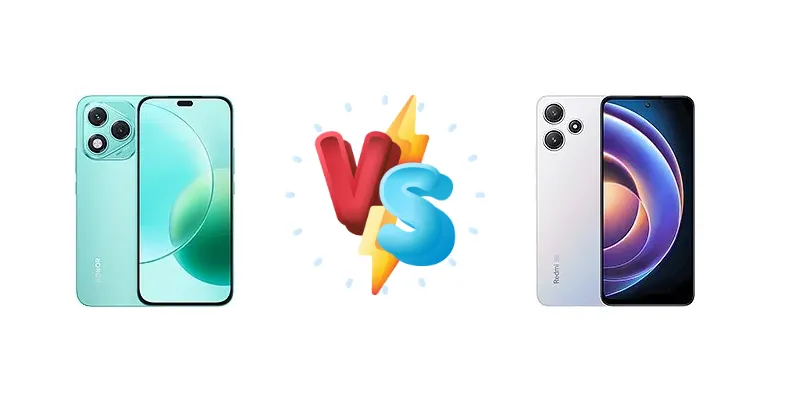
The Honor 400 Lite and Xiaomi Redmi Note 12R represent compelling options in the increasingly competitive sub-$200 smartphone market. While both aim to deliver essential features at an accessible price, they diverge significantly in their core hardware choices – specifically, their chipsets and charging capabilities. This comparison dissects these differences to determine which device offers the best value for your money.
🏆 Quick Verdict
For the average user prioritizing sustained performance and longer battery life, the Honor 400 Lite emerges as the stronger contender. Its Dimensity 7025 Ultra chipset, coupled with impressive 48:56h endurance, provides a smoother experience than the Redmi Note 12R, despite the latter's more efficient 4nm process.
| Network |
|---|
| 2G bands | GSM 850 / 900 / 1800 / 1900 | GSM 850 / 900 / 1800 / 1900 |
| 3G bands | HSDPA 850 / 900 / 1900 / 2100 | HSDPA 850 / 900 / 2100 |
| 4G bands | LTE | 1, 3, 5, 8, 34, 38, 39, 40, 41 |
| 5G bands | SA/NSA | 1, 5, 8, 28, 41, 78 SA/NSA |
| Speed | HSPA, LTE, 5G | HSPA, LTE, 5G |
| Technology | GSM / HSPA / LTE / 5G | GSM / CDMA / HSPA / EVDO / LTE / 5G |
| Launch |
|---|
| Announced | 2025, April 03 | 2023, June 28 |
| Status | Available. Released 2025, April 08 | Available. Released 2023, June 28 |
| Body |
|---|
| Build | - | Glass front, plastic frame, glass back |
| Dimensions | 161 x 74.6 x 7.3 mm (6.34 x 2.94 x 0.29 in) | 168.6 x 76.3 x 8.2 mm (6.64 x 3.00 x 0.32 in) |
| SIM | Nano-SIM + Nano-SIM + eSIM (max 2 at a time) | Nano-SIM + Nano-SIM |
| Weight | 171 g (6.03 oz) | 199 g (7.02 oz) |
| Display |
|---|
| Protection | Mohs level 4 | - |
| Resolution | 1080 x 2412 pixels, 20:9 ratio (~394 ppi density) | 1080 x 2460 pixels (~396 ppi density) |
| Size | 6.7 inches, 108.0 cm2 (~89.9% screen-to-body ratio) | 6.79 inches, 109.5 cm2 (~85.1% screen-to-body ratio) |
| Type | AMOLED, 120Hz, 3840Hz PWM, 3500 nits (peak) | IPS LCD, 90Hz, 550 nits |
| Platform |
|---|
| CPU | Octa-core (2x2.5 GHz Cortex-A78 & 6x2.0 GHz Cortex-A55) | Octa-core (2x2.2 GHz Cortex-A78 & 6x1.95 GHz Cortex-A55) |
| Chipset | Mediatek Dimensity 7025 Ultra (6 nm) | Qualcomm SM4450 Snapdragon 4 Gen 2 (4 nm) |
| GPU | IMG BXM-8-256 | Adreno 613 |
| OS | Android 15, up to 6 major Android upgrades, MagicOS 9 | Android 13, MIUI 14 |
| Memory |
|---|
| Card slot | No | microSDXC (uses shared SIM slot) |
| Internal | 256GB 8GB RAM, 256GB 12GB RAM | 128GB 4GB RAM, 128GB 6GB RAM, 128GB 8GB RAM, 256GB 8GB RAM |
| Main Camera |
|---|
| Dual | 108 MP, f/1.8, (wide), 1/1.67", PDAF
5 MP, f/2.2, (ultrawide) | 50 MP, f/1.8, (wide), PDAF
2 MP (macro) |
| Features | LED flash, HDR, panorama | LED flash, HDR |
| Video | 1080p@30fps | 1080p@30fps |
| Selfie camera |
|---|
| Features | - | HDR |
| Single | 16 MP, f/2.5, (wide) | 5 MP, f/2.2, (wide), 1/5.0", 1.12µm |
| Video | 1080p@30fps | 1080p@30fps |
| Sound |
|---|
| 35mm jack | No | Yes |
| Loudspeaker | Yes | Yes |
| Comms |
|---|
| Bluetooth | 5.3, A2DP, LE | 5.3, A2DP, LE |
| Infrared port | - | Yes |
| NFC | Yes (market/region dependent) | Yes (market/region dependent) |
| Positioning | GPS, GLONASS, GALILEO, BDS | GPS, GLONASS, GALILEO, BDS |
| Radio | Unspecified | No |
| USB | USB Type-C 2.0, OTG | USB Type-C |
| WLAN | Wi-Fi 802.11 a/b/g/n/ac, dual-band, Wi-Fi Direct | Wi-Fi 802.11 a/b/g/n/ac, dual-band |
| Features |
|---|
| Sensors | Fingerprint (under display, optical), accelerometer, compass, proximity (ultrasonic) | Fingerprint (side-mounted), accelerometer, compass |
| Battery |
|---|
| Charging | 35W wired | 18W wired, PD |
| Type | Li-Po 5230 mAh | Li-Po 5000 mAh |
| Misc |
|---|
| Colors | Marrs Green, Velvet Black, Velvet Grey | Black, Blue, Silver |
| Models | ABR-NX1, ABR-N31C1 | 23076RA4BC |
| Price | € 199.90 / $ 308.03 / £ 169.00 | About 150 EUR |
| EU LABEL |
|---|
| Battery | 48:56h endurance, 1400 cycles | - |
| Energy | Class B | - |
| Free fall | Class B (180 falls) | - |
| Repairability | Class B | - |
Honor 400 Lite
- Superior battery endurance (48:56h)
- Faster 35W wired charging
- Potentially better CPU performance due to higher clock speeds
- Likely less power efficient chipset (6nm vs 4nm)
- Camera performance is unknown and potentially average
Xiaomi Redmi Note 12R
- More power-efficient chipset (4nm)
- PD charging compatibility
- Xiaomi’s reputation for software optimization
- Slower charging speed (18W)
- Lower battery endurance compared to Honor 400 Lite
Display Comparison
Display specifications are not provided, so we must infer. Both devices likely feature LCD panels given their price point. The Redmi Note 12R, benefiting from Xiaomi’s display expertise, may offer slightly better color calibration. However, without specific data on peak brightness or resolution, it’s difficult to definitively declare a winner. Bezels are likely comparable, reflecting cost-saving measures in this segment.
Camera Comparison
Camera details are absent, so analysis relies on brand tendencies. Xiaomi typically emphasizes camera features, even in budget models, but the Redmi Note 12R likely features a standard configuration. Honor, while improving, often prioritizes core performance. Without sensor size or aperture information, it’s impossible to assess image quality. The presence of a 2MP macro lens on either device is largely a marketing tactic and offers limited practical benefit.
Performance
The core battleground lies in the chipsets. The Honor 400 Lite’s Mediatek Dimensity 7025 Ultra (6nm) features a 2x2.5 GHz Cortex-A78 and 6x2.0 GHz Cortex-A55 configuration. The Redmi Note 12R counters with the Qualcomm SM4450 Snapdragon 4 Gen 2 (4nm) and a 2x2.2 GHz Cortex-A78 & 6x1.95 GHz Cortex-A55 setup. While the Snapdragon 4 Gen 2 boasts a more efficient 4nm process, the Dimensity 7025 Ultra’s higher clock speeds on the prime cores suggest superior single-core performance, crucial for responsive app launches and smoother UI navigation. The 6nm process of the Dimensity 7025 Ultra is still efficient, and the performance difference will be noticeable in demanding tasks. RAM specifications are unknown, but LPDDR4X is probable on both.
Battery Life
The Honor 400 Lite’s 48:56h endurance is a significant advantage. This suggests a larger battery capacity and/or more efficient power management. The Redmi Note 12R’s 18W wired charging with PD is convenient, but slower than the Honor 400 Lite’s 35W wired charging. While the Snapdragon 4 Gen 2’s 4nm process contributes to efficiency, the Honor 400 Lite’s superior endurance indicates a more substantial battery or optimized software.
Buying Guide
Buy the Honor 400 Lite if you need a phone capable of handling demanding apps and multitasking without significant slowdown, and if you value extended battery life between charges. Buy the Xiaomi Redmi Note 12R if you prioritize a slightly more power-efficient chipset for lighter usage and appreciate the convenience of Power Delivery (PD) charging, even at a slower wattage.
Frequently Asked Questions
❓ Will the Dimensity 7025 Ultra in the Honor 400 Lite struggle with graphically intensive games like PUBG Mobile?
While not a flagship chipset, the Dimensity 7025 Ultra should handle PUBG Mobile at medium settings with reasonable frame rates. The Cortex-A78 cores provide sufficient processing power, but expect some frame drops during intense firefights. Optimizing in-game settings is recommended for a smoother experience.
❓ Does the Redmi Note 12R’s 18W charging with PD offer any real-world benefits over standard charging?
Power Delivery (PD) allows for more efficient charging and compatibility with a wider range of chargers, including those for laptops and tablets. However, the 18W wattage is relatively slow compared to the Honor 400 Lite’s 35W. The benefit is primarily convenience and potential compatibility, not significantly faster charging times.
❓ How does the 4nm process of the Snapdragon 4 Gen 2 translate to real-world battery savings on the Redmi Note 12R?
The 4nm process generally leads to lower power consumption at the same performance level. This means the Redmi Note 12R *should* exhibit better battery life during light usage scenarios like browsing or messaging. However, the Honor 400 Lite’s larger battery and optimized power management appear to offset this advantage, resulting in significantly longer overall endurance.