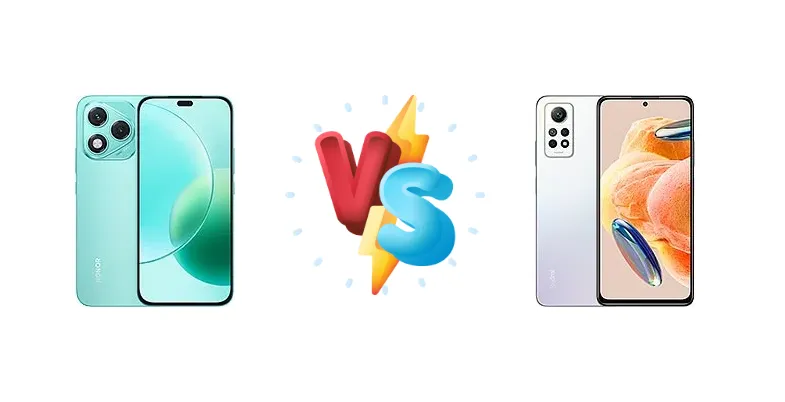
The Honor 400 Lite and Xiaomi Redmi Note 12 Pro 4G represent compelling options in the competitive mid-range smartphone market. While both aim to deliver a balanced experience, they take different approaches to achieving it. The Honor 400 Lite leverages a newer Mediatek Dimensity 7025 Ultra chipset, while the Redmi Note 12 Pro 4G relies on the established Qualcomm Snapdragon 732G. This comparison dives deep into their specifications to determine which device offers the best value.
🏆 Quick Verdict
For the average user prioritizing fast charging and a proven track record, the Xiaomi Redmi Note 12 Pro 4G is the better choice. Its 67W charging significantly reduces downtime. However, the Honor 400 Lite’s newer Dimensity 7025 Ultra chipset offers potential for future software optimization and slightly better long-term performance.
| Network |
|---|
| 2G bands | GSM 850 / 900 / 1800 / 1900 | GSM 850 / 900 / 1800 / 1900 |
| 3G bands | HSDPA 850 / 900 / 1900 / 2100 | HSDPA 850 / 900 / 1700(AWS) / 1900 / 2100 |
| 4G bands | LTE | 1, 2, 3, 4, 5, 7, 8, 20, 28, 38, 40, 41, 66 |
| 5G bands | SA/NSA | - |
| Speed | HSPA, LTE, 5G | HSPA, LTE |
| Technology | GSM / HSPA / LTE / 5G | GSM / HSPA / LTE |
| Launch |
|---|
| Announced | 2025, April 03 | 2023, March 03 |
| Status | Available. Released 2025, April 08 | Available. Released 2023, April 11 |
| Body |
|---|
| Dimensions | 161 x 74.6 x 7.3 mm (6.34 x 2.94 x 0.29 in) | 164.2 x 76.1 x 8.1 mm (6.46 x 3.00 x 0.32 in) |
| SIM | Nano-SIM + Nano-SIM + eSIM (max 2 at a time) | Nano-SIM + Nano-SIM |
| Weight | 171 g (6.03 oz) | 201.8 g (7.13 oz) |
| Display |
|---|
| Protection | Mohs level 4 | - |
| Resolution | 1080 x 2412 pixels, 20:9 ratio (~394 ppi density) | 1080 x 2400 pixels, 20:9 ratio (~395 ppi density) |
| Size | 6.7 inches, 108.0 cm2 (~89.9% screen-to-body ratio) | 6.67 inches, 107.4 cm2 (~86.0% screen-to-body ratio) |
| Type | AMOLED, 120Hz, 3840Hz PWM, 3500 nits (peak) | AMOLED, 120Hz, Dolby Vision, 700 nits (HBM), 1100 nits (peak) |
| Platform |
|---|
| CPU | Octa-core (2x2.5 GHz Cortex-A78 & 6x2.0 GHz Cortex-A55) | Octa-core (2x2.2 GHz Kryo 470 Gold & 6x1.8 GHz Kryo 470 Silver) |
| Chipset | Mediatek Dimensity 7025 Ultra (6 nm) | Qualcomm SM7150 Snapdragon 732G (8 nm) |
| GPU | IMG BXM-8-256 | Adreno 618 |
| OS | Android 15, up to 6 major Android upgrades, MagicOS 9 | Android 11, MIUI 13 |
| Memory |
|---|
| Card slot | No | microSDXC (uses shared SIM slot) |
| Internal | 256GB 8GB RAM, 256GB 12GB RAM | 128GB 6GB RAM, 128GB 8GB RAM, 256GB 8GB RAM |
| | - | UFS 2.2 |
| Main Camera |
|---|
| Dual | 108 MP, f/1.8, (wide), 1/1.67", PDAF
5 MP, f/2.2, (ultrawide) | - |
| Features | LED flash, HDR, panorama | LED flash, HDR, panorama |
| Quad | - | 108 MP, f/1.9, (wide), 1/1.52", 0.7µm, PDAF
8 MP, 120˚, (ultrawide)
2 MP (macro)
Auxiliary lens |
| Video | 1080p@30fps | 4K@30fps, 1080p@30/60fps |
| Selfie camera |
|---|
| Single | 16 MP, f/2.5, (wide) | 16 MP, f/2.4, (wide) |
| Video | 1080p@30fps | 1080p@30fps |
| Sound |
|---|
| 3.5mm jack | - | Yes |
| 35mm jack | No | Yes |
| Loudspeaker | Yes | Yes, with stereo speakers |
| Comms |
|---|
| Bluetooth | 5.3, A2DP, LE | 5.0, A2DP, LE |
| Infrared port | - | Yes |
| NFC | Yes (market/region dependent) | Yes (market/region dependent) |
| Positioning | GPS, GLONASS, GALILEO, BDS | GPS, GLONASS, GALILEO, BDS |
| Radio | Unspecified | Unspecified |
| USB | USB Type-C 2.0, OTG | USB Type-C 2.0, OTG |
| WLAN | Wi-Fi 802.11 a/b/g/n/ac, dual-band, Wi-Fi Direct | Wi-Fi 802.11 a/b/g/n/ac, dual-band |
| Features |
|---|
| Sensors | Fingerprint (under display, optical), accelerometer, compass, proximity (ultrasonic) | Fingerprint (side-mounted), accelerometer, gyro, compass |
| Battery |
|---|
| Charging | 35W wired | 67W wired |
| Type | Li-Po 5230 mAh | Li-Po 5000 mAh |
| Misc |
|---|
| Colors | Marrs Green, Velvet Black, Velvet Grey | Star Blue, Graphite Gray, Polar White, Ice blue |
| Models | ABR-NX1, ABR-N31C1 | 2209116AG, 2209116AG |
| Price | € 199.90 / $ 308.03 / £ 169.00 | About 150 EUR |
| EU LABEL |
|---|
| Battery | 48:56h endurance, 1400 cycles | - |
| Energy | Class B | - |
| Free fall | Class B (180 falls) | - |
| Repairability | Class B | - |
Honor 400 Lite
- Newer Mediatek Dimensity 7025 Ultra chipset for potentially better performance.
- Excellent battery endurance (48:56h).
- Longer battery lifespan with 1400 charge cycles.
- Slower 35W charging compared to the Redmi Note 12 Pro 4G.
- Display specifications are unknown, potentially lagging behind competitors.
Xiaomi Redmi Note 12 Pro 4G
- Ultra-fast 67W wired charging for minimal downtime.
- Proven Qualcomm Snapdragon 732G platform for stability.
- Potentially higher refresh rate display (based on market trends).
- Older chipset architecture compared to the Dimensity 7025 Ultra.
- Potentially lower battery endurance compared to the Honor 400 Lite.
Display Comparison
Display specifications are absent from the provided data, but considering the price bracket, both devices likely feature LCD panels with FHD+ resolution. The Redmi Note 12 Pro 4G, based on market trends, may offer a higher refresh rate (potentially 120Hz) compared to the Honor 400 Lite. Bezels are expected to be similar, and color accuracy will likely be adequate for everyday use, though neither is expected to challenge flagship-level displays.
Camera Comparison
Camera details are missing, but given the price point, both phones likely feature a multi-camera setup with a primary sensor around 50MP. The Redmi Note 12 Pro 4G, historically, has focused on camera features, potentially offering better image processing algorithms. Without specific sensor size or aperture information, it’s difficult to definitively declare a winner. The presence or absence of Optical Image Stabilization (OIS) would be a significant differentiator, favoring the device that includes it.
Performance
The core difference lies in the chipsets. The Honor 400 Lite’s Mediatek Dimensity 7025 Ultra (6nm) utilizes a more modern architecture with its Cortex-A78 cores clocked at 2.5 GHz, suggesting a performance advantage in CPU-intensive tasks compared to the Redmi Note 12 Pro 4G’s Snapdragon 732G (8nm). The 8nm process of the Snapdragon 732G is generally more efficient, but the newer architecture of the Dimensity 7025 Ultra should offset this. The Honor 400 Lite’s CPU configuration (2x2.5 GHz Cortex-A78 & 6x2.0 GHz Cortex-A55) is geared towards a balance of performance and efficiency, while the Snapdragon 732G (2x2.2 GHz Kryo 470 Gold & 6x1.8 GHz Kryo 470 Silver) prioritizes stability. Gamers will likely see a slight edge with the Honor 400 Lite, but real-world differences will depend on game optimization.
Battery Life
The Honor 400 Lite boasts an impressive 48:56h endurance rating, suggesting excellent battery life. However, the Redmi Note 12 Pro 4G compensates with its significantly faster 67W wired charging. While the Honor 400 Lite’s 35W charging is respectable, the Redmi Note 12 Pro 4G can likely achieve a full charge in under 45 minutes, while the Honor 400 Lite will take considerably longer. The Honor 400 Lite also claims 1400 charge cycles, indicating a longer lifespan before battery degradation.
Buying Guide
Buy the Honor 400 Lite if you prioritize a more modern chipset with potential for future software updates and are willing to trade off charging speed. This phone is ideal for users who frequently multitask and appreciate a potentially smoother experience. Buy the Xiaomi Redmi Note 12 Pro 4G if you value incredibly fast charging, a well-established platform, and don't mind a slightly older chipset. This is the phone for users who need to quickly top up their battery throughout the day.
Frequently Asked Questions
❓ Will the Dimensity 7025 Ultra in the Honor 400 Lite handle demanding games like Genshin Impact?
The Dimensity 7025 Ultra is capable of running Genshin Impact, but you'll likely need to lower graphics settings to achieve a consistently smooth frame rate. The chipset's newer architecture provides a performance boost over the Snapdragon 732G, but it's not a flagship-level processor.
❓ How long does it *actually* take to fully charge the Redmi Note 12 Pro 4G with the 67W charger?
The Redmi Note 12 Pro 4G can typically charge from 0% to 100% in around 40-45 minutes with the included 67W charger. This is a significant advantage over the Honor 400 Lite's 35W charging, which will take considerably longer.
❓ Is the 1400 charge cycle claim for the Honor 400 Lite realistic?
While 1400 cycles is a high number, it's a marketing claim. However, it suggests that Honor has implemented battery health management features to prolong the battery's lifespan. Expect noticeable degradation after 800-1000 cycles, but it still indicates better long-term battery health compared to phones with lower cycle counts.