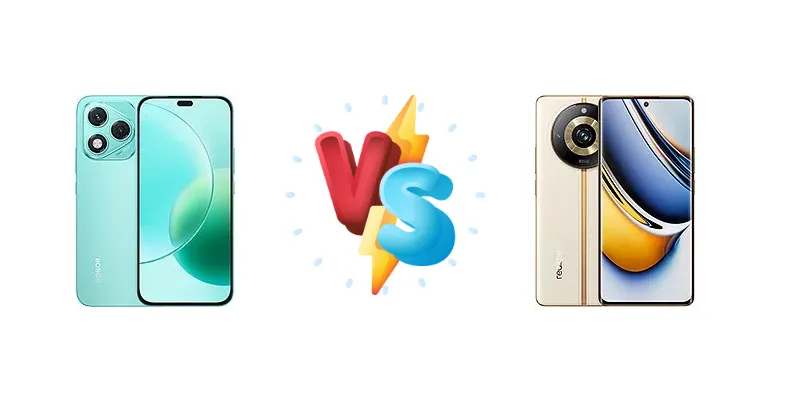
The mid-range smartphone market is fiercely competitive, and the Honor 400 Lite and Realme 11 Pro+ represent compelling options. The Honor prioritizes exceptional battery endurance, while the Realme 11 Pro+ focuses on blazing-fast charging and a brighter display. This comparison dissects their key specifications to determine which device delivers the best overall experience.
🏆 Quick Verdict
For users prioritizing longevity and sustained performance, the Honor 400 Lite emerges as the winner. Its remarkable 48:56h battery endurance and 1400 charge cycles significantly outperform the Realme 11 Pro+'s 112h rating. However, the Realme 11 Pro+ is a strong contender for those who value rapid replenishment with its 100W charging.
| Network |
|---|
| 2G bands | GSM 850 / 900 / 1800 / 1900 | GSM 850 / 900 / 1800 / 1900 |
| 3G bands | HSDPA 850 / 900 / 1900 / 2100 | HSDPA 850 / 900 / 2100 |
| 4G bands | LTE | 1, 3, 5, 8, 28, 38, 40, 41 - India |
| 5G bands | SA/NSA | 1, 3, 5, 8, 28, 40, 41, 77, 78 SA/NSA - International |
| Speed | HSPA, LTE, 5G | HSPA, LTE, 5G |
| Technology | GSM / HSPA / LTE / 5G | GSM / CDMA / HSPA / CDMA2000 / LTE / 5G |
| | - | CDMA2000 1x |
| Launch |
|---|
| Announced | 2025, April 03 | 2023, May 10 |
| Status | Available. Released 2025, April 08 | Available. Released 2023, May 15 |
| Body |
|---|
| Build | - | Glass front, leather or plastic back, plastic frame |
| Dimensions | 161 x 74.6 x 7.3 mm (6.34 x 2.94 x 0.29 in) | 161.6 x 73.9 x 8.2 mm or 8.7 mm |
| SIM | Nano-SIM + Nano-SIM + eSIM (max 2 at a time) | Nano-SIM + Nano-SIM |
| Weight | 171 g (6.03 oz) | 183 g or 189 g (6.46 oz) |
| Display |
|---|
| Protection | Mohs level 4 | - |
| Resolution | 1080 x 2412 pixels, 20:9 ratio (~394 ppi density) | 1080 x 2412 pixels, 20:9 ratio (~394 ppi density) |
| Size | 6.7 inches, 108.0 cm2 (~89.9% screen-to-body ratio) | 6.7 inches, 108.0 cm2 (~90.5% screen-to-body ratio) |
| Type | AMOLED, 120Hz, 3840Hz PWM, 3500 nits (peak) | AMOLED, 1B colors, HDR10+, 120Hz, 950 nits (peak) |
| Platform |
|---|
| CPU | Octa-core (2x2.5 GHz Cortex-A78 & 6x2.0 GHz Cortex-A55) | Octa-core (2x2.6 GHz Cortex-A78 & 6x2.0 GHz Cortex-A55) |
| Chipset | Mediatek Dimensity 7025 Ultra (6 nm) | Mediatek Dimensity 7050 (6 nm) |
| GPU | IMG BXM-8-256 | Mali-G68 MC4 |
| OS | Android 15, up to 6 major Android upgrades, MagicOS 9 | Android 13, up to 2 major Android upgrades, Realme UI 5.0 |
| Memory |
|---|
| Card slot | No | No |
| Internal | 256GB 8GB RAM, 256GB 12GB RAM | 256GB 8GB RAM, 256GB 12GB RAM, 512GB 12GB RAM, 1TB 12GB RAM |
| Main Camera |
|---|
| Dual | 108 MP, f/1.8, (wide), 1/1.67", PDAF
5 MP, f/2.2, (ultrawide) | - |
| Features | LED flash, HDR, panorama | LED flash, HDR, panorama |
| Triple | - | 200 MP, f/1.7, 23mm (wide), 1/1.4", 0.56µm, PDAF, OIS
8 MP, f/2.2, 16mm, 112˚ (ultrawide)
2 MP (macro) |
| Video | 1080p@30fps | 4K@30fps, 1080p@30/60/120/480fps, 720p@960fps, gyro-EIS |
| Selfie camera |
|---|
| Features | - | Panorama |
| Single | 16 MP, f/2.5, (wide) | 32 MP, f/2.5, 22mm (wide) |
| Video | 1080p@30fps | 1080p@30fps |
| Sound |
|---|
| 3.5mm jack | - | No |
| 35mm jack | No | No |
| Loudspeaker | Yes | Yes, with stereo speakers |
| | - | 24-bit/192kHz audio |
| Comms |
|---|
| Bluetooth | 5.3, A2DP, LE | 5.2, A2DP, LE, aptX HD |
| NFC | Yes (market/region dependent) | Yes |
| Positioning | GPS, GLONASS, GALILEO, BDS | GPS, GLONASS, GALILEO, BDS, QZSS, NavIC |
| Radio | Unspecified | No |
| USB | USB Type-C 2.0, OTG | USB Type-C 2.0 |
| WLAN | Wi-Fi 802.11 a/b/g/n/ac, dual-band, Wi-Fi Direct | Wi-Fi 802.11 a/b/g/n/ac/6, dual-band |
| Features |
|---|
| Sensors | Fingerprint (under display, optical), accelerometer, compass, proximity (ultrasonic) | Fingerprint (under display, optical), accelerometer, gyro, proximity, compass |
| Battery |
|---|
| Charging | 35W wired | 100W wired |
| Type | Li-Po 5230 mAh | 5000 mAh |
| Misc |
|---|
| Colors | Marrs Green, Velvet Black, Velvet Grey | Astral Black, Sunrise Beige, Oasis Green |
| Models | ABR-NX1, ABR-N31C1 | RMX3740, RMX3741 |
| Price | € 199.90 / $ 308.03 / £ 169.00 | € 399.90 / ₹ 27,990 |
| EU LABEL |
|---|
| Battery | 48:56h endurance, 1400 cycles | - |
| Energy | Class B | - |
| Free fall | Class B (180 falls) | - |
| Repairability | Class B | - |
Honor 400 Lite
- Exceptional battery life (48:56h endurance)
- Long-term battery health (1400 charge cycles)
- Potentially more sustained performance due to thermal management
- Slower charging speed (35W)
- Display brightness likely lower than Realme 11 Pro+
Realme 11 Pro+
- Ultra-fast 100W charging
- Brighter display (793 nits)
- Slightly faster CPU clock speed
- Significantly shorter battery life (112h endurance)
- Fewer charge cycles, potentially impacting long-term battery health
Display Comparison
The Realme 11 Pro+ boasts a significantly brighter display, reaching a measured 793 nits. While the Honor 400 Lite’s display brightness isn’t specified, the Realme’s higher peak brightness will provide superior visibility outdoors under direct sunlight. The Realme likely utilizes a higher-quality panel, though both devices share a similar 6nm chipset, meaning display power draw won’t be drastically different. The absence of LTPO technology on either device suggests neither offers adaptive refresh rates for optimal power efficiency.
Camera Comparison
The Realme 11 Pro+ is marketed with a focus on its camera capabilities, though specific sensor details are missing. Without knowing the sensor size or aperture, it’s difficult to assess its low-light performance. The Honor 400 Lite’s camera specifications are also absent, making a direct comparison challenging. It’s reasonable to assume the Realme 11 Pro+ offers a more versatile camera system, given its positioning as a 'Pro+' model, but image quality will ultimately depend on software processing and sensor quality, which are currently unknown.
Performance
Both phones are powered by Mediatek Dimensity 7000-series chipsets fabricated on a 6nm process. The Realme 11 Pro+ features the Dimensity 7050, with a slightly higher CPU clock speed (2.6 GHz vs 2.5 GHz on the Honor 400 Lite’s Dimensity 7025 Ultra). This marginal clock speed difference translates to a minor performance edge for the Realme in CPU-intensive tasks. However, both chipsets utilize the same core configuration (2x Cortex-A78 & 6x Cortex-A55), suggesting similar overall performance. The Honor 400 Lite’s endurance suggests potentially more conservative thermal throttling profiles, allowing sustained performance over longer periods.
Battery Life
The Honor 400 Lite’s battery endurance of 48:56h is a standout feature, dwarfing the Realme 11 Pro+'s reported 112h. This difference is substantial and indicates the Honor is significantly more power-efficient. While the Realme 11 Pro+ compensates with 100W wired charging – a massive advantage over the Honor’s 35W – the Honor’s longevity reduces the need for frequent charging. The Honor also boasts an impressive 1400 charge cycles, suggesting superior long-term battery health compared to the Realme.
Buying Guide
Buy the Honor 400 Lite if you need a phone that will reliably last through a full day – and then some – of heavy use, and if you value long-term battery health. It’s ideal for travelers, commuters, or anyone who dislikes frequent charging. Buy the Realme 11 Pro+ if you prioritize quick top-ups and a brighter screen, and if you frequently find yourself needing to recharge in short bursts. It’s a better fit for power users who demand convenience.
Frequently Asked Questions
❓ How much faster is the 100W charging on the Realme 11 Pro+ compared to the 35W charging on the Honor 400 Lite?
The 100W charging on the Realme 11 Pro+ will significantly reduce charging times. While exact 0-100% times aren't available, it's reasonable to expect a full charge in under 30 minutes, compared to potentially over an hour for the Honor 400 Lite. However, this speed comes at the cost of potentially reduced long-term battery health due to the higher charging rate.
❓ Will the Dimensity 7050 in the Realme 11 Pro+ provide a noticeable gaming advantage over the Dimensity 7025 Ultra in the Honor 400 Lite?
The performance difference between the Dimensity 7050 and 7025 Ultra is likely minimal in most gaming scenarios. Both chipsets are capable of handling popular mobile games at high settings. The Honor 400 Lite’s potentially more conservative thermal management could actually lead to more consistent frame rates during extended gaming sessions, preventing throttling.
❓ Does the Realme 11 Pro+ support video recording at 4K resolution?
While not explicitly stated in the provided data, the 'Pro+' designation and the Dimensity 7050 chipset suggest 4K video recording is likely supported. However, the quality of the recording will depend on the camera sensor and image processing capabilities, which remain unknown.